
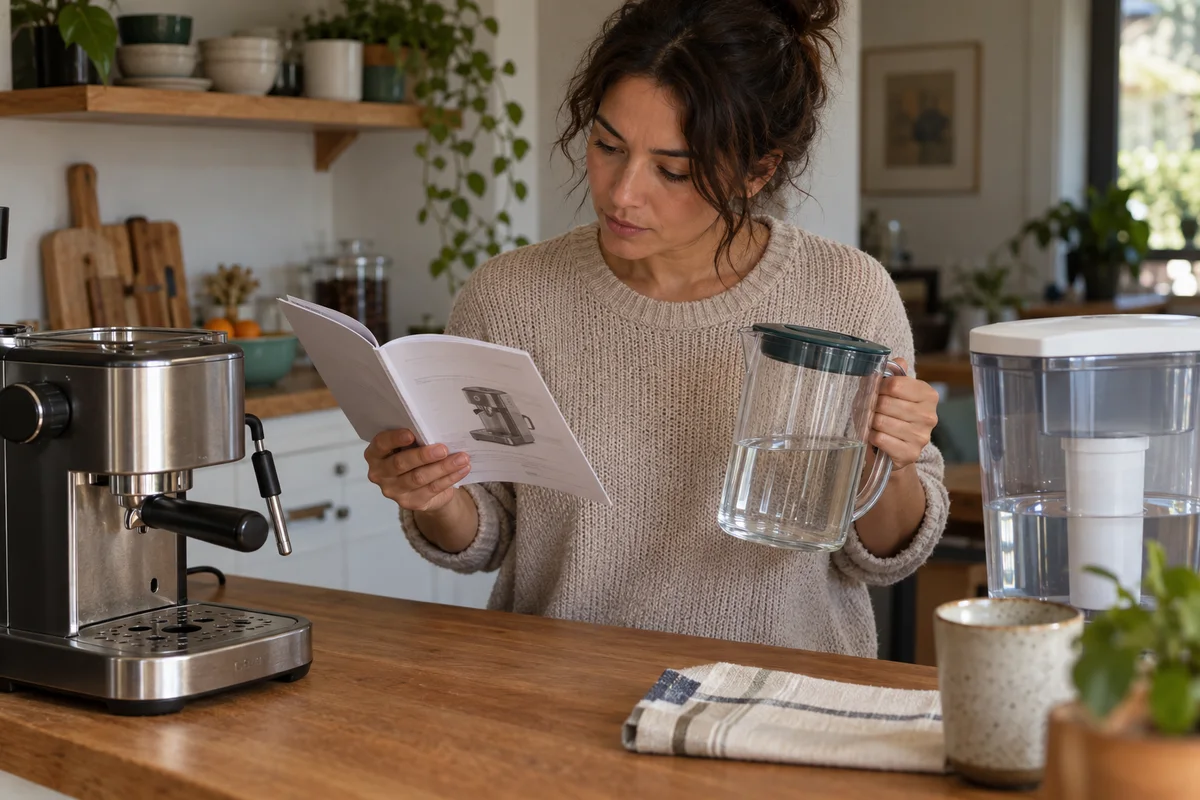
AI-generated scene illustration; not a photograph of the recommended product.
The espresso machine is ready for a weekend breakfast, but its water-hardness strip and the new countertop filter seem to be giving different messages. One product promises mineral-rich drinking water; the other asks for water that meets its own instructions. Buying a Waterdrop M6SL for this coffee corner requires more than matching the word “filtered” on two boxes.
The short answer
M6SL is a mineralized drinking-water RO system, not a certified universal espresso-water recipe. Breville’s water guidance warns against water with almost no minerals and says suitability can vary by machine. Mineral addition after RO is relevant, but does not by itself prove that the finished water meets a particular machine’s requirements.
Choose the water specification before choosing a second appliance. If your existing water already meets the coffee machine’s instructions, M6SL needs a separate drinking-water justification; espresso alone may not justify its cost and upkeep.
Contents
- The short answer
- The coffee-machine requirement
- The finished water
- A kitchen comparison
- The morning handoff
- Maintenance continuity
- Buying advice
- Frequently asked questions
- Sources and verification
The coffee-machine requirement
Find the exact machine model, its regional instruction book, and any supplied water-testing instructions. Record what it says about water sources, hardness, filters and descaling. Do not substitute a general coffee blog’s preferred recipe for an explicit manufacturer restriction.
A useful first question is whether the machine needs a specific range or simply directs the owner to a particular maintenance setting. Those are different decisions. Keep the unit and test method alongside any numerical requirement; a bare number copied into a phone note loses important context.
If the manual is unclear about remineralized RO, ask support about that finished water rather than asking whether “filtered water” is good. Include the exact coffee-machine model and the M6SL name. Do not interpret silence as approval, and do not change an appliance to bypass its water-sensing behavior.
The finished water
Waterdrop describes M6SL as producing mineral-rich, lightly alkaline water. That distinguishes it from a claim of nearly mineral-free output. It does not give this article a measured hardness, alkalinity or mineral composition for your particular pitcher.
TDS, hardness and alkalinity are not interchangeable labels. A TDS display alone cannot establish the complete water specification that an espresso manufacturer might require. Obtain the relevant method or analysis where the machine’s instructions require it, rather than trying to turn one display into several unmeasured properties.
Record the final water source actually going into the coffee machine. The feed water entering an RO appliance and water leaving its finishing stage are different points in the process. A specification for the first is not automatically a specification for the second.
Do not remove a mineral stage, mix in unverified additives or alter a cartridge to chase an internet target. If compatibility cannot be established for the supported configuration, compare another approved water source.
A kitchen comparison
Put three options beside each other: the existing suitable supply, another source expressly accepted by the coffee-machine manufacturer, and M6SL after its output is qualified. Compare the whole routine rather than choosing the option with the longest filtration description.
For the existing supply, list the maintenance already required and whether an actual problem remains. For a purchased water source, consider storage, carrying and container handling. For a countertop system, include space, refilling, filter replacement and the work of keeping its pitcher ready.
The comparison should use your own consumption, not a universal cups-per-day assumption. A household making occasional espresso may value a small supported water supply differently from a household that also wants a daily drinking-water station. Neither pattern proves the other is wasteful.
Our M6SL ownership budget covers replacement planning. Add coffee use only after the water question is resolved. Extra demand is not a reason to count a manufacturer’s maximum filter life as a guaranteed household replacement interval.
The morning handoff
Design the physical handoff with both appliances cold and unplugged where appropriate. Identify the intended fill opening and a stable place to put the pitcher. Check cabinet clearance and avoid carrying water over plugs, sockets or powered equipment.
Do not connect M6SL permanently to the espresso machine with an improvised tube. A manually filled countertop routine is not authorization for an automatic plumbing conversion. Follow each appliance’s filling, container and placement instructions.
Keep coffee-machine cleaners and descaling products separate from the drinking-water equipment. A bottle left beside the wrong tank is an avoidable source of confusion. Household members should be able to tell which container holds ordinary water and which equipment is undergoing maintenance.
Heating is another separate job. Our M6SL tea-station guide explains the model’s filtration role; it does not establish a coffee machine’s mineral compatibility. A tidy counter can still contain two appliances with different requirements.
Maintenance continuity
A change in water source should trigger a review of the coffee machine’s applicable hardness setting and maintenance instructions. It is not permission to stop descaling or discard the machine’s own filter without checking its manual.
Keep the dated support answer and the relevant water assessment together. Revisit them if the source water, filter configuration or coffee machine changes. A result from an old configuration should not become permanent approval for every later pitcher.
If coffee starts behaving differently, record the observation before buying more equipment. Changes in beans, preparation, maintenance or settings can also affect the result. This article cannot diagnose a machine or attribute a taste change to one mineral.
Avoid promising better extraction, longer machine life or guaranteed scale prevention. We have not conducted a brewing comparison, water analysis or durability test. The value here is a purchasing sequence that keeps an attractive filtration claim from answering an unverified appliance question.
Buying advice
Shortlist M6SL when you have a separate, evidence-based reason to want its countertop drinking-water function and can establish that the finished water suits the coffee machine. Make that compatibility question a condition of purchase, not an experiment performed after the return window.
Postpone when the machine’s requirements are unknown, when a claimed mineral target has no relevant test behind it, or when the existing supported source already solves the coffee task. An additional appliance may be convenient without being necessary.
Before using the partner listing below, confirm the exact M6SL package, available filters, current seller inventory, delivery and return terms. The linked item is the water system, not an endorsement or sale of a Breville machine. No current price or joint manufacturer approval is claimed.
Frequently asked questions
Is RO always unsuitable?
No universal answer applies. Breville distinguishes very low-mineral water from potentially suitable remineralized RO for applicable models, with the exact machine’s instructions taking priority.
Does mineral addition prove compatibility?
No. It describes a process, not a measured match to every espresso machine’s finished-water requirements.
Is TDS enough?
Not when the required assessment concerns other water properties. Use the test and criteria specified for the actual appliance.
Can descaling stop?
Do not assume that. Continue the coffee machine’s applicable maintenance instructions after changing water sources.
Sources and verification
Checked October 31, 2026. Documentation-based buying guidance; no water, extraction, scale or lifetime testing. Manufacturer-store availability is not a promise about the linked marketplace seller.
- Waterdrop M6SL product identity and mineralized-water description
- Breville water selection, hardness and maintenance guidance
Keep reading
Related guides
 Kitchen
M6SL Houseplant Water
Separate houseplant species, drainage and water-source concerns before choosing M6SL mineralized RO for a household watering routine.
Read guide → Kitchen
Moving House With M6SL
Plan upright handling, manufacturer-approved preparation and the destination kitchen before treating Waterdrop M6SL as a travel-ready appliance.
Read guide → Kitchen
M6SL Dispense Volume: Match the Cup Before Pouring
Compare M6SL serving presets and the manual's volume adjustment with your actual mug, leaving headroom instead of assuming a nominal size fits.
Read guide →