
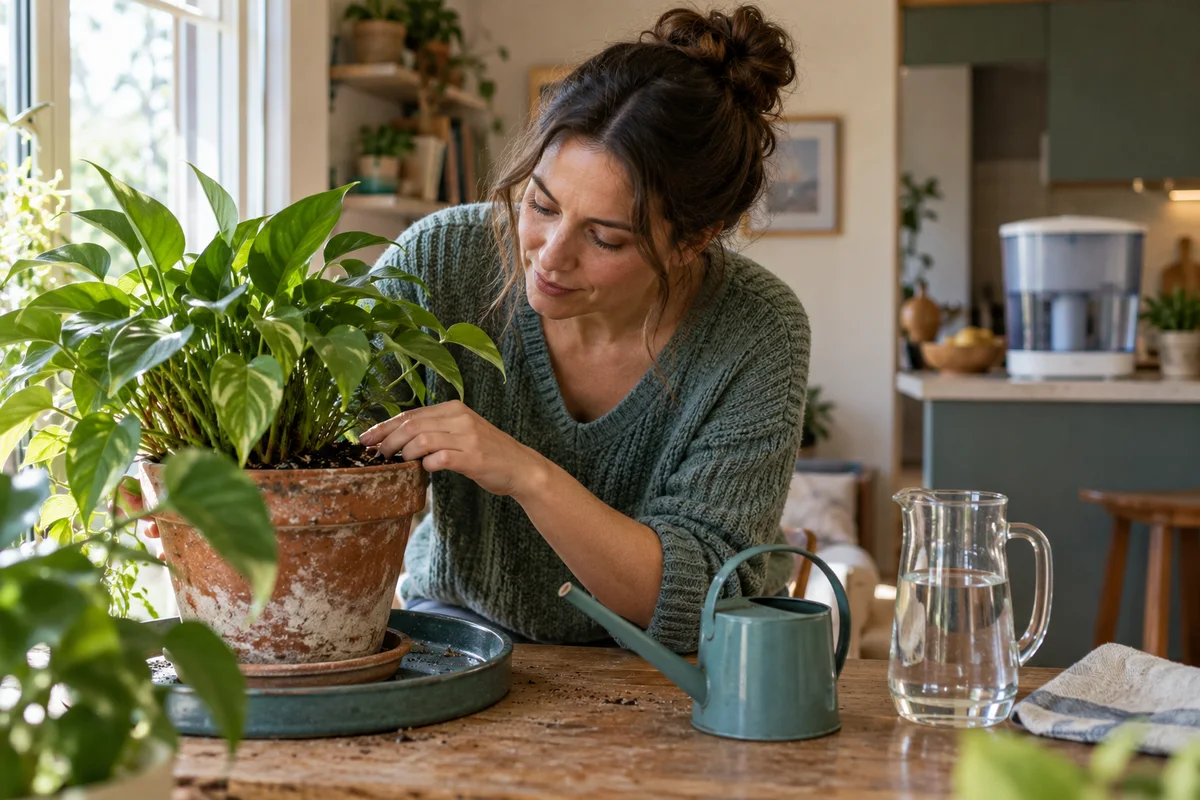
AI-generated scene illustration; not a photograph of the recommended product.
A small collection of houseplants has moved away from a chilly window, and the kitchen now has a mineralized RO dispenser. It is tempting to make the new pitcher the answer to every plant problem. Before buying Waterdrop M6SL for this purpose, separate the plant’s actual watering needs from the appeal of a new water-treatment appliance.
The short answer
M6SL is a drinking-water system with a mineral finishing stage, not a universal plant-care solution. Choose water around the identified plant, growing medium and relevant supply issue. Do not assume that “RO,” “alkaline” or a lower TDS display means every plant will benefit.
For many households, assessing watering frequency, drainage and the existing source comes before buying a filter. If the only reason for ordering M6SL is an undiagnosed yellow leaf, postpone the purchase and investigate the growing conditions first.
Contents
- The short answer
- The plant record
- The source question
- Mineralized RO
- The watering handoff
- A practical comparison
- Observation and limits
- Buying advice
- Frequently asked questions
- Sources and verification
The plant record
Start with the species, container and growing medium. Keep the care label or use a reliable species-specific horticultural reference. A succulent and a plant that prefers consistently moist medium should not receive the same routine merely because their pots sit on one shelf.
Illinois Extension’s watering guidance explains that water needs depend on the plant and its surroundings, including light, temperature, humidity, container and medium. That is a reason to assess the individual pot rather than prescribe a fixed weekly pour.
Make one short record per plant: identification, location, pot drainage, last watering and the observation used to decide the next watering. Leave uncertain identification marked uncertain. A record is more useful than changing the water source and the watering frequency simultaneously, then being unable to tell what changed.
This is an evergreen household task, not evidence that a particular plant trend is surging or that autumn automatically creates a water-quality problem.
The source question
Identify the tap that supplies the watering can and whether it passes through a household softener. “Tap water” is not a sufficiently precise description when different taps have different treatment paths. Ask the responsible supplier or installer if that route is unknown.
Illinois Extension advises avoiding softened water. Iowa State’s houseplant guide also discusses potential salt accumulation with heavily softened water. These are source-selection cautions, not a diagnosis of every browned leaf.
Do not conclude that a drinking-water filter removes the particular substance you are concerned about without checking the exact model’s evidence and intended feed conditions. Nor should a softener label be treated as proof that every unsoftened alternative is appropriate for every species.
Keep the supply question small and answerable. For example: which tap is unsoftened, what source does the plant reference recommend, and what evidence supports a change? That is more actionable than asking which water is universally “purest.”
Mineralized RO
Waterdrop describes M6SL as mineral-rich, lightly alkaline drinking water. The finishing stage means it should not be treated as equivalent to distilled water or an unspecified low-mineral laboratory supply.
The presence of an RO membrane somewhere inside an appliance does not describe every property of the water that reaches the pitcher. If a species-specific recommendation depends on mineral content or another water property, resolve that requirement using suitable information rather than the process name.
Do not bypass the mineral stage or alter the filter to create a different output for plants. M6SL’s supported configuration should remain intact. If that configuration does not meet the intended task, use a different appropriate source rather than modifying the appliance.
A TDS reading is not a complete plant nutrient analysis. It cannot tell you that all relevant ions are present in suitable amounts, or that a drinking-water pitcher replaces a species-appropriate feeding plan.
The watering handoff
Use a separate, clearly assigned watering container. Keep potting mix, plant treatments and fertilizer away from the drinking-water pitcher and machine. Do not place a soil-covered pot on the appliance or use its tank to mix a plant-care solution.
Follow the plant’s relevant water-temperature guidance. The Illinois reference recommends room-temperature water. This does not require heating water inside M6SL or storing prepared water indefinitely; ordinary handling and the water system’s own care instructions still apply.
Carry water to a tray or suitable watering area rather than pouring beside electrical connections. Allow drainage according to the plant’s needs and avoid leaving unintended standing water around furniture or cables.
If a houseplant reference recommends a particular watering technique, follow it for that species and pot. Do not convert one general webpage into instructions for every unusual plant, self-watering planter or specialist growing system.
A practical comparison
Compare retaining the current suitable source, using another appropriate household supply, obtaining a small quantity of a suitable alternative, and adding a countertop system. Keep the existing pots and growing conditions in the comparison.
The simplest suitable option may be a different tap or a corrected watering routine. A new system adds counter space, electricity, refilling and filter ownership. Those obligations need a real benefit beyond the idea that more treatment must be better.
If the household already wants M6SL for drinking water, plant use is still a separate suitability check. Do not count the same purchase benefit twice by assuming that every additional use is automatically supported.
Estimate intended volume from actual watering records, not the number of plants alone. A tiny pot and a large established plant can create very different handling demands. Add only appropriate usage to the filter ownership worksheet after deciding that the source fits.
Observation and limits
Keep other major care variables steady where practical when evaluating an appropriate change. Record the source and the watering decision, but do not manufacture a success story from the next leaf that appears.
A continuing problem may need advice from an extension service or another qualified horticultural source. Photographs and a clear history can help that discussion. Water treatment should not become a substitute for identifying pests, drainage problems or an unsuitable location.
Our humidifier-water guide concerns an appliance with different requirements. It does not settle the plant question. Similarly, the M6SL overview describes the drinking-water product, not a fertilizer or plant-treatment device.
We have not grown comparison plants with M6SL water, measured its finished mineral composition or tested a particular species. No growth rate, recovery time or reduced plant-loss claim is made.
Buying advice
Consider M6SL for an established drinking-water need, with any plant-water use qualified separately. Confirm the intended feed supply, supported filters, pitcher handling and ownership work.
Pass on buying it solely to treat an unidentified plant symptom or to obtain supposedly mineral-free water. If a plant needs a specific water profile, obtain evidence for that profile before choosing the appliance.
Check the actual partner seller’s package, stock, delivery and return conditions before ordering. A manufacturer store’s availability message is not a marketplace inventory guarantee. The commercial link is for the complete M6SL system; the horticultural references do not endorse it.
Frequently asked questions
Does RO mean distilled?
No. RO and distillation are different processes, and M6SL is specifically described as mineralized drinking-water output.
Can fertilizer enter the tank?
Do not use the drinking-water appliance or pitcher to mix plant treatments. Keep that work in separate suitable containers.
Should all pots share a schedule?
No. Use the identified plant and growing conditions to decide watering, rather than a single calendar rule.
Will new water fix yellow leaves?
That is not established. Investigate the plant and its growing conditions instead of attributing an undiagnosed symptom to the water.
Sources and verification
Checked October 31, 2026. No M6SL plant trial or water analysis; horticultural guidance is not product endorsement.
- Waterdrop M6SL product description
- Illinois Extension houseplant watering
- Iowa State Extension houseplant care
Keep reading
Related guides
 Kitchen
M6SL Espresso Water
Qualify M6SL finished water against your espresso machine's instructions before treating mineralized RO as a universal coffee-water solution.
Read guide → Kitchen
Moving House With M6SL
Plan upright handling, manufacturer-approved preparation and the destination kitchen before treating Waterdrop M6SL as a travel-ready appliance.
Read guide → Kitchen
M6SL Dispense Volume: Match the Cup Before Pouring
Compare M6SL serving presets and the manual's volume adjustment with your actual mug, leaving headroom instead of assuming a nominal size fits.
Read guide →