
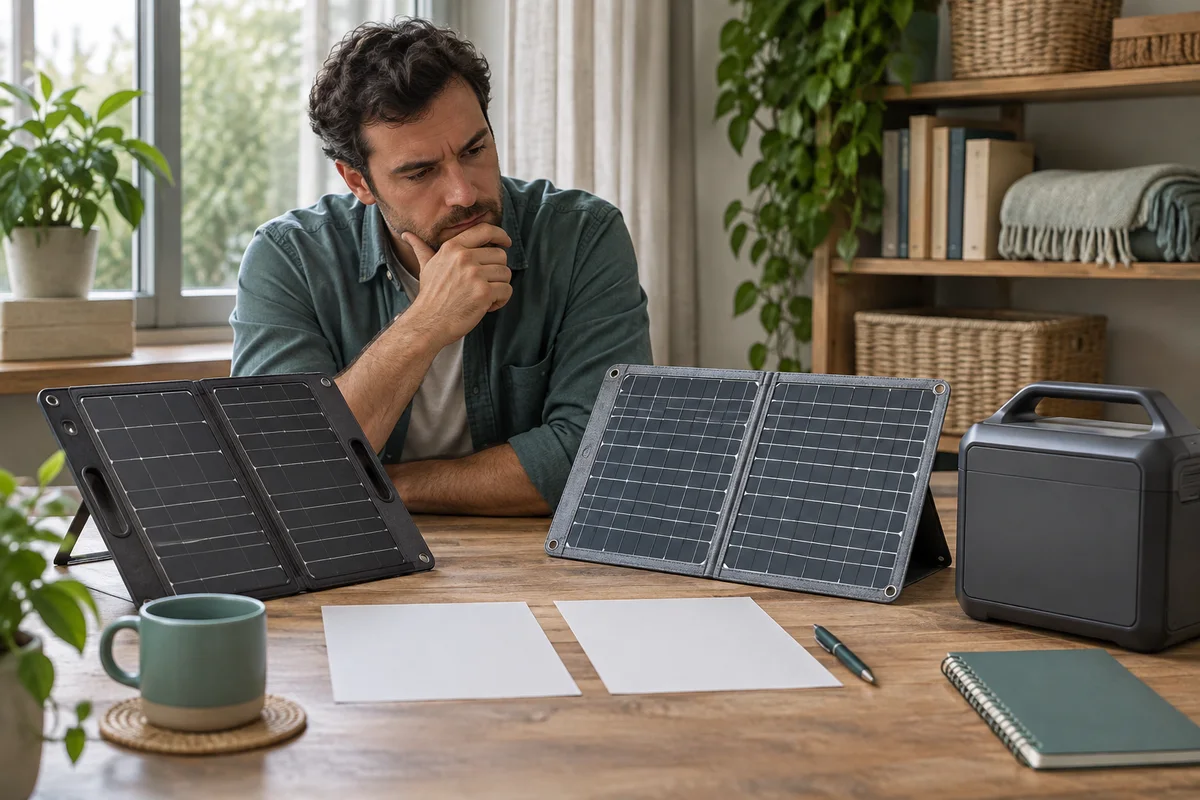
AI-generated scene illustration; not a photograph of the recommended product.
A holiday solar bundle offers more panel watts than your present setup. Two folding panels seem easy to add beside an AC180, especially when winter daylight is limited. The buying decision is not settled by adding the wattage printed on the boxes. The complete array must match the station’s electrical input and the conditions in which it will operate.
The short answer
Qualify the entire proposed solar array before buying panels, splitters or adapters for AC180. BLUETTI’s AC180 manual specifies a 12–60V open-circuit-voltage range, 10A maximum input current and 500W maximum solar input. It warns against exceeding 60V. These are separate constraints, not a promise that any package labeled 500W is compatible.
Obtain an exact, manufacturer-supported configuration covering panel model, quantity, arrangement, cables and cold-weather voltage. This guide helps qualify a purchase; it is not a wiring tutorial or permission to experiment with live connections.
Contents
- The short answer
- Start with the whole array
- Leave winter voltage to a qualified check
- Check current and cables separately
- Make the purchase comparison explicit
- Separate compatibility from useful production
- Buying advice
- Frequently asked questions
- Sources and verification
Start with the whole array
A panel’s nameplate describes that panel under specified conditions. A station sees the electrical behavior of whatever combination reaches its input. Listing two panels separately does not establish the combined result.
Write down every proposed panel model and quantity. Record open-circuit voltage, operating voltage, current information and the manufacturer’s temperature data. Do not substitute nominal marketing voltage for the open-circuit value needed by the station’s instructions.
Then identify the proposed arrangement. Series and parallel are not interchangeable shopping terms. They affect the quantities that must be checked, and neither is automatically preferable simply because a forum user used it successfully.
If a seller cannot identify the complete arrangement behind a bundle photograph, keep compatibility unresolved. Buying a splitter first and asking what it does afterward reverses the useful order.
Leave winter voltage to a qualified check
Open-circuit voltage can change with panel temperature. A configuration that appears below a limit using one headline figure is not automatically qualified for colder conditions.
Ask the panel manufacturer or BLUETTI to evaluate the exact array against the lowest relevant panel temperature and its published coefficient. Request the calculation basis, rather than a general reassurance that the panels are commonly used with power stations.
Do not aim to place an array as close as possible to the station’s maximum voltage. The manual’s limit is a boundary, not an efficiency target. An apparent small numerical margin is not a substitute for the correct temperature-adjusted assessment.
An unresolved answer is a reason to postpone the extra panel purchase. It is not a reason to try a sunny-day connection and infer future compatibility from one successful start.
Check current and cables separately
Passing the voltage check does not finish the evaluation. The manual also gives input-current and input-power limits. Have the proposed arrangement assessed against all of them.
Do not assume the station will safely clip any imaginable oversized array. Nor should a connector that physically fits be treated as evidence of electrical suitability, polarity or cable rating. Adapters can change an interface without making an unsupported combination supported.
Include the actual supplied solar cable, any approved extension, and the exact connection to the station in the question. Do not use an accessory intended for a different BLUETTI input merely because its product title says solar.
Keep electrical work within the manufacturer’s instructions and appropriate qualified assistance. This article deliberately does not describe assembly, live probing, custom connectors or protective-device design.
Make the purchase comparison explicit
| Purchase question | Evidence needed before ordering |
|---|---|
| Which panels? | Exact models and quantity |
| Which arrangement? | A complete supported configuration |
| Voltage qualification? | Array open-circuit behavior, including temperature |
| Other limits? | Current and input-power compatibility |
| Cable route? | Exact approved cables and connection |
| Practical output? | Site-specific sunlight and placement |
| Delivery? | Selected seller’s actual package and dispatch timing |
Keep the response with the order record. A description such as “two compatible panels” is less useful than a named configuration that can be checked again when a replacement is needed.
If one component changes, reopen the qualification. A panel with a similar wattage may have different voltage and current characteristics. Treat a substituted bundle component as a new question.
Separate compatibility from useful production
An electrically compatible array can still be a disappointing purchase if the available place is shaded, poorly oriented or occupied when the sun reaches it. Estimate the usable location before choosing panel quantity.
The window-solar guide addresses sunlight behind glazing. Its task differs from this article: a good location cannot make an electrically incompatible array acceptable, and electrical compatibility cannot restore light blocked by a building.
Plan stable panel placement and the station’s separate dry, ventilated location as the instructions require. Do not put the station in direct sun or create a cable route across an essential walkway just to obtain a better angle.
Avoid treating rated panel watts as continuous household charging power. Weather and placement affect actual production. No output measurement or charging-time test was performed for this guide.
Buying advice
Consider an AC180 solar bundle when a verified array, usable placement and realistic charging opportunity all support the household’s task. Compare a supported single-panel option with the proposed multi-panel setup before assuming more pieces provide better value.
Skip an unclear bundle when the seller cannot state its exact components or provide adequate compatibility evidence. Retaining a known supported configuration may cost less than adding panels that require different cables or never serve the intended location.
BLUETTI’s AC180 product page currently displays several package-specific shipping notices. They do not establish delivery for a separate marketplace offer. Check the selected partner listing’s stock, included panel and delivery estimate before paying.
The partner CTA below is for the AC180 listing, not a guaranteed panel-array design service. The AC180 overview covers the station’s broader tradeoffs.
Frequently asked questions
Does a 500W bundle automatically meet the limits?
No. Its voltage, current, arrangement and cables need separate qualification. Total advertised watts are insufficient.
Can two panels be connected because each is compatible alone?
Do not assume that. A combined array presents different electrical characteristics from either panel on its own.
Is an adapter enough to establish compatibility?
No. Physical fit does not verify polarity, ratings, temperature behavior or manufacturer support.
Should I copy another owner’s wiring arrangement?
Use their experience only as a question to investigate. Obtain approval for your own exact components and conditions instead.
Sources and verification
Checked November 20, 2026. Manufacturer-document analysis and an original purchase checklist; no solar installation or electrical test was performed.
- BLUETTI AC180 manual — solar input constraints and operating precautions.
- BLUETTI AC180 product page — station and current package context.
Keep reading
Related guides
 Power & Outdoors
AC180 or a Laptop Power Bank: Buy for the Load
Compare a compatible laptop power bank with AC180 through charging profiles, cable requirements, extra loads and the practical cost of carrying.
Read guide → Power & Outdoors
AC180 Delivery Damage: Document Before Powering On
Prepare a safe support and return plan for an AC180 delivery with suspected damage; a return label alone does not settle lithium-battery transport.
Read guide → Power & Outdoors
Used AC180: Charge Percentage Is Not Battery Health
Assess a used BLUETTI AC180 through condition, documented ownership and support rather than treating a full battery icon as proof of remaining capacity.
Read guide →