
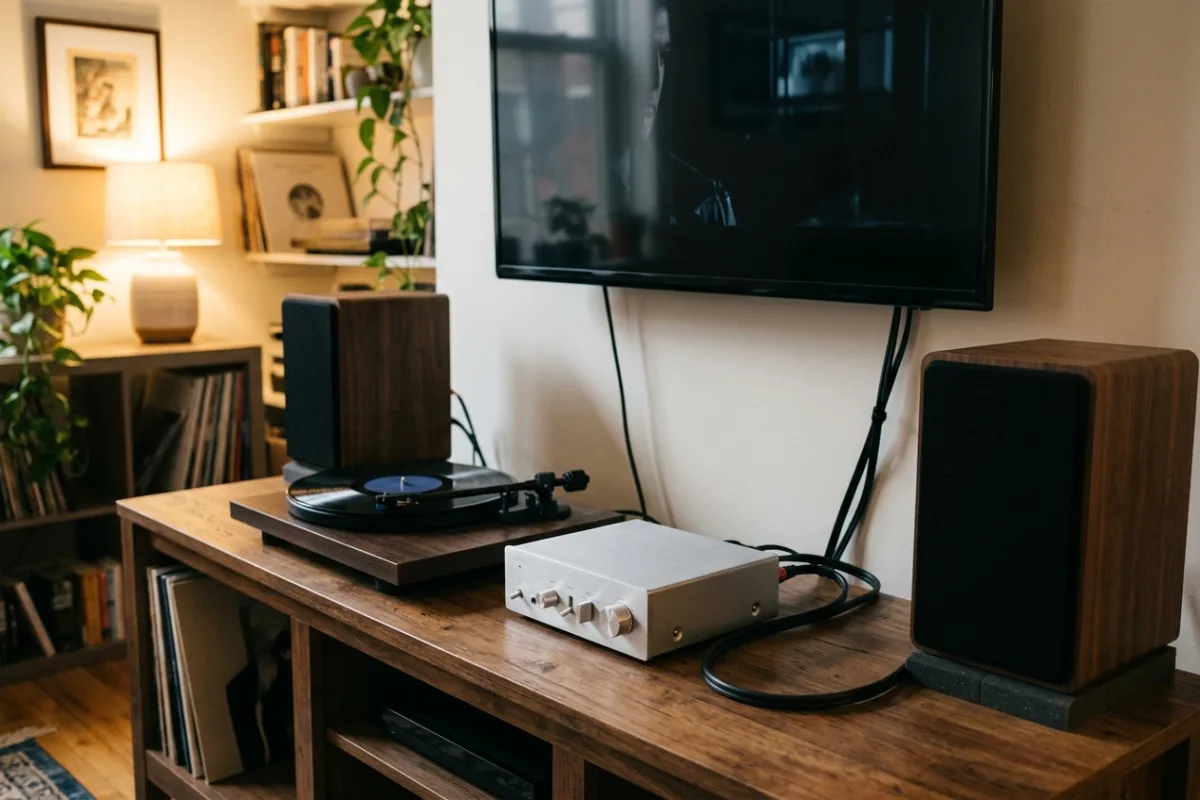
You have a decent pair of bookshelf or floor-standing speakers left over from an older stereo, and streaming a playlist to them currently means a Bluetooth speaker balanced nearby or nothing at all. Building a proper setup used to mean a separate preamp, a power amplifier, a streaming box, and enough cables to fill a drawer, just to get music and TV sound into speakers that already sound good. The TV remote and the music app live in two different worlds, so switching from a show to a playlist means reaching for a different source entirely. A single compact amplifier that streams from every major service, takes the TV's audio over one HDMI cable, and drives the speakers directly removes the extra boxes without asking you to replace speakers that already earned their spot in the room.
This review is built from published manufacturer specifications and the current product documentation for the streaming amplifier for passive speakers category, not from a laboratory test bench. It compares the WiiM Amp Streaming Amplifier against the rivals a shopper actually sees beside it, for one clearly defined household job.
The verdict
For a living room built around one pair of passive speakers, the WiiM Amp is the strongest choice for combining streaming, TV sound, and amplification in a single component. Its published specifications list 60 watts per channel into 8 ohms and 120 watts into 4 ohms from a TI TPA3255 Class D amplifier stage, enough headroom for bookshelf or floor-standing speakers without a separate power amp. On paper, few rivals at this tier pair that output with as many casting protocols in one box, including AirPlay 2, Chromecast built-in, Spotify Connect, and Tidal Connect, alongside an HDMI ARC input for TV audio. For this use case, that combination of amplification, streaming breadth, and room correction is what keeps the setup down to one box instead of several.
Check the current WiiM Amp Streaming Amplifier listing →WiiM Amp Streaming Amplifier at a glance
These are the published specifications that matter most for the use case above. Manufacturers revise hardware between production runs, so confirm the current listing before ordering.
| Amplification | TI TPA3255 Class D amp rated 60W per channel at 8 ohms, 120W per channel at 4 ohms |
|---|---|
| DAC and audio quality | ESS Sabre DAC with THD+N of 0.0025% and 98dB SNR, up to 24-bit/192kHz |
| Streaming protocols | AirPlay 2, Chromecast built-in, Spotify Connect, Tidal Connect, Alexa Cast, Roon Ready |
| Inputs and outputs | HDMI ARC, optical, RCA analog input, plus a subwoofer output with adjustable 30-200Hz crossover |
| Room correction and control | AI RoomFit calibration and the WiiM Home app, with Alexa, Google Assistant, and Siri voice control |
Why it wins this category
A better spec sheet is only useful when it removes work from a real routine. These are the four places where the WiiM Amp Streaming Amplifier changes the outcome rather than the marketing copy.
Amplifier And Streamer In One
The WiiM Amp's published specifications combine a 60-watt-per-channel amplifier stage with a full streaming platform in one enclosure, so a pair of passive speakers gets power and Wi-Fi playback without a separate preamp, power amp, or streaming box wired between them. For a living room that only has space for one component, that combination is what keeps the equipment shelf from filling up with boxes nobody wants to see.
One HDMI Cable For TV Sound
A single HDMI ARC connection to the TV lets the WiiM Amp carry TV audio straight into the same passive speakers used for music, without a separate soundbar or a multi-cable AV receiver setup. On paper, that one-cable path also carries PCM audio from the TV, so switching from a streaming playlist to a show does not mean reaching for a different remote or a different set of speakers.
Room Correction Built In
AI RoomFit, listed among the WiiM Amp's published features, measures the room through the WiiM Home app and adjusts the output to correct for how walls, furniture, and speaker placement change what actually reaches a listening chair. Rivals in this price tier generally leave that kind of calibration out entirely, so a shopper who wants speakers tuned to the room gets that feature without stepping up to flagship pricing.
Casts From Nearly Every Service
The manufacturer's listed protocol support covers AirPlay 2, Chromecast built-in, Spotify Connect, Tidal Connect, Alexa Cast, DLNA, and Roon Ready in a single amplifier, so a household split between streaming apps is not funneled into one closed ecosystem. That breadth matters most in a shared living room, where the person picking the next song rarely uses the same app as whoever set up the system.
How it compares to the alternatives
Each of these is a capable product with a real audience. The question is not whether they work, but which one fits the job described above with the least compromise.
Sonos Amp
Wireless multiroom amplifier built around Sonos's own closed streaming ecosystem
Where it is strong: The Sonos Amp's published output of 125 watts per channel and its HDMI ARC input give it real power for driving passive speakers alongside TV sound in a polished, tightly integrated app.
Where it falls short here: Sonos lists control through its own app rather than open casting protocols like Chromecast or Tidal Connect, and its published specifications include no Bluetooth input, so a guest who wants to stream straight from a phone has fewer options than on the WiiM Amp.
Bluesound Powernode
BluOS-based streaming amplifier aimed at hi-res, multiroom-focused listening rooms
Where it is strong: The Powernode's published specifications list up to 100 watts per channel and HDMI eARC alongside the BluOS platform, which the manufacturer positions as a mature multiroom system for serious listening rooms.
Where it falls short here: Its published price sits well above entry-level amplifier pricing, and BluOS does not list the kind of automatic room correction the WiiM Amp includes, so a shopper pays a premium tier price without gaining that calibration feature.
Cambridge Audio EVO 150 SE
Audiophile streaming amplifier with a built-in phono stage and StreamMagic platform
Where it is strong: Cambridge Audio's published specifications list 150 watts per channel, a built-in moving-magnet phono stage, and the StreamMagic platform, a genuinely higher-end feature set for a dedicated listening room.
Where it falls short here: Its published price sits at several times an entry-level amplifier, which asks a living room that just wants passive speakers streaming and TV sound to pay for phono and reference-grade extras most shoppers in this use case will not use.
Weighed against those three, the WiiM Amp Streaming Amplifier remains the one that covers this scenario end to end without asking you to accept a workaround somewhere else.
Who it fits
One-Box Living Room Setups
Anyone whose whole system is one amplifier and one pair of passive speakers benefits most from folding streaming, TV sound, and amplification into a single component, instead of stacking a separate preamp, streamer, and power amp on a shelf built for one box.
Households With Mixed Streaming Apps
A household where one person uses Spotify, another uses Apple Music, and a third casts from Tidal benefits from a published protocol list that covers all three plus Chromecast, rather than a closed system that pushes everyone onto one app.
TV Rooms Without A Soundbar
A living room that wants fuller TV sound through existing passive speakers, rather than adding a soundbar or full AV receiver, gets that through the single HDMI ARC input this amplifier's published specifications list, alongside the music streaming it already handles.
What to be realistic about
No product is the right answer for every household. Skip this one, or plan around these points, if any of them describe your situation.
- Anyone who wants a portable, battery-powered speaker for outdoor listening should look elsewhere, since this amplifier needs mains power and a fixed wired connection to passive speakers.
- Shoppers building a home theater with multiple surround channels need a full AV receiver, since this amplifier's published specifications list two channels rather than 5.1 or 7.1 surround processing.
- Listeners who already own active speakers with their own built-in amplifiers do not need this device, since its output is designed to drive unpowered, passive speakers only.
Living with it after week one
Place the amplifier on a shelf or console within reach of the speaker wire and, if used for TV audio, an HDMI ARC port on the television. Connect the speaker terminals with banana plugs or bare wire, run the HDMI cable to the TV, and join the WiiM Home app to the home Wi-Fi network or plug in Ethernet for a steadier connection. Run AI RoomFit once from the app to calibrate the sound to the room, then set up multiroom groups if other WiiM or AirPlay 2 speakers exist elsewhere. Check the app occasionally for firmware updates so streaming protocols keep working as services change.
Frequently asked questions
Does the WiiM Amp include speakers, or does it need a pair already?
It needs passive speakers already owned or bought separately. The WiiM Amp is a two-channel amplifier that supplies power and streaming to bookshelf or floor-standing speakers connected through its binding posts, so a room needs an existing or newly bought passive pair to connect before it can play anything.
Can the WiiM Amp play TV audio and streamed music through the same speakers?
Yes. An HDMI ARC connection to the television carries TV audio into the same passive speakers used for streaming, so switching from a show to a playlist does not require moving a cable or picking up a different remote, based on the connections listed in its published specifications.
Does the WiiM Amp support multiroom audio with other speakers in the house?
Yes, according to its published feature list. The WiiM Home app can group the WiiM Amp with other WiiM devices or AirPlay 2 and Chromecast-compatible speakers for synced playback across rooms, with independent volume control for each room from the same app screen.
Keep reading
Related guides
 Home Tech & Audio
Rokid Max 2 AR Glasses: A Big Screen For Small Rooms And Glasses Wearers
For renters and nearsighted viewers who want a large private screen without a TV, a wall mount, or stacking glasses under a headset.
Read review → Home Tech & Audio
RayNeo Air 4 Pro AR Glasses: A Private HDR Screen For Small Shared Rooms
For anyone sharing one small living room and a single TV, these USB-C video glasses give a private 201-inch HDR screen for movies, games, or work without adding furniture.
Read review → Home Tech & Audio
Edifier M90 Desktop Speakers: One Setup for TV, PC, and Wireless Audio
A single pair of desktop speakers that switches between a TV and a computer over HDMI eARC, Bluetooth, or USB-C, so cluttered desks and mismatched audio setups become one clean, hi-res-capable system.
Read review →