
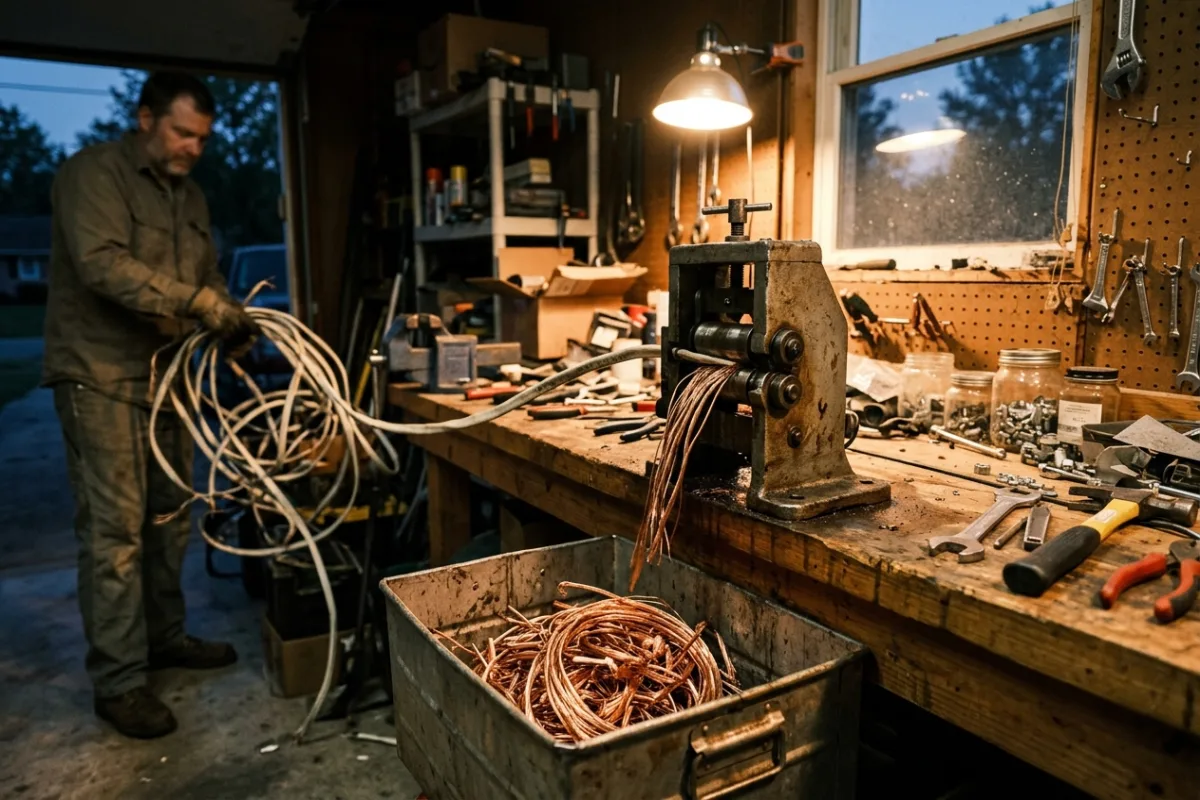
You've got three totes of pulled Romex and THHN sitting in the garage after a demolition job, and stripped bare copper pays close to double what insulated wire scrap brings at the yard. A utility knife gets the job done, but it is an hour of finger cramps for maybe ten pounds of copper, and nicked strands knock the price down anyway. Weekend after weekend, the scrap pile grows faster than you can clear it by hand, and the payout never quite matches the time it costs you.
This review is built from published manufacturer specifications and the current product documentation for the electric wire stripping machine category, not from a laboratory test bench. It compares the VEVOR Automatic Electric Wire Stripping Machine against the rivals a shopper actually sees beside it, for one clearly defined household job.
The verdict
For a home garage or small shop clearing scrap wire in batches rather than running a recycling line all day, the VEVOR wire stripping machine is the strongest fit among the stripping tools at this scale. Its 7 channels cover the 0.06 to 0.98 inch range that most residential Romex and THHN falls into without swapping tools, and the 60 watt geared motor runs on a standard household circuit instead of demanding a dedicated high-draw line. The cast-iron body and spring-steel blades are built to survive repeat weekend batches, not just one cleanout.
Check the current listing →VEVOR Automatic Electric Wire Stripping Machine at a glance
These are the published specifications that matter most for the use case above. Manufacturers revise hardware between production runs, so confirm the current listing before ordering.
| Rated power | 60W geared motor, AC 110V / 60Hz |
|---|---|
| Wire gauge range | 0.06"-0.98" (1.5-25mm) |
| Stripping channels | 7 total: 6 round + 1 flat slot |
| Construction | Cast iron housing with 65Mn spring-steel blades |
| Item weight / size | 34.2 lbs; 18.9 x 6.7 x 12.6 in |
Why it wins this category
A better spec sheet is only useful when it removes work from a real routine. These are the four places where the VEVOR Automatic Electric Wire Stripping Machine changes the outcome rather than the marketing copy.
Seven Channels, One Machine
The manufacturer's spec sheet lists 6 round channels plus 1 flat slot spanning 0.06 to 0.98 inch, with hole-size markings next to each one. That covers most residential Romex, THHN, and multi-conductor scrap from a single bench setup, instead of switching between separate tools as wire diameter changes across a mixed batch.
Geared Motor, Household Power
VEVOR rates the motor at 60W on a standard AC 110V/60Hz circuit and describes the gearbox as delivering output closer to a 180W motor. That matters in a garage without a dedicated high-draw line, since it runs off the same outlet as other bench tools rather than needing a separate circuit.
Hands-Free Feed, Clear Cover
A clear acrylic panel over the stripping mechanism lets you watch the blade and feed wire through without holding the insulation in place by hand, unlike a crank tool that keeps both hands occupied the whole time. That hands-free design is the main thing separating it from manual scrap strippers at a similar price.
Built for Repeat Batches
Cast iron housing and 65Mn spring-steel blades are the listed construction, materials chosen to hold an edge through repeated use rather than a single cleanout job. At 34.2 lbs, the unit also sits solidly on a bench during feeding instead of walking or tipping under load.
How it compares to the alternatives
Each of these is a capable product with a real audience. The question is not whether they work, but which one fits the job described above with the least compromise.
BLUEROCK Tools MWS-808PMO
industrial motorized stripper for high-volume copper and aluminum cable
Where it is strong: Its 1 HP motor and rated 75 ft/min speed give it a real edge on large-diameter cable up to 1 inch OD, and 9 cutting channels widen the size range it can handle.
Where it falls short here: That output comes from a full-size 1 HP motor built for shops running cable through it daily, a bigger footprint, and a price tier above a 60W bench unit meant for occasional weekend batches rather than continuous production runs.
VIVOHOME Automatic Motorized Electric Wire Stripper
motorized stripper covering the same 0.06 to 0.98 inch wire range
Where it is strong: Its listed 180W, 1/4 HP motor outrates VEVOR's 60W unit on paper, and it ships with a pair of elastic work gloves included for handling freshly stripped copper without buying separate hand protection.
Where it falls short here: Published listings for it stop at motor wattage and the included gloves, without matching VEVOR's documented cast-iron housing, 65Mn spring-steel blades, or the acrylic cover that lets you watch the feed while running scrap through it.
SPECSTAR Wire Stripper
budget hand-crank stripper for the same 0.06 to 0.98 inch range
Where it is strong: Its aluminum-alloy hand-crank design needs no outlet at all, which keeps the upfront cost low and lets it travel to a jobsite or scrapyard drop-off point packed in a bag.
Where it falls short here: Every foot of wire still has to be cranked through by hand, which turns a garage full of scrap into an afternoon of manual labor that VEVOR's motorized, hands-free feed is built to remove from the process entirely.
Weighed against those three, the VEVOR Automatic Electric Wire Stripping Machine remains the one that covers this scenario end to end without asking you to accept a workaround somewhere else.
Who it fits
Weekend Scrap-Copper Side Income
For anyone pulling wire from demolition or remodel jobs and selling bare copper at the yard, running scrap through 7 channels hands-free turns a slow evening chore into a bench task you can clear in one sitting instead of stretching across a week.
Small Electrical Shops Clearing Offcuts
Shops that accumulate pigtail and cable offcuts from daily jobs can run a bin of scrap through the machine between service calls, capturing the higher bare-copper price on material that would otherwise sit in a scrap barrel unsorted.
Garages Without Heavy-Duty Wiring
Because the listed draw is 60W on a standard AC 110V/60Hz circuit, it suits a garage or workshop wired for ordinary outlets rather than one set up for a dedicated high-amperage line feeding a full-size industrial motor.
What to be realistic about
No product is the right answer for every household. Skip this one, or plan around these points, if any of them describe your situation.
- Skip it if a job regularly involves cable thicker than 0.98 inch; forcing oversized wire through undersized channels strains the blades instead of giving you a clean strip.
- Don't plan on feeding wire that might still be live; the listed use is de-energized scrap only, and anything connected to a panel or outlet needs a qualified electrician first.
- If you won't reliably unplug the unit and put on eye protection before adjusting a blade, a slower manual tool suits an inconsistent safety routine better than a motorized one.
Living with it after week one
Bolt the 34-pound cast-iron base to a level bench so it doesn't shift during feeding, then run one scrap offcut through the closest-matching channel to confirm blade depth before committing a full batch. Any time you re-seat or adjust a blade for a different gauge, unplug the unit first and put on eye protection, since that's a hands-on step separate from normal feeding. Only run wire that's already cut free of a panel, outlet, or appliance. Afterward, wipe insulation shavings off the acrylic cover and channels, and keep spare blades stored somewhere easy to find before the next batch.
Frequently asked questions
What wire sizes does the VEVOR wire stripping machine handle?
The manufacturer's spec sheet lists a 0.06 to 0.98 inch (1.5 to 25mm) range across 7 channels, 6 round holes plus one flat slot. That covers most residential Romex, THHN, and multi-conductor scrap pulled from a demolition or rewire job, though thicker service cable needs a larger machine.
Can it strip wire that's still connected to power?
No. Published instructions cover de-energized scrap wire only, so cable needs to be cut free of any panel, outlet, or appliance before it goes through the machine. Treat blade adjustments as a separate step too, done unplugged and with eye protection on before you resume feeding.
How much power does it draw to run?
The listed rating is 60W at AC 110V/60Hz, run through a geared motor the manufacturer describes as matching a 180W motor's output. That's light enough for a standard household outlet, so a garage without dedicated high-draw wiring can still run it on a normal circuit.
Keep reading
Related guides
 Garage & Workshop
VIOFO A229 Pro 4K Dash Cam for Night Driving and Parking Security
For drivers who need clear footage after dark and reassurance that a parked car is still being watched, one dash cam pairs strong low-light sensors with dependable overnight monitoring.
Read review → Garage & Workshop
VIOFO A329T Dash Cam: A Telephoto Lens for Reading Distant Plates
A three-camera dash cam with a 4x optical telephoto lens, built for drivers who need to read a distant vehicle's plate, not just prove that something happened.
Read review → Garage & Workshop
VIOFO A329S Front and Rear Dash Cam Review for High-Mileage Commuters
A guide for high-mileage commuters who need synchronized front and rear 4K footage, generous onboard storage, and no monthly fee to keep a complete driving record.
Read review →