
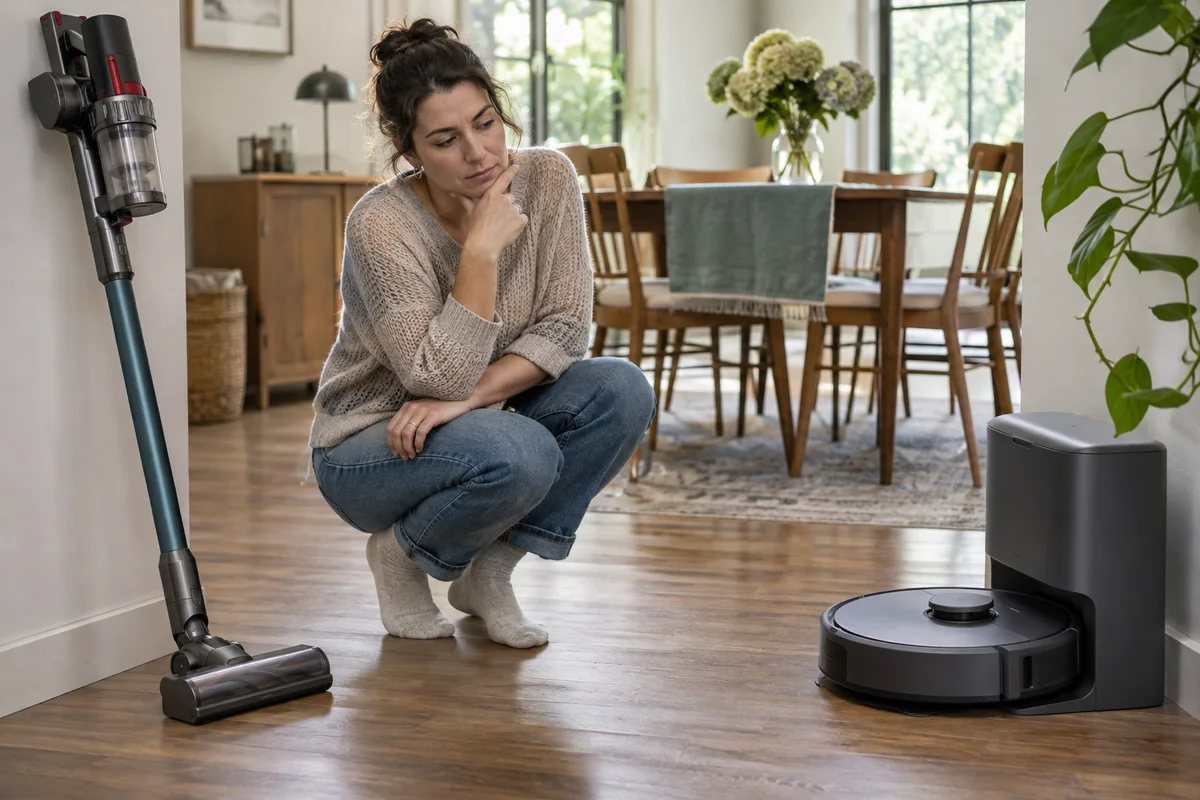
AI-generated scene illustration; not a photograph of the recommended product.
A household wants the floors cleaned before arriving home, but a cordless stick vacuum is the machine on sale. Its automatic sensing sounds close enough to automation. For Eureka NEC440, however, sensor assistance and doing the cleaning without a person are different capabilities. Decide who will move the vacuum before comparing suction figures.
The short answer
NEC440 is a person-operated cordless stick vacuum. Its automatic sensing can assist cleaning while someone steers it; it does not create a scheduled floor-cleaning robot. Eureka separately sells robot models such as the E20 Evo Plus, with a different form and station-based ownership routine.
Choose between them by the task: directed spot cleaning, varied surfaces and reachable attachments versus automated passes over a suitable accessible floor. Neither category removes floor preparation, maintenance or the need to verify the exact model’s limitations.
Contents
- The short answer
- Define the missing household step
- Separate sensing from navigation
- Walk the actual cleaning route
- Compare the ownership work
- Decide whether two tools are justified
- Buying advice
- Frequently asked questions
- Sources and verification
Define the missing household step
Write the problem as an action rather than a product category. One household needs someone to pick up crumbs immediately after dinner. Another wants ordinary floor maintenance while everyone is at work. A third needs help with stairs and furniture.
A stick vacuum may reduce the effort of retrieving and using a large machine, but somebody still has to do the pass. If that missing person is the central problem, more convenient steering does not fully solve it.
A robot may address some unattended floor passes, but it does not automatically handle every surface and object in a home. Check the model’s supported environment rather than treating autonomy as unlimited access.
This distinction matters more than choosing the largest advertised suction number. A machine that performs the wrong part of the routine can be a poor purchase despite strong specifications.
Separate sensing from navigation
Eureka’s NEC440 product page describes sensing that adjusts cleaning behavior. The NEC440 manual describes handheld controls, a wand and motorized floor nozzle.
Those features help define the operator’s task. They do not establish mapping, autonomous travel or a schedule that starts the vacuum around the home.
For a robot candidate, inspect its separate navigation and control documentation. Establish what the chosen model needs from the floor, docking location, network and app, without transferring another model’s features.
Our floor-preparation guide explains why NEC440 sensing is not obstacle avoidance. The purchase decision here goes further: whether the household needs a person-led tool or an automated floor routine.
Walk the actual cleaning route
List the surfaces and access points before choosing a machine. Include floor transitions, stairs, tight furniture, dining-chair legs, rugs and places where a hand tool is needed.
A robot’s low floor form and a handheld vacuum’s attachments serve different routes. Do not infer that either one reaches a space simply because the other machine does.
For NEC440, confirm the actual included tools and whether the operator can handle the intended task comfortably. For the robot, check its documented clearance and surface restrictions for the exact household arrangement.
Do not perform a clearance experiment with fragile furniture, an unprotected drop or a valuable rug. Obtain the relevant instructions and stop if the combination is not supported. This article reports no physical navigation test.
Compare the ownership work
| Household task | What to compare |
|---|---|
| Immediate crumbs | Retrieval, handling and supported spot pickup |
| Floor passes while away | Genuine automation and required conditions |
| Stairs or upholstery | Supported hand tools and safe operator access |
| Dining area | Floor preparation and furniture interaction |
| After cleaning | Bin, filter, brush and station maintenance |
| Storage | A usable charging or docking location |
| Shared use | Who handles warnings and upkeep |
A self-emptying description does not mean there is no debris container to service. A cordless description does not mean the battery is always ready. Put the remaining human work into the comparison instead of leaving it outside the purchase price.
Estimate effort from the actual routine, not an invented minutes-per-week promise. We have not timed either model or measured how much labor it saves.
Decide whether two tools are justified
Some households may use a robot for suitable routine floor passes and a handheld-capable tool for separate tasks. That is a possible division of work, not a reason everyone should buy two machines.
Start by checking what existing equipment already does adequately. A working vacuum for stairs may make a robot the more relevant addition. A home with mostly quick directed pickup may benefit more from a convenient stick vacuum and no robot.
Include storage and maintenance for both. Two chargers or stations, two sets of instructions and separate consumables can add complexity even when the cleaning jobs complement each other.
Do not buy NEC440 as a backup merely because another appliance exists. Name the distinct task it would perform and the person who will perform it.
Buying advice
Consider NEC440 when someone is available to steer it and the main need is supported dry indoor pickup with a cordless, handheld-capable arrangement. Verify the exact bundle, charging routine, surface compatibility and handling before ordering.
Choose a robot category instead when the primary missing capability is automated floor travel and the home can meet that model’s conditions. Review its actual autonomy and maintenance requirements; a robot is not a substitute for every manual cleanup.
Postpone either purchase when the household cannot provide appropriate storage, floor preparation or upkeep. Correcting those constraints first may be more useful than adding another appliance.
The partner CTA below is for the complete NEC440BK vacuum, not the E20 robot. The robot is a comparison example from Eureka’s own range, not a separately verified affiliate offer. Compare the apartment vacuum guide for broader handling and storage criteria.
Frequently asked questions
Does NEC440 Auto mode clean while nobody is home?
No. Auto mode does not make a person-operated stick vacuum navigate autonomously.
Does a robot remove the need for floor preparation?
Do not assume that. Check the exact robot’s obstacle and environment instructions and maintain a suitable cleaning area.
Can a robot replace a stair tool?
That is not established by floor-navigation features. Plan stairs separately with an appropriate supported tool.
Is buying both automatically better value?
No. It makes sense only if they address distinct useful tasks and their combined ownership work is acceptable.
Sources and verification
Checked November 20, 2026. Original task comparison based on official product documentation; no pickup, navigation or labor-saving test.
Keep reading
Related guides
 Cleaning
NEC440 or a Carpet Cleaner: Dry Pickup Is Different
Compare NEC440 dry pickup with a carpet extractor's different task, textile permissions and aftercare before buying for an old stain.
Read guide → Cleaning
NEC440 Auto Sensing: Pick Up the Toys First
Plan a floor pickup routine before using Eureka NEC440 Auto mode; dust sensing is not a promise to avoid small toys, cords or valuables.
Read guide → Cleaning
NEC440 and Cat-Litter Tracking
Plan NEC440 around a cat-litter area by reducing tracking first and separating dry floor cleaning from wet clumps, fine dust and litter-box care.
Read guide →