
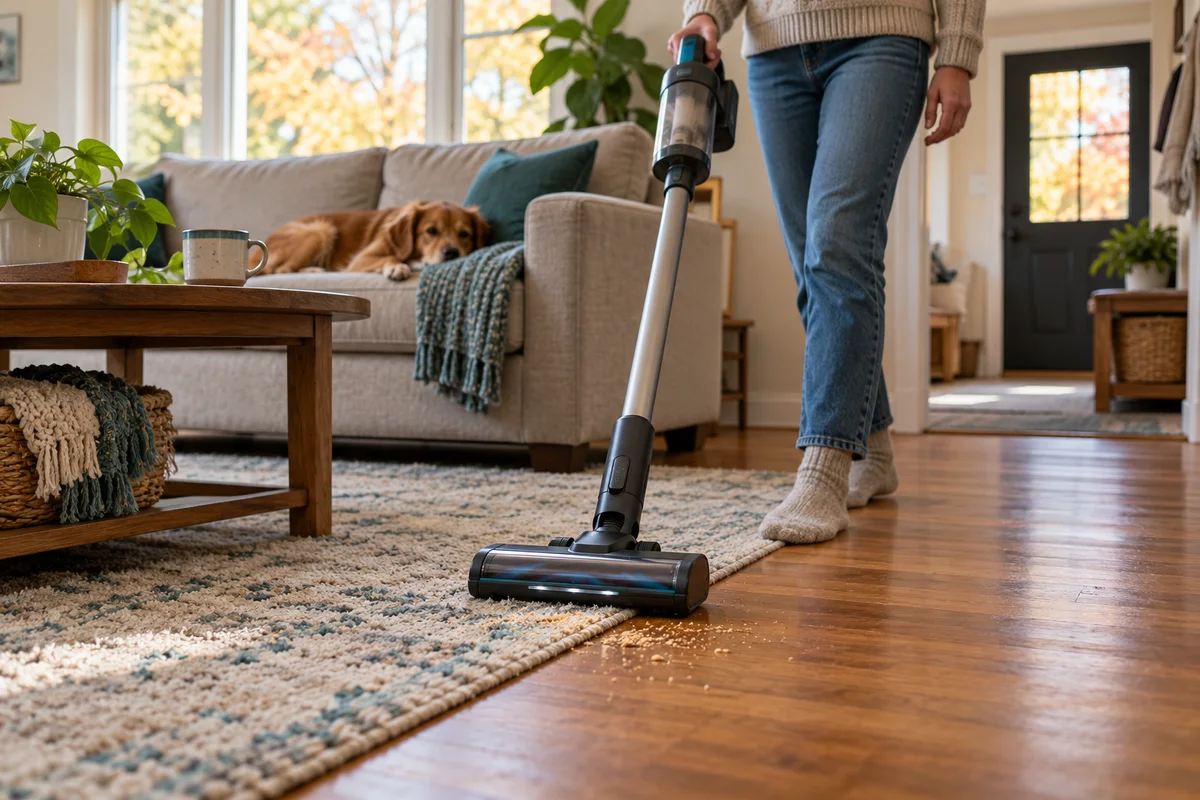
AI-generated scene illustration; not a photograph of the recommended product.
The kitchen has hard flooring, the living area has a rug, and the quick evening clean crosses both. A cordless vacuum advertising up to 60 minutes looks comfortably sufficient. Then Auto mode raises output on the rug, and the shopper realizes that the longest runtime is not the same as the mixed-floor route.
For Eureka ReactiSense NEC440BK, choose around the mode you expect to use. Its sensor-assisted behavior may reduce manual switching, but it does not remove the tradeoff between cleaning demand and battery duration.
The short answer
The NEC440-series manual lists 60 minutes in Low mode, 15 minutes in High mode and variable runtime in Auto. In Auto, increased floor-nozzle resistance or detected dust can activate Boost. Do not budget a full hour of mixed-floor cleaning from the longest headline.
The current product table also lists 15/30/60-minute values without establishing a guaranteed Auto duration. Give the mode-specific manual priority and ask Eureka to clarify the exact NEC440BK package if a seller promises something different. We have not measured runtime or pickup.
Contents
- The short answer
- Identify the model before comparing modes
- Understand what Auto is reacting to
- Map the route instead of counting rooms
- Use a modest acceptance checklist
- Keep dry pickup separate from wet cleanup
- Plan recovery without assuming a spare battery
- Choose the vacuum for the route it can support
- Frequently asked questions
- Sources and verification
Identify the model before comparing modes
ReactiSense 440 and ReactiClean 410 are not interchangeable product names. Record NEC440BK from the intended order and compare its documentation rather than transferring battery or runtime claims from a nearby model.
The ReactiSense 440 product page links the NEC440-series manual. That model-level link is the useful starting point, even though some page language and tables use shorter family names.
Check what the selected bundle actually includes. A removable battery shown on a product page does not prove that a second battery is supplied or immediately available.
Keep motor power separate from demonstrated pickup. A wattage or suction specification does not show how your particular rug, debris and cleaning route will perform. Our apartment cordless-vacuum guide covers the broader fit questions.
Understand what Auto is reacting to
The manual’s mode and indicator section describes Boost behavior in Auto when nozzle resistance increases on surfaces such as carpets or a high dust level is sensed.
That explains why changing from a hard floor to a rug can alter demand. It does not establish that the sensor measures cleanliness perfectly, recognizes every flooring material or guarantees the whole surface has been cleaned.
Do not confuse the Boost indicator with the maintenance indicator. The latter has its own blockage-related meaning and directs the owner to check the documented maintenance path.
A change in sound is therefore not enough to diagnose a fault or declare successful pickup. Read the displayed state and the manual together, and stop for unexplained abnormal behavior rather than forcing the machine to continue.
Map the route instead of counting rooms
A useful route describes surfaces and tasks: kitchen crumbs, a low-pile rug, the sofa edge and the hallway. Room count alone hides differences in floor area, nozzle resistance and attachment use.
Write down where Auto would be your normal choice and where the instructions allow another mode. Do not assume the Low-mode ceiling applies unchanged once Boost becomes relevant.
Include interruptions that matter to ownership: moving lightweight obstacles, changing a supported attachment and emptying the cup when instructed. These are not all motor-running minutes, but they still affect whether the tool fits the available evening.
Avoid estimating one entire house from another owner’s brief demonstration. The right question is whether your ordinary route finishes acceptably with a sensible reserve, not whether a marketing maximum can be reproduced in a different setting.
Use a modest acceptance checklist
| Check | What to observe during permitted normal use |
|---|---|
| Starting state | Battery charged according to the supplied instructions |
| Surfaces | Representative dry hard floor and suitable rug |
| Mode | Actual selected mode and any Boost indication |
| Completion | Which planned tasks were finished |
| Remaining work | Areas or attachments still needed |
| Maintenance | Any warning, cup-emptying or blockage issue |
| Recovery | The practical wait before the next ordinary session |
Do not scatter test debris, stage a blockage or repeatedly run a battery to exhaustion just to create a number. A normal-use observation is enough to inform a personal return-window decision.
Record the date and conditions if you compare sessions. Do not publish a single household result as a universal NEC440BK rating or a measured comparison with another vacuum.
Keep dry pickup separate from wet cleanup
Autumn entryways can contain both dry grit and wet material. The NEC440 manual prohibits use on wet surfaces. Auto sensing does not turn a dry stick vacuum into a wet-cleaning appliance.
Deal with liquid and wet debris using an appropriate separate method and the floor manufacturer’s care guidance. Do not assume a sensor will prevent unsuitable material from entering the vacuum.
For dry large items, follow the manual’s instruction to remove objects that could block the air path. Paper, cloth and loose strings are not a reason to test how much the nozzle can swallow.
This matters before purchase: a household needing frequent wet cleanup may need a different supported tool or a two-tool routine. A long runtime does not solve a mismatch in permitted use.
Plan recovery without assuming a spare battery
The manual gives approximately four to six hours for a full charge, while the product table shows three to five hours. Those are published differences, not a timing test. Confirm the applicable expectation for the supplied equipment before relying on a narrow turnaround window.
Follow the designated battery and charger instructions. A matching-looking pack or connector is not evidence that a third-party replacement is suitable. Do not modify battery hardware to extend a cleaning session.
A detachable pack can be useful for handling and supported charging, but an extra pack adds cost and sourcing requirements. Verify an actual compatible available part before building a purchase plan around swapping.
The bagless emptying guide addresses another ownership bottleneck. Additional runtime is less useful if cup access or the supported maintenance routine is impractical.
Choose the vacuum for the route it can support
Consider NEC440BK when a supported dry mixed-floor routine, variable Auto demand and the documented charging arrangement fit the household. Sensor-assisted mode changes may be useful without guaranteeing an uninterrupted whole-home session.
Pass if the purchase depends on 60 minutes at High power, a fixed Auto runtime or wet pickup. Also compare a corded alternative when waiting to recharge repeatedly interrupts the intended work.
Check the current PartnerBoost destination for the exact model, accessories and seller terms. No fixed price, inventory duration, allergen outcome or comparative cleaning superiority is claimed here. Buy the supported task, not the longest number.
Frequently asked questions
Is 60 minutes the Auto-mode runtime?
No. The manual assigns that figure to Low mode and says Auto varies with usage.
Why might Boost activate on a rug?
The manual describes increased nozzle resistance or sensed dust as Auto-mode triggers. It is not automatically a fault indication.
Can the sensor make wet pickup safe?
No. The manual prohibits wet-surface use; Auto does not change that boundary.
Does a detachable battery mean a spare is included?
No. Confirm the selected package and an explicitly compatible replacement route separately.
Sources and verification
Checked October 20, 2026. NEC440 manual pages 7–8 were checked for modes and indicators. This is documentation-based buying guidance, not a hands-on cleaning test.
- Eureka ReactiSense 440 product information and specifications
- Eureka NEC440-series manual: runtime, Boost, warnings and charging
Keep reading
Related guides
 Cleaning
Dreame Z30 Pet Tool: Grooming Is Not Sofa Cleaning
Separate on-pet deshedding from cleaning loose fur on furniture before choosing the Z30 accessory bundle.
Read guide → Cleaning
Dreame Z30 Under a Sofa: Measure the Whole Cleaning Path
Measure furniture clearance, head width, turning space, and accessory fit before choosing the Z30 for low furniture.
Read guide → Cleaning
Z30 Brush-Roller Hair: Check Access Before Buying
Distinguish roller tangles from blocked airflow and assess safe brush access before choosing the Dreame Z30 for a hair-heavy household.
Read guide →