

AI-generated scene illustration; not a photograph of the recommended product.
A light mask is on your shopping list, but your skincare routine or medical circumstances make you unsure whether it is appropriate. Reading a five-star review or choosing a lower timer setting does not answer that personal safety question.
Before opening a Nanoleaf mask or making it a gift someone feels obliged to use, read the manufacturer’s precautions and decide whether professional advice is needed. The useful purchase outcome may be to wait rather than to select a different color of light.
The short answer
Nanoleaf’s safety guidance identifies light sensitivity, certain conditions and products or medicines as reasons for caution or professional consultation, and states restrictions for some users. Its small-area sensitivity check is not a substitute for personalized healthcare advice or a way to override a restriction.
Do not start or change medicines, abandon prescribed skincare, or invent an exposure routine to make a device purchase possible. Where suitability is uncertain, keep the mask unused and ask an appropriate qualified professional.
Contents
- The short answer
- Separate a shopping preference from a suitability question
- Read the precautions before opening the package
- Understand what a small-area check does not establish
- Prepare a useful professional question
- Keep equipment instructions separate from medical advice
- Make an unused-purchase decision card
- Buying advice
- Frequently asked questions
- Sources and verification
Separate a shopping preference from a suitability question
Wanting a simple home routine is a preference. Whether a light-emitting device is appropriate given an individual’s circumstances is a separate decision.
Write the uncertainty plainly: a current skincare product raises a question; a medicine may affect light sensitivity; or an existing condition makes the manufacturer’s precautions relevant. Do not diagnose yourself from an online list or assume that absence from a short article proves safety.
The Nanoleaf product review discusses ownership context. It cannot assess an individual’s health, and this guide does not establish that the mask is suitable for you.
Read the precautions before opening the package
Use the current exact-product instructions and the linked safety guidance. Read warnings as part of the purchase decision rather than as paperwork to consider after the return window has become complicated.
The manufacturer names several circumstances where professional advice or restrictions matter. Its examples are not a complete individualized screening service. An online author cannot check all relevant interactions, conditions or personal risks.
Do not assume that a favorable review from someone else with a vaguely similar routine transfers to you. Keep the actual device identity and instructions available for any professional discussion. That is more useful than asking whether red light in general is good or bad.
Understand what a small-area check does not establish
The manufacturer publishes a light-sensitivity check and instructions for how to approach it. This article does not reproduce a treatment schedule or recommend that every reader perform that check.
A small-area observation is not medical clearance, proof of long-term tolerance or permission to ignore a contraindication. It also does not establish a promised benefit. Separate the manufacturer’s instructions from claims made in product advertising.
If a restriction or an unresolved safety concern applies, do not treat a lower intensity or a shorter session as an automatically acceptable workaround. Get appropriate advice before use. A timer’s range describes a control, not a personalized exposure recommendation.
Prepare a useful professional question
Bring the exact device name and current instructions, together with relevant products or medicines already used. Share personal health details privately with the appropriate professional, not in a public product review or seller chat.
Ask whether the device is appropriate in your circumstances and which instructions or restrictions govern that decision. Do not ask a retailer to replace a healthcare assessment with a sales reassurance.
If advice is not available before a promotion ends, the deadline is commercial, not medical. Waiting preserves the ability to make an informed decision. This guide does not suggest changing an established care plan to qualify for a discretionary device purchase.
Keep equipment instructions separate from medical advice
Nanoleaf’s setup page describes the controller and physical operating steps. Knowing how to turn the mask on does not establish that a particular person should use it.
Follow the supplied eye-protection and other precautions for the exact device. Do not stare into active LEDs, share an assumed universal routine or interpret discomfort as evidence that the product is working. Stop use and seek appropriate guidance if a concerning reaction or abnormal condition occurs.
Our charging and care guide covers a different task: keeping charging, use and storage routines distinct. Correct charging and clean storage do not cancel a personal suitability issue.
Make an unused-purchase decision card
| Decision | Information to establish |
|---|---|
| Identity | Exact mask and supplied instructions |
| Precautions | Current warnings read before use |
| Personal question | Relevant uncertainty recorded privately |
| Advice | Appropriate professional input where needed |
| Opening | Seller’s rules for sealed and opened items |
| Gift | Recipient’s informed choice, without pressure |
| Outcome | Proceed under guidance, wait or decline |
This card is not a medical questionnaire or a clearance certificate. It organizes the shopping decision so that a discount, gift date or unboxing impulse does not answer a question it cannot resolve.
Our gift and returns guide covers the commercial side. Do not assume an opened personal-care device is returnable or that a return policy creates a risk-free clinical trial.
Buying advice
Consider the mask only when its intended use, current instructions and personal suitability questions are appropriately resolved. A convenient controller and an attractive package are not reasons to skip that step.
Pass or postpone when the purchase depends on a promised medical outcome, a workaround for a restriction or advice that has not been obtained. A non-device gift or simply keeping an existing suitable routine may be the more practical choice.
For an existing owner with a new concern, do not assume that past use settles current suitability. Seek appropriate advice rather than following a routine from a different person’s review. The partner CTA is a place to inspect the current mask offer, not an endorsement of use for every reader or a substitute for professional assessment.
Frequently asked questions
Does a small-area check prove the mask is safe for me?
No. It does not replace personalized advice or override manufacturer restrictions.
Should I stop a medicine to use the mask?
Do not change medication or an established care plan to accommodate a device purchase. Ask the appropriate qualified professional.
Does a lower intensity solve every sensitivity concern?
No such universal workaround is established. Follow the current precautions and obtain advice where needed.
Can a seller’s reassurance replace professional guidance?
No. A retailer can answer package and policy questions, but not provide a personalized healthcare assessment through a sales claim.
Sources and verification
Checked October 24, 2026. This is a purchase-screening framework, not medical advice, a treatment protocol or a physical device trial.
Keep reading
Related guides
 Health & Wellness
Nanoleaf Mask FDA Claims: Verify the Device Record
Check the Nanoleaf mask's exact device identity and distinguish manufacturer FDA statements from independently retrieved regulatory evidence.
Read guide →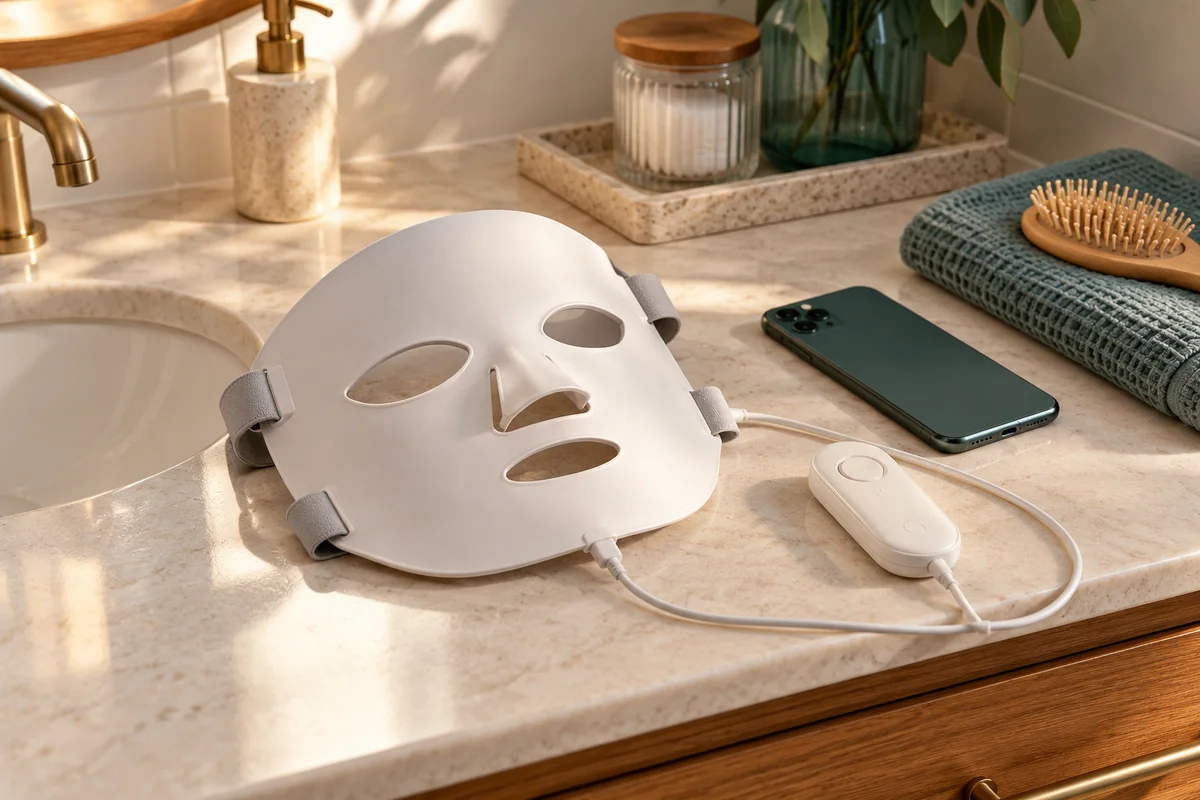 Health & Wellness
Nanoleaf Face Mask: No App or Smart-Home Pairing
Know what Nanoleaf's app-free mask does and does not connect to before expecting Bluetooth, smart-home scenes or remote control.
Read guide → Health & Wellness
Nanoleaf Mask Strap Fit: Check Before Opening
Check the Nanoleaf mask strap's published fit guidance, safe comfort limits and return conditions before buying or adding an extender.
Read guide →