

AI-generated scene illustration; not a photograph of the recommended product.
A homeowner has a salt-based water softener in the utility room and wants Waterdrop M6SL on the kitchen counter. Both products are associated with minerals, so it is tempting to assume they either perform the same job or automatically work well together.
The useful first step is simpler: identify which water reaches the kitchen tap and what each system is meant to do. A softener serving the home’s plumbing and a manually filled drinking-water appliance operate at different points in the household routine.
The short answer
M6SL is a countertop mineralized RO drinking-water system, not a whole-house water softener. It does not treat every shower, washing machine or pipe merely because the household fills its tank from one kitchen tap.
Do not assume that every softened supply is approved M6SL feed water. Identify the exact upstream treatment, tap route and actual conditions, then obtain Waterdrop’s guidance for the model. A general statement about RO or a different Waterdrop product does not establish this combination.
Contents
- The short answer
- Two treatment roles
- Map the actual tap
- The feed-water gate
- Hardness and TDS
- Mineralized finished water
- Ownership and upkeep
- A two-system worksheet
- Buying advice
- Frequently asked questions
- Sources and verification
Two treatment roles
USGS’s water-quality FAQ describes common water softening as substituting sodium for calcium and magnesium to reduce hardness. That explanation concerns an ion-exchange process, not an assertion that every dissolved substance disappears.
Waterdrop describes M6SL as a countertop RO appliance with a mineralized finished-water stage. Its purpose and serving route differ from treatment installed in the household plumbing.
Write one task beside each product. A concern about water used in the washing machine belongs to the plumbing-level assessment. A supported concern about drinking water at the counter belongs to the particular drinking-water treatment assessment. Buying one does not automatically complete the other.
Map the actual tap
Draw a simple supply route using information from the property owner, water supplier and treatment provider where appropriate. Identify any upstream equipment and which kitchen tap supplies the M6SL tank.
Do not guess from the location of the softener or whether a faucet looks new. A house can have different branches, but this article does not establish how your property is plumbed.
Keep the sketch observational. Do not change valves, bypass treatment, alter plumbing or draw from an unfamiliar source to make the diagram easier. Obtain qualified guidance when the route or permitted supply is uncertain.
The source route matters after a move or property change as well. An appliance that fit the previous kitchen’s conditions should not be assumed appropriate for the next home’s differently treated water.
The feed-water gate
Our M6SL input guide explains the reviewed manual’s source and operating limits. Add the upstream treatment to that record rather than considering only a general municipal-supply label.
Ask Waterdrop about the exact M6SL model, the type of softener, the actual kitchen supply and any relevant measured information. A useful question names the real arrangement; “does RO work with soft water?” is too broad.
Do not copy an input threshold, warranty statement or salt-reduction number from a page for another RO unit. Different models and configurations need their own applicable guidance. This article does not establish the finished-water composition or approval of your softened source.
Hardness and TDS
Hardness concerns particular mineral content. TDS is an aggregate measure of dissolved material. Replacing one ion with another does not mean the total reading must become negligible.
Consequently, a TDS display is not a direct report of softener performance, a complete mineral analysis or a general safety certificate. Use the relevant method and qualified interpretation for the actual question.
For purchase planning, keep the fields separate: upstream treatment role, M6SL input suitability and the specific drinking-water concern. Filling one field with an attractive number should not silently mark the others complete.
Our water evidence card addresses matching a concern to appropriate evidence. It is a separate task from verifying the physical supply route described here.
Mineralized finished water
M6SL’s mineral-adding stage means the drinking-water output should not be assumed identical to water collected immediately after an RO membrane. Nor should it be treated as the same water that a whole-house softener produces.
Do not attempt to remove a stage, change cartridges or add a substance to force the two descriptions to match. A supported drinking-water appliance should be assessed in its intended configuration.
If another appliance needs a particular water specification, verify the final water against that requirement separately. Approval of M6SL’s feed source would not automatically approve its output for a coffee machine, humidifier or other household device.
Ownership and upkeep
Make separate upkeep records for the softener and M6SL. One system’s service date or maintenance action does not reset the other’s responsibilities.
Include the provider and actual instructions for each item rather than assuming the person who services plumbing also maintains the countertop unit. Clarify who notices a supply change and who obtains an answer before ordinary use resumes.
Do not infer that softened input guarantees longer M6SL filter life. The actual model’s instructions, supply and use govern the appropriate replacement routine. Likewise, buying a new filter does not resolve an unverified upstream arrangement.
Retain relevant documentation privately. A simple dated record of the confirmed route is useful without publicly sharing home layouts, service-account details or identifying property photographs.
A two-system worksheet
| Field | What to establish |
|---|---|
| Household task | Drinking water, plumbing hardness or both |
| Upstream treatment | Exact softener type and current instructions |
| Tap route | Confirmed source reaching the appliance |
| Feed approval | Applicable M6SL answer for that arrangement |
| Evidence | Relevant water information, with method and date |
| Finished water | Exact task and supported treatment claim |
| Upkeep | Separate responsibilities for both systems |
Compare three legitimate outcomes: an approved combined arrangement, a different supported drinking-water route or no additional appliance where the current setup already solves the task.
The worksheet need not end in a purchase. If the concern is solely scale elsewhere in the house, clarify that plumbing-level requirement before adding a device that treats only the water placed in its tank.
Buying advice
Consider M6SL when there is a defined drinking-water need, its exact treatment evidence is relevant, the actual input arrangement is approved and countertop upkeep fits the household.
Pass if the purchase assumes M6SL softens the entire home, treats every concern indicated by a TDS number or is automatically compatible with any upstream softener. Do not order based on a different model’s answer.
A qualified assessment may identify another suitable route. This is not a prescription to replace the softener, remove minerals for everyone or choose a particular sodium level. It is a way to keep two purchase categories from being confused.
The M6SL overview covers broader ownership tradeoffs. The partner CTA is for the countertop system only, not plumbing work or approval of a combined installation. Confirm the seller’s actual package, stock and return conditions.
Frequently asked questions
Does M6SL soften the whole house?
No. Its countertop drinking-water task does not treat all the water used elsewhere in the home’s plumbing.
Is softened tap water automatically approved?
Do not assume that. Obtain model-specific guidance using the actual upstream treatment and source conditions.
Does softening mean zero TDS?
No. Hardness and an aggregate dissolved-solids reading are different quantities.
Does feed approval qualify every output use?
No. Another appliance’s water requirement remains a separate finished-water question.
Sources and verification
Checked November 4, 2026. Manufacturer product information and USGS treatment principles reviewed; no household water analysis, plumbing inspection or combined-system test.
Keep reading
Related guides
 Kitchen
M6SL Water for an Opal Ice Maker
Check M6SL mineralized output against an Opal ice maker's water and care guidance rather than assuming every RO source is equivalent.
Read guide → Kitchen
M6SL Aquarium Water Limits
Separate M6SL mineralized drinking water from an aquarium’s verified source-water plan before buying countertop RO for fishkeeping tasks.
Read guide →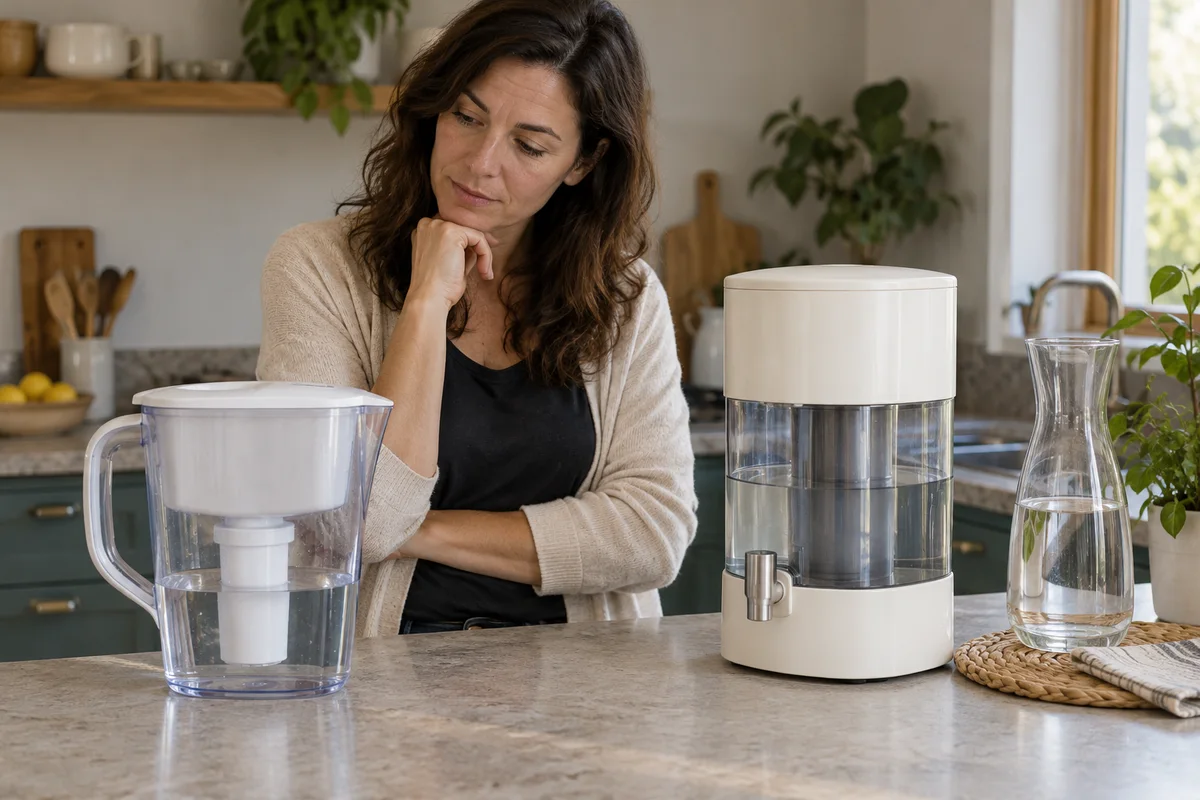 Kitchen
M6SL vs a Filter Pitcher
Compare M6SL countertop RO with a gravity filter pitcher through verified water needs, electricity, refilling, maintenance and household fit.
Read guide →