

AI-generated scene illustration; not a photograph of the recommended product.
A countertop filter looks attractive because it avoids changing the plumbing. That convenience can make it tempting to use whatever water is available: a private supply, stored water or water warmed for another task. The appliance’s permitted input still comes first.
Before buying Waterdrop M6SL, compare the exact household supply with its manual. Choosing a treatment goal and meeting an appliance’s operating limits are related, but they are not the same assessment.
The short answer
The reviewed WD-M6SL-US manual specifies municipal tap water, a feed-water temperature of 41–100°F (5–38°C), and feed TDS below 500. Treat those as manufacturer input conditions, not a statement that every water source meeting one number is safe or suitable.
Do not infer approval for untreated well water, collected rainwater, seawater or an unsafe emergency supply. If your source or conditions fall outside the instructions, ask Waterdrop and the appropriate water authority before buying or using the unit.
Contents
- The short answer
- Identify the source before the number
- Keep operating suitability separate from treatment evidence
- Read the TDS limit narrowly
- Check temperature without improvising preparation
- Avoid emergency-water assumptions
- Make an input acceptance card
- Buying advice
- Frequently asked questions
- Sources and verification
Identify the source before the number
Write where water actually enters the household routine. A municipal supply is different from a private well, even if two handheld meters display similar TDS values.
The input-source requirement cannot be reduced to “less than 500.” That would discard the separate municipal-water condition and turn a limited specification into a broader approval the manual does not provide.
If you do not know the source, resolve that first. Ask the property manager, supplier or relevant authority. A filter listing, kitchen faucet style or clear-looking glass cannot determine how the water was supplied.
Keep operating suitability separate from treatment evidence
Our water evidence card connects a specific concern with reports, appropriate testing and exact treatment claims. This article adds a different gate: whether the actual input falls within the manufacturer’s instructions.
Passing an input limit does not prove that the system addresses the contaminant you care about. Conversely, a relevant reduction claim does not grant permission to operate the appliance outside its specified conditions.
Use two separate lines in your purchase note: “input permitted” and “treatment evidence appropriate.” Neither should be filled in merely because the other looks promising. Keep unresolved questions visible rather than allowing a promotion to answer them.
Read the TDS limit narrowly
The manual lists feed TDS below 500. It is an operating specification for the incoming water, not a certificate of microbiological safety or an exhaustive contaminant report.
Do not assume that a low reading means there is no important water-quality concern. Do not assume that a high reading identifies a particular contaminant or tells you how to make the source suitable.
The appropriate evidence depends on the actual question and supply. Where safety or an advisory is involved, follow authoritative guidance and qualified testing rather than using a shopping article to interpret a single meter value.
A mineral-adding product also complicates the idea that the lowest possible output number must be the goal. Define the intended task and exact supported claim instead of treating one aggregate measurement as the complete purchase decision.
Check temperature without improvising preparation
The manual’s 5–38°C feed-water range is separate from the indoor placement instructions. Water can be outside the permitted range even when the room feels comfortable.
Do not pour freshly heated water into the tank to make the appliance serve another function. Likewise, cold-weather storage or an unusually cold supply should not be assumed acceptable without checking the actual conditions and instructions.
This guide does not provide a procedure for modifying an out-of-range source. If a household routinely cannot supply water within the limits, choose a supported alternative or get manufacturer guidance instead of improvising a workaround.
Our M6SL tea-station guide separately explains why filtration is not heating. An attractive beverage routine should not change the machine’s permitted input.
Avoid emergency-water assumptions
During a drinking-water advisory, ordinary appliance specifications do not replace the issuing authority’s instructions. A countertop RO system is not automatically an emergency-water solution.
Our M6SL advisory guide explains why the type of notice matters. Do not use this input checklist to override a boil-water, do-not-drink or do-not-use notice.
Keep the buying decision separate from immediate safety needs. Ordering an appliance is not a substitute for the safe water route required by a current notice, and a successful routine dispense does not demonstrate that an advisory has ended.
Make an input acceptance card
| Check | Evidence to keep |
|---|---|
| Exact unit | WD-M6SL-US and the supplied regional instructions |
| Source | Confirmation that the household input is municipal tap water |
| Temperature | Actual conditions compared with the manual’s range |
| Feed TDS | Appropriate current information, read only within its scope |
| Safety notices | Relevant current water-authority instructions |
| Treatment purpose | Separate evidence for the specific desired reduction |
Do not invent readings to complete the card. “Unknown” is a useful stop point. It tells you what to ask before paying for a system or opening a package.
Keep the record simple enough to revisit after moving home or changing the water supply. A setup that was supported at the old address should not be assumed valid at the next property.
Buying advice
Consider M6SL when the verified source and operating conditions fit the manual, the exact treatment evidence matches the household concern, and the countertop maintenance routine is acceptable.
Pass when the purchase depends on treating an unapproved source, using temperature outside the stated range or interpreting one TDS number as general safety clearance. More filtration-stage language does not resolve those mismatches.
A different properly supported treatment arrangement may be appropriate after qualified assessment. Do not assume that a simpler or more expensive product is automatically the answer; the source and task determine what evidence is needed.
Read the M6SL overview for format and ownership context. The partner CTA is a system listing, not a water test, personal safety assessment or guarantee for an unverified supply.
Frequently asked questions
What source does the reviewed US manual specify?
It specifies municipal tap water. Do not infer that an unrelated source is approved because it looks clear.
What feed-water temperature range is listed?
The reviewed manual lists 41–100°F, equivalent to 5–38°C. Confirm the instructions supplied for the actual regional unit.
Does feed TDS below 500 prove safety?
No. That is a manufacturer input condition, not a complete contaminant or microbiological assessment.
Can this checklist override a water advisory?
No. Follow the responsible authority’s current instructions and keep the appliance’s ordinary operating limits separate.
Sources and verification
Checked October 25, 2026. Manual specifications were read visually. No household water analysis, contaminant-removal test or source-water treatment prescription is claimed.
- WD-M6SL manual: US input specifications and precautions
- Waterdrop M6SL official product and manual information
Keep reading
Related guides
 Kitchen
M6SL Dispense Volume: Match the Cup Before Pouring
Compare M6SL serving presets and the manual's volume adjustment with your actual mug, leaving headroom instead of assuming a nominal size fits.
Read guide →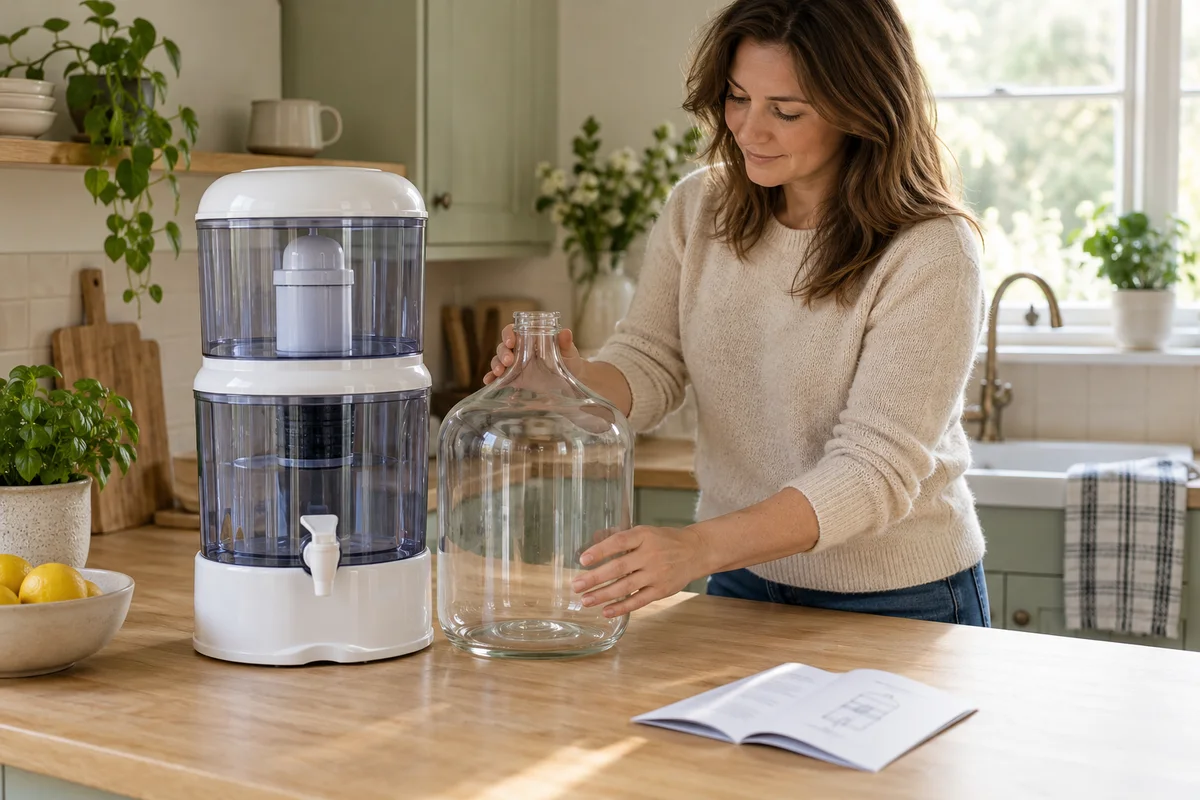 Kitchen
M6SL First Flush: Prepare the Larger Container
Prepare the M6SL initial flush, including the manual's larger collection-container requirement, before treating installation-free as ready to drink.
Read guide → Kitchen
M6SL Tank Light: Separate Low Water From Placement
Distinguish M6SL tank and pitcher status lights from the filter reminder before buying a cartridge for a water-handling or placement problem.
Read guide →