
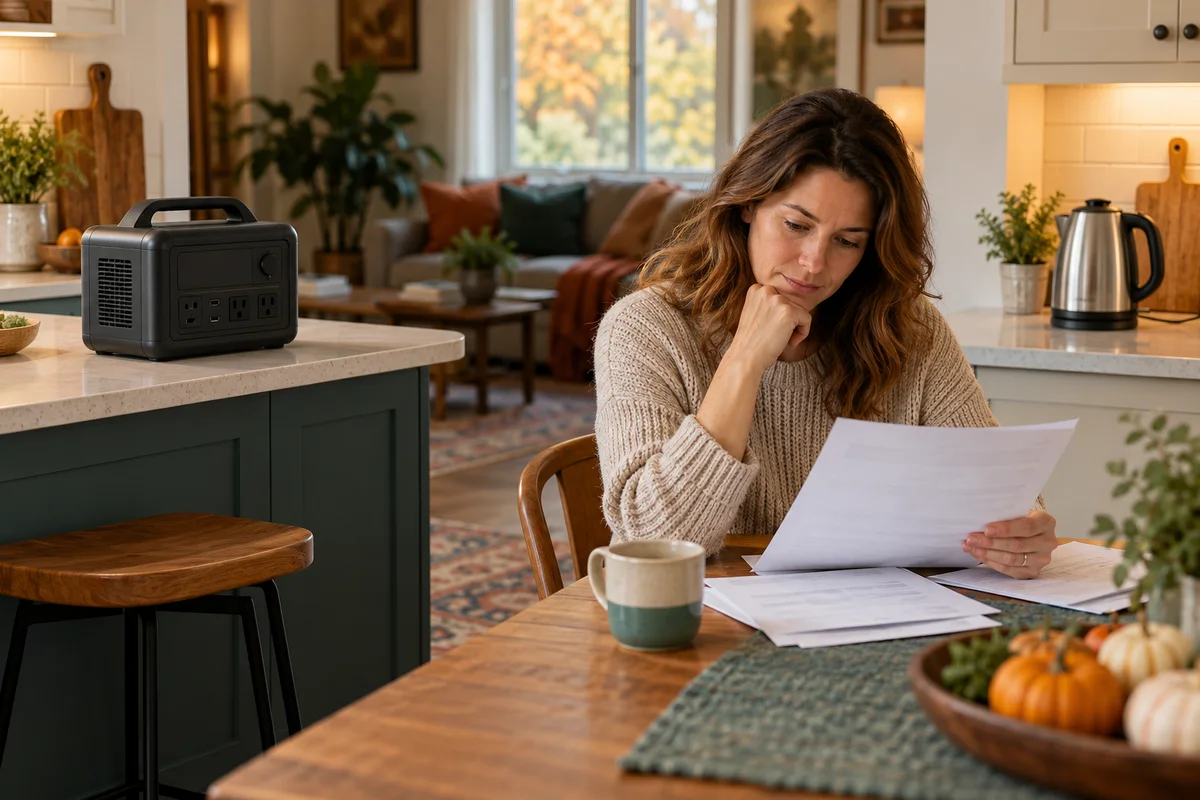
AI-generated scene illustration; not a photograph of the recommended product.
A shopper sees 2,700W beside a compact power station and starts building a list of appliances around that number. The kettle, a pump and a kitchen machine all have wattage labels, so they appear comparable. They are not necessarily comparable loads.
Before buying BLUETTI Elite 100 V2, separate the continuous output rating from the special Power Lifting allowance. That distinction can decide whether the station addresses the household’s task or merely looks suitable in a headline.
The short answer
The current US manual says Elite 100 V2 Power Lifting is for pure resistive loads rated 1,800W–2,700W, while actual output remains 1,800W. It is disabled by default. The feature does not turn the station into a general-purpose 2,700W continuous supply.
Do not use that allowance to qualify a compressor, pump, motor-driven appliance or mixed electronic load. Identify the exact load and obtain applicable manufacturer compatibility guidance. If your task genuinely requires more continuous output, compare equipment with an appropriate continuous rating.
Contents
- The short answer
- Read the three numbers as different questions
- Identify the appliance rather than its everyday name
- Use a go-or-no-go worksheet
- Keep heating time separate from electrical permission
- A winter outlook is a planning cue, not an outage prediction
- Compare the complete alternative
- Frequently asked questions
- Sources and verification
Read the three numbers as different questions
Continuous output answers what the inverter is rated to supply under its stated conditions. A startup or peak allowance concerns a different operating demand. Power Lifting is a restricted feature, not a synonym for either.
Keep those labels next to the numbers in your comparison. Copying only the largest wattage into a shopping spreadsheet removes the condition that makes it meaningful.
The Elite 100 V2 US manual, section 5.3 is more useful for this decision than an unlabeled marketplace headline. Check the manual applicable to your regional version.
Do not infer a specific voltage-adjustment mechanism or exact heating performance from the feature’s name. The verified boundary here is the manufacturer’s restricted load class and retained actual output, not a laboratory explanation of every connected appliance.
Identify the appliance rather than its everyday name
“Kettle” may sound like a simple heating load, but the exact model still matters. An appliance can contain controls, electronics or other components beyond a heating element. A product category is not proof of a pure resistive construction.
Read the appliance documentation and ask its manufacturer about the proposed supply. Avoid opening equipment to identify internal parts. A procurement question should not become an unqualified electrical investigation.
For motor loads, obtain the relevant startup requirement through authoritative documentation. Do not size a pump by applying a heating-load feature to a running-wattage label.
BLUETTI’s well-pump buying guidance itself distinguishes pump startup sizing from Power Lifting’s resistive-load role. That distinction is useful; its broader sales recommendation is not proof that a specific household pump is compatible.
Use a go-or-no-go worksheet
| Question | Why it changes the purchase |
|---|---|
| What exact appliance model is involved? | Similar names can hide different electrical demands |
| What is its required continuous input? | Establishes the ordinary load requirement |
| Does it have startup demand? | Requires a separate supported allowance |
| Is pure-resistive suitability explicitly established? | Determines whether Power Lifting is relevant |
| What else shares the output? | A single compatible device does not qualify a combined setup |
| Which operating arrangement will be used? | Regional instructions and mode conditions remain applicable |
Write “unconfirmed” where evidence is missing. An empty field is a reason to ask a focused question, not a reason to replace it with the highest station rating.
If the manufacturer cannot confirm the arrangement, compare a correctly rated alternative or an appliance with supported lower demand. The shortest path may be changing the load rather than buying more accessories.
Keep heating time separate from electrical permission
A permitted mode does not establish the same task time as ordinary wall power. Do not promise that a high-rated heating appliance completes its job at its nameplate rate when the station’s actual output remains lower.
For a household decision, ask what matters: one acceptable task, a repeated series of tasks or simultaneous service. A station that suits an occasional supported appliance may still be inconvenient for a busy routine.
We have not measured boiling time, appliance behavior or energy consumption. Any real-world trial should follow both manufacturers’ approved operation and return conditions, without deliberate overloads.
Our AC180 space-heater energy guide explains another independent constraint: energy stored in watt-hours. It concerns a different model and does not qualify an Elite 100 V2 load.
A winter outlook is a planning cue, not an outage prediction
NOAA released its 2026–2027 US Winter Outlook on October 15. It describes regional seasonal probabilities, not a forecast that an individual home will lose electricity.
That is a timely reason to review equipment assumptions before a rushed purchase. It is not evidence that a particular station will prevent disruption or that every region faces the same conditions.
Start with the essential task and its documented requirements. Do not turn a seasonal headline into a justification for connecting unqualified heating equipment.
Our Elite 100 V2 UPS guide covers a separate restriction involving sensitive loads. Passing a wattage check does not remove that restriction or make a portable station suitable for life-critical equipment.
Compare the complete alternative
If a larger continuous rating is necessary, compare size, safe placement, energy capacity and charging arrangements alongside output. Buying an oversized unit can introduce handling and storage problems that the original task never needed.
If only one occasional appliance drives the requirement, compare an appropriately supported lower-demand appliance. Do not assume a feature with a larger number is always the cheaper route to the completed task.
Include required approved accessories and current seller terms, but do not count speculative adapters as solutions. Keep compatibility approval ahead of price comparison.
Elite 100 V2 is a candidate when its real output, supported load classes and ownership routine fit. Pass when the purchase depends on treating Power Lifting as unrestricted continuous output. The partner listing is the next check after that decision, not a replacement for it.
Frequently asked questions
Does Power Lifting provide 2,700W of continuous output?
No. The cited US manual retains 1,800W actual output and limits the feature to the specified pure resistive loads.
Can I use the Power Lifting number to size a pump?
No. A pump’s motor and startup requirements need a separate supported assessment.
Is every appliance sold as a heater a pure resistive load?
Do not assume so. Confirm the exact appliance’s construction and permitted supply with its manufacturer.
Does a compatible wattage guarantee enough runtime?
No. Output compatibility and stored-energy duration are separate decisions. Neither was physically tested here.
Sources and verification
Checked October 20, 2026. This is published-specification analysis, not a load, boiling-time or inverter test.
- Elite 100 V2 current US manual: Power Lifting restrictions
- BLUETTI pump guide: startup demand versus resistive-load mode
- NOAA October 15 winter outlook and forecast boundaries
Keep reading
Related guides
 Power & Outdoors
AC180 12V Outlet: Check the Load, Not Just the Plug
Match AC180's regulated 12V car-style output to an appliance's voltage, current and approved cable instead of relying on socket shape.
Read guide → Power & Outdoors
AC180 Wireless Charging: Check the Phone and Case
Check AC180 wireless charging compatibility, phone cases and realistic charging expectations before making the pad part of an outage plan.
Read guide → Power & Outdoors
AC180 Home Backup: Keep Power Out of Wall Outlets
Separate directly powered appliances from household wiring before buying an AC180 for outages; rule out backfeeding and plan the right system.
Read guide →