
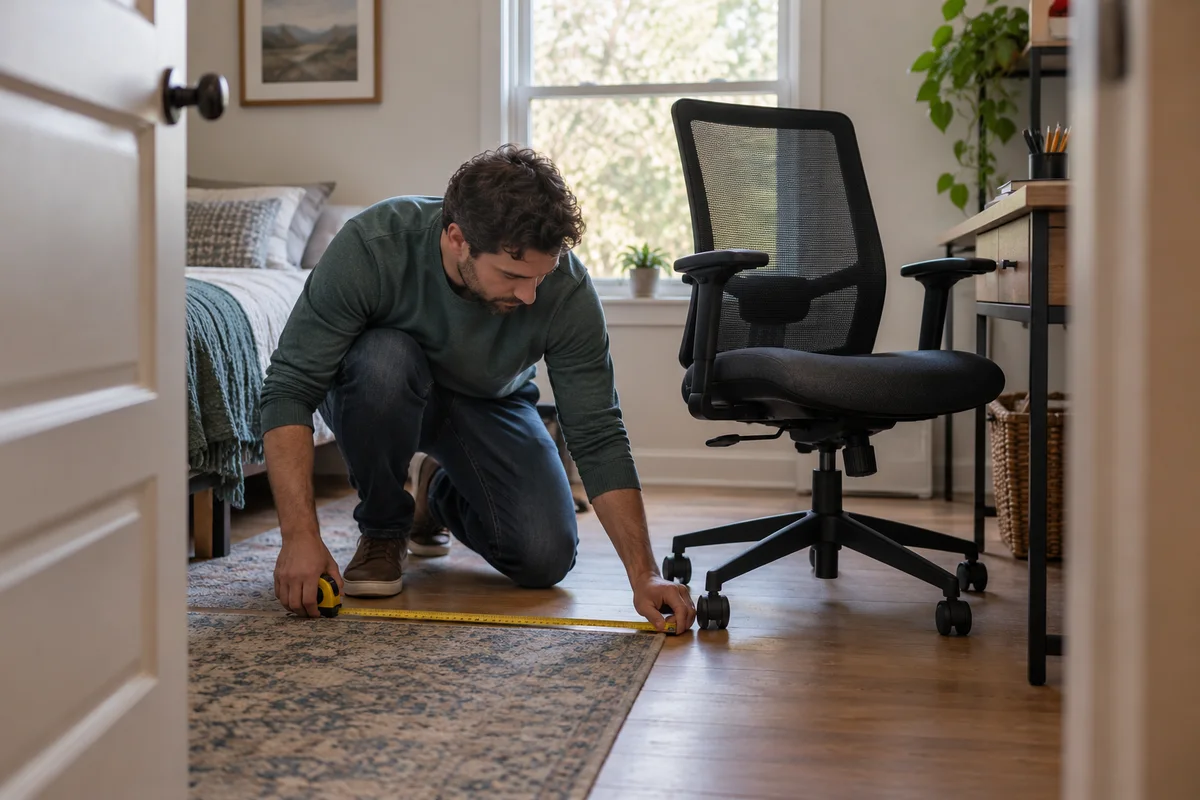
AI-generated scene illustration; not a photograph of the recommended product.
A spare-bedroom desk leaves enough room for an EC300 chair when everything is pushed in. The difficulty appears during ordinary use: the chair must roll back, turn, allow the person to stand and perhaps recline without meeting the bed.
The relevant measurement is not just a chair width or the space in a styled photograph. It is the room used by the supported chair and person across the movements the household actually needs.
The short answer
Assess EC300 in several ordinary states: parked, working, getting in or out, turning and any intended supported recline. Confirm clearly labeled overall dimensions and relevant movement information rather than treating seat dimensions as the room footprint.
Do not calculate a universal wall clearance from a 130-degree recline label. The backrest, seat, base, person and nearby furniture form a larger moving arrangement. If the room cannot support the required movements while keeping the exit clear, choose a smaller suitable setup or a different room arrangement.
Contents
- The short answer
- The room map
- Dimensions with labels
- The working position
- Entry and exit
- Turning and casters
- Recline space
- The state worksheet
- Buying advice
- Frequently asked questions
- Sources and verification
The room map
Sketch the desk, doors, storage openings, bed and household walking route. Record the current arrangement before moving furniture or ordering another chair.
Separate fixed boundaries from things that can legitimately move. A bedside cabinet may be repositionable; a door’s required opening or the route out of the room should not be treated as optional space.
Include the desk itself, not only the room walls. An apron, drawer, pedestal or crossbar can limit the chair’s approach even when the desktop appears wide enough.
This map is a practical shopping aid, not a building-code or accessibility assessment. Obtain appropriate qualified guidance when a household has specific access requirements rather than copying a universal allowance from a furniture article.
Dimensions with labels
Ask for measurements of the exact current EC300 configuration. Identify overall width, base extent and the geometry relevant to the intended movement; do not silently substitute cushion width or arm-pad span.
ProtoArc’s EC300 page lists a sliding seat, adjustable backrest, headrest and four recline lock positions. Those features describe supported adjustments, not one guaranteed room-clearance figure.
Our seat-width guide distinguishes the user’s seated space from the chair’s external dimensions. This article instead examines the room needed during use.
A useful manufacturer question is specific: which overall dimensions apply to the assembled configuration, and what information describes the intended recline position? Leave an unresolved measurement blank rather than scaling it from a promotional photograph.
The working position
Start with the desk task, not the deepest recline. Determine whether a suitable supported seated position can approach the keyboard or other work without the arms or base meeting fixed furniture.
Do not solve a failed approach by leaning forward indefinitely, twisting around an obstruction or removing structural parts. A chair can fit inside a rectangle while still being impractical at the actual desk.
The CCOHS sitting-work overview treats the chair, workstation and task together and emphasizes room for changes in position. It does not certify EC300 or prescribe one footprint for all homes.
Keep this a fit-and-layout decision rather than a health promise. A new chair does not make an unsuitable desk arrangement suitable merely because it has more controls.
Entry and exit
A person needs to get into the chair, roll or reposition appropriately and stand again. Compare that sequence with the normal location of the desk and surrounding furniture.
Consider whether another person opening the room door or using nearby storage would interrupt the sequence. A home office that also serves as a bedroom has several ordinary uses, not one frozen arrangement.
Do not place a tape, loose object or measuring tool where it can interfere with moving parts or create a trip hazard. Make observations safely, and use an appropriate permitted evaluation rather than a stunt in a cramped space.
If the required route cannot remain clear, change the layout or chair category before purchasing. Do not accept a blocked exit because the chair can technically be squeezed under the desk.
Turning and casters
The base, wheels, arm supports and backrest occupy different shapes. Turning the chair changes which part extends toward a bed, cabinet or doorway.
Observe normal supported movement, not a forced spin. Include cables and objects stored under the desk that might catch during an ordinary change of position.
A different caster does not automatically shrink the base, change a fixed arm position or make the room larger. Obtain exact compatibility guidance for any part change; do not modify the base or wedge wheels to force a layout to work.
Similarly, a floor mat has its own boundary and care requirements. Its outline should not be mistaken for the entire movement area of the chair and person.
Recline space
EC300’s published locks include 90, 105, 120 and 130 degrees. Choose only the supported positions relevant to the actual task; owning a deep-recline feature does not require using it in a room that cannot accommodate it.
An angle alone does not give the distance between a wall and the back of the chair. Geometry and the actual supported setup matter, and this guide provides no invented rear-clearance dimension.
Do not recline into a wall, furniture, a cable or a moving door to see whether the chair survives contact. Follow the instructions and obtain an appropriate evaluation opportunity or clear manufacturer information.
If upright work fits safely but a desired resting position does not, record that tradeoff honestly. A separate break location or a different chair can be preferable to paying for a feature the room cannot support.
The state worksheet
| State | What must remain practical |
|---|---|
| Parked | Desk and storage access in normal household use |
| Working | Supported approach to the actual task |
| Entry and exit | Getting in and standing without obstruction |
| Turning | Base, arms, backrest and cables clear |
| Reclined | The intended supported position without collision |
| Shared room | Doors, other furniture and walking route available |
Assess only states the supported arrangement and intended use require. The worksheet is not a license to improvise a new chair position or alter safety-critical hardware.
Our delivery and assembly plan addresses a different stage: getting the carton and parts into the room. Passing that route does not establish that the final working layout passes these states.
Buying advice
Consider EC300 when its supported body fit and required room states both work at the real desk. Its adjustment range can be useful without making it a universally compact chair.
Pass when a critical measurement remains unresolved, a required movement blocks the room or the only solution involves unsupported modification. Keeping a suitable existing chair may be more sensible than buying a larger adjustable model around a photo.
Read the EC300 overview for broader features and confirm the selected seller’s evaluation and return conditions. The partner CTA is for the chair, not a layout service, a room-fit guarantee or an approved aftermarket base. No physical clearance trial was performed here.
Frequently asked questions
Seat equals footprint?
No. Seat dimensions describe one part of the chair, not every external or moving boundary.
A universal gap?
This guide supplies none. Use exact labeled information and the actual supported room arrangement.
Every recline required?
No. Decide which supported positions the household needs and whether the room can accommodate them.
Carton route passed?
Delivery access and working clearance are separate tests. Passing one does not establish the other.
Sources and verification
Checked November 2, 2026. Published chair features and workstation principles only; no chair, room or access-compliance trial.
Keep reading
Related guides
 Home Office
EC300 Trial and Return Planning
Plan an EC300 purchase around the actual seller, permitted assembled-chair trial, return costs and a repeatable fit record before ordering online.
Read guide → Home Office
EC200 Guitar Practice Space
Check EC200 arm clearance, guitar movement and foot support before choosing a single chair for office work and household music practice.
Read guide → Home Office
EC300 Sewing Workspace
Assess EC300 around the sewing machine, fabric, table and foot pedal before choosing one office chair for a mixed home workspace.
Read guide →