
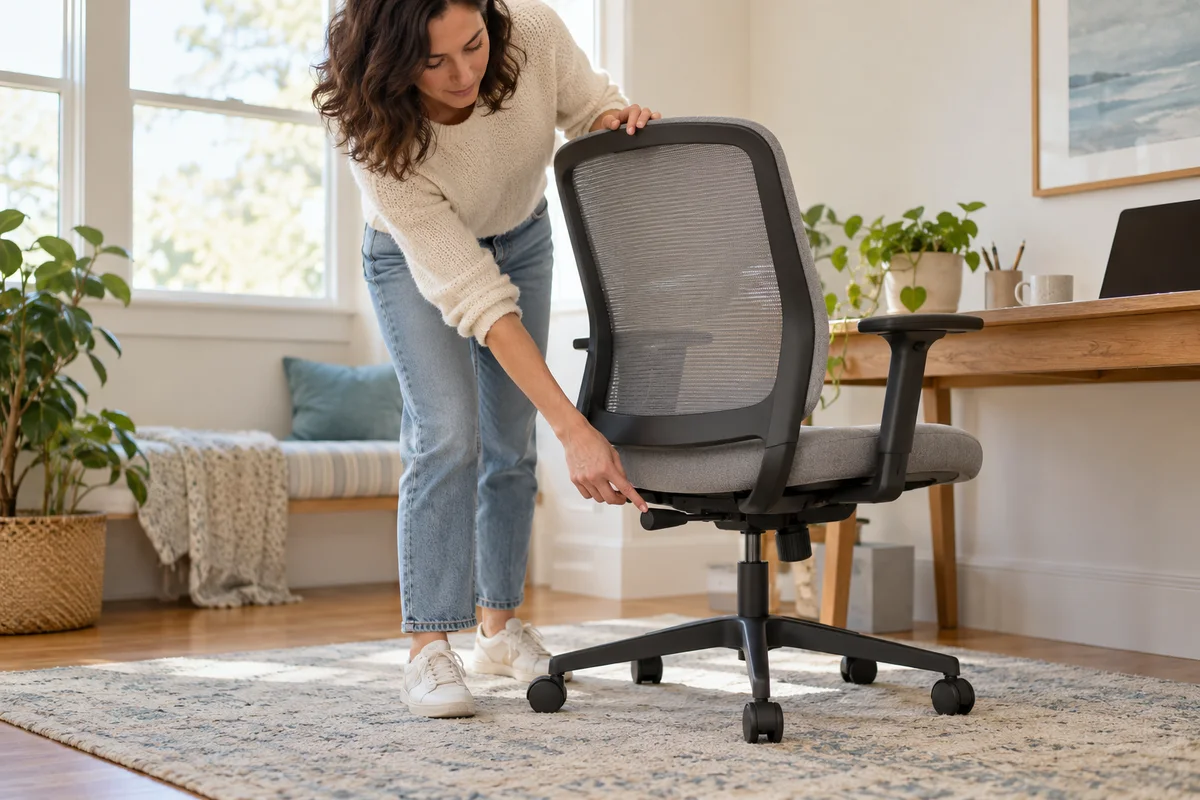
AI-generated scene illustration; not a photograph of the recommended product.
The EC300 is assembled, the desk is ready, and the seat does not rise when its owner pulls a control. It is easy to conclude that the gas lift has failed, especially when several adjustments sit beneath the same cushion.
Before ordering a replacement cylinder or another chair, separate control identification, the normal adjustment method and a possible fault. The mechanism that changes seat depth is not the same task as changing sitting height.
The short answer
ProtoArc’s EC300 FAQ places the height adjustment at the rear underside of the seat. Its normal method distinguishes lowering while seated from raising with weight removed. Follow the supplied model instructions, identify the correct control and do not force it.
If the seat still will not adjust normally, contact ProtoArc support. A cylinder purchase, structural modification or improvised height conversion should not be the first response. Stop using a chair that behaves unpredictably or will not support a stable position.
Contents
- The short answer
- Name the movement before touching the control
- Use the documented loaded and unloaded distinction
- Separate a control issue from a support request
- Record the actual symptom
- Keep correct operation separate from personal fit
- Plan support before buying replacement parts
- Make a pre-purchase control check
- Buying advice
- Frequently asked questions
- Sources and verification
Name the movement before touching the control
There are several different observations an owner might describe as “the seat will not move.” It might not slide forward, the backrest might remain locked, or the whole sitting surface might stay at the same height.
Describe the movement relative to the floor. Height adjustment changes the sitting level. Seat-depth adjustment changes the cushion’s fore-and-aft position. Reclining changes a different part of the seated arrangement.
Our EC300 seat-depth guide handles the front slide control. Read it only if that is the motion in question. Repeatedly operating an unrelated lever adds confusion without testing the height mechanism.
Use the documented loaded and unloaded distinction
The official FAQ’s raising and lowering instructions require different weight conditions. Follow them gently in a stable ordinary setup, with the chair clear of nearby obstacles and the user able to stand safely.
Do not bounce on the seat, pull with excessive force or ask another person to push down on the mechanism. None of those actions is established here as a supported adjustment method.
A nonmoving seat under an inappropriate adjustment condition is not sufficient evidence of a defective cylinder. Equally, correctly identifying the control does not prove the mechanism is healthy. The outcome still needs to be observed normally.
Separate a control issue from a support request
If the permitted method does not produce normal movement, stop repeating the attempt and make a concise record. Include whether the seat would not rise, would not lower, or changed position unexpectedly.
Do not remove load-bearing components to investigate a theory. This article does not provide gas-lift repair, valve manipulation or disassembly instructions. A pressurized structural component should not become a household experiment.
ProtoArc’s FAQ identifies possible control engagement and gas-lift issues, then directs unresolved cases to support. That list helps frame the question; it is not a diagnosis of the particular chair in your room.
Record the actual symptom
| Observation | Useful note | Avoid assuming |
|---|---|---|
| No rise | Correct control identified; permitted unloaded method attempted | Cylinder is definitely broken |
| No lowering | Correct control and normal seated method checked | More force is necessary |
| Unexpected sinking | When and under what ordinary conditions it occurs | Repeated adjustment will make it safe |
| Different movement | Slide or recline moves instead | All controls perform the same task |
| Unclear instructions | Exact model and manual revision | Another chair’s video applies |
Add the seller, order or delivery evidence, and a brief description of assembly status. Send only the information support needs through its legitimate channel.
A short video may be useful if requested, but do not recreate an unstable event to obtain footage. Describe an unsafe symptom instead of deliberately repeating it.
Keep correct operation separate from personal fit
A height mechanism can work correctly while the available sitting range is still unsuitable for the user or work surface. That is a fit problem, not evidence that the lever needs further adjustment.
Check the actual seat surface, foot support, desk underside and reach to the work. A tall headrest or a large overall chair-height number does not establish the height at which someone sits.
For a genuinely high fixed surface, our EC200 high-desk guide explains the category distinction. It is not an EC300 compatibility certificate, but its warning against improvised height conversion remains a useful separate purchasing principle.
Plan support before buying replacement parts
A part that appears to fit is not automatically approved for the complete chair. Ask the manufacturer to identify the exact supported replacement and whether the original purchase has an applicable service route.
Keep service logistics separate from the price of a component. Returning a whole chair, obtaining a part and booking a repair can have different requirements. Do not dismantle the chair merely to make a return box smaller before obtaining instructions.
The EC300 hardware guide concerns identified hardware, not permission to substitute a gas lift. Different structural parts require their own exact approval.
Make a pre-purchase control check
Someone who has not yet bought EC300 can use this support information constructively. Confirm that instructions for the model are available, the controls are identifiable, and the seller’s assessment and service conditions are understood.
Do not ask a sales agent to promise that the chair fits every desk or body. Ask instead how the supported range is measured and what happens if the normal height mechanism fails.
When ordinary movement is hard for the intended user, compare other supported chair designs or obtain appropriate assistance. More adjustment features do not automatically produce a simpler everyday routine.
Buying advice
Consider EC300 if its verified range suits the workstation, the intended user can operate the documented controls and there is a credible support route. These conditions matter more than the sheer number of adjustment labels.
Pass if the purchase only makes sense after an unapproved cylinder change, a platform beneath the base or another improvised conversion. Choose furniture designed for the actual working height rather than converting a chair outside its supported configuration.
If you already own the chair, a precise support conversation is usually the next information-gathering step before another purchase. We have not inspected your mechanism and do not diagnose a fault from the symptom alone.
Frequently asked questions
Is the front seat-depth control the height control?
Do not treat them as interchangeable. Use the EC300 instructions to identify the rear height control separately.
Should I remain seated when trying to raise the chair?
ProtoArc’s normal raising method removes weight from the cushion. Follow the exact supplied instructions and maintain a stable position.
Can I fix a nonmoving seat by forcing the lever?
No force-based repair is recommended here. If the supported method fails, stop and ask support.
Does a correctly working gas lift prove the chair fits my desk?
No. Correct operation and suitable working-height geometry are separate checks.
Sources and verification
Checked October 23, 2026. No chair inspection, gas-lift repair or personal ergonomic assessment was performed.
- ProtoArc EC300 FAQ: height adjustment and troubleshooting
- ProtoArc EC300 product information: model and adjustment context
Keep reading
Related guides
 Home Office
EC300 Headrest: Check Movement and Locking Separately
Separate EC300 headrest movement, retained position and locked-state support resources before treating adjustment count as proof of personal fit.
Read guide → Home Office
EC300 Seat Depth: Check the Slide Before Buying
Identify the EC300 front seat-depth control, verify its supported slide and retained position, then separate mechanism operation from personal fit.
Read guide → Home Office
EC300 Replacement Screws: Match the Location and Thread
Identify EC300 replacement hardware by manual location and exact part callout rather than choosing chair screws by appearance.
Read guide →