

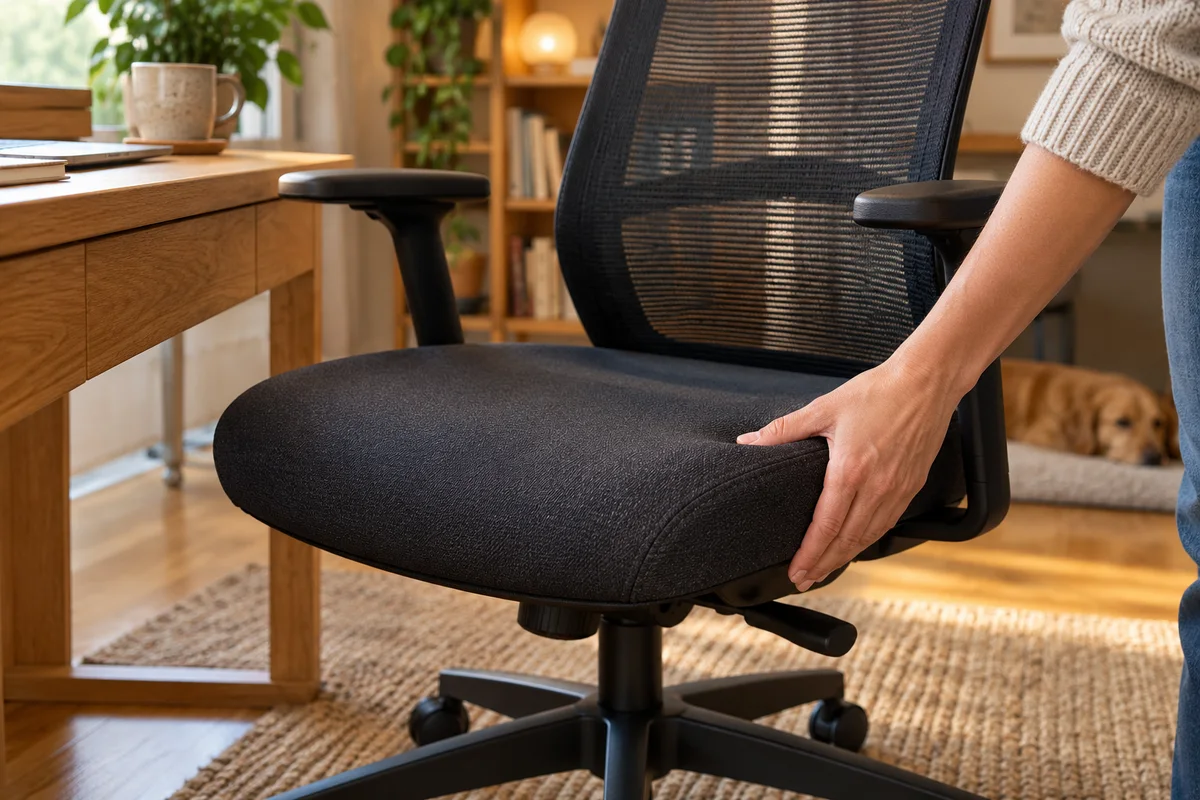
AI-generated scene illustration; not a photograph of the recommended product.
The only available home workspace is a tall fixed counter. A conventional adjustable office chair seems like a tidy solution: roll it underneath, raise the seat, and call it a desk.
The important question is not whether ProtoArc EC200 has height adjustment. It is whether its supported adjustment range can create a usable seated workstation at that particular surface. A standing-height picture does not prove that every high counter becomes a suitable seated desk.
The short answer
Do not buy EC200 for a fixed high work surface without comparing the exact chair’s supported seat-height range with your actual seated working position. An ordinary office chair and a purpose-designed drafting-height chair are different categories.
A footrest can support feet in an otherwise appropriate setup; it cannot raise a chair that is too low to reach the work comfortably. Do not modify the gas lift or add a homemade platform as a shortcut.
Contents
- The short answer
- Measure the task surface rather than its label
- Compare real seated working height
- Distinguish feet support from desk reach
- Make a high-surface qualification card
- Compare changing the surface with changing the chair
- Reject improvised height conversions
- Check movement as well as the stationary pose
- Decide whether EC200 belongs on this shortlist
- Frequently asked questions
- Sources and verification
Measure the task surface rather than its label
A “standing desk” may be height adjustable and able to lower for seated work. A kitchen counter, drafting bench, or fixed bar-height table may not lower at all. Those are different constraints even if photographs look similar.
Measure the surface you will actually use, including the available space beneath it. A drawer or thick apron can reduce clearance despite an apparently generous overall height.
Then identify the input task. Typing at a keyboard, sketching on a surface, and inspecting an object can have different practical reach requirements. Do not choose a chair from the counter’s decorative name alone.
Compare real seated working height
Use the current exact regional EC200 dimension drawing and obtain a clarification from ProtoArc if its measurement basis is unclear. Seat measurements can be presented differently across listings; do not combine numbers from another model or an informal review.
Record whether a published figure refers to the seat surface, a component adjustment, or overall chair height. The tall headrest does not tell you how high you will sit.
Our EC200 review introduces the model. This article intentionally avoids assigning one universal height number to every regional listing and user.
Distinguish feet support from desk reach
Consider two different mismatches.
In the first, a correctly supported chair position brings the hands to the work, but the feet need suitable support. A stable, appropriately selected footrest may address that particular issue.
In the second, even the highest permitted seat position leaves the work too high. A footrest does not change the seat-to-surface relationship. Raising the feet while the shoulders still reach upward does not solve the missing chair height.
OSHA’s workstation guidance addresses chair adjustment and support as parts of the complete arrangement. Use that framework to identify the mismatch rather than treating every high-desk problem as a footrest purchase.
Make a high-surface qualification card
| Check | What to record |
|---|---|
| Surface | Fixed or genuinely adjustable, with actual usable height |
| Clearance | Underside obstacles, knee and leg space |
| Chair | Exact model, regional range, measurement definition |
| Work position | Whether the actual input task is reachable |
| Feet | Supported without unstable improvisation |
| Access | Safe sitting down, standing up, and movement around the base |
| Seller | Availability and permitted assessment or return conditions |
Do this before ordering accessories. If the main geometry fails, a headrest, nicer cushion, or upgraded casters will not correct it.
The shared-chair guide covers restoring settings between users. Here the initial question is more fundamental: can this category of chair serve the work surface at all?
Compare changing the surface with changing the chair
If a height-adjustable desk can lower sufficiently for an appropriate seated arrangement, a conventional office chair may be a sensible candidate. Confirm the complete setup rather than assuming every standing desk has the same lower limit.
If a fixed counter is essential, investigate a chair explicitly designed and supported for the required working height. Check its foot support, access, stability instructions, and fit rather than merely searching for a taller cylinder.
Another option is a separate ordinary-height work surface. It may solve the actual task with less complexity than trying to convert an unsuitable counter into an all-day desk. Compare the available space and real use, not just the furniture style.
Reject improvised height conversions
Do not stack cushions, place a rolling chair on a platform, replace structural parts with an unapproved conversion, or use a foot ring intended for another chair.
A component that physically fits is not evidence that the complete modified chair remains supported by the manufacturer. If a conversion is claimed, obtain exact written approval for the model and complete arrangement.
This guide does not provide modification or repair instructions. An unresolved height mismatch is a reason to choose a supported configuration, not a challenge to overcome with a taller-looking component.
Check movement as well as the stationary pose
A photo can show someone in a plausible position while hiding how they got there. Include sitting down, standing up, moving close to the surface, and keeping the base clear of traffic.
Do not use chair arms as climbing aids or allow the chair to roll while trying to reach an unsuitable surface. Follow the chair’s instructions for ordinary use.
The EC200 floor and caster guide addresses a separate rolling-surface decision. Appropriate casters do not change the chair’s supported working-height category, but an unsuitable floor can add another problem to an already awkward setup.
Decide whether EC200 belongs on this shortlist
Consider EC200 when the actual surface can work with its documented adjustment range, you fit its current supported user limits, and the complete workstation passes your assessment.
Do not select it for a fixed high counter merely because the product page shows a height-adjustable desk. That image establishes neither your counter dimensions nor your individual seated reach.
The official EC200 page displayed sold-out status during this check. Confirm the selected partner offer independently; manufacturer-store availability does not determine every retailer’s stock. Do not plan an urgent workspace change around an assumed shipment.
Frequently asked questions
Does a standing-desk photograph prove high-counter compatibility?
No. A height-adjustable desk can lower; your fixed counter may not. Compare actual dimensions and the task.
Will a footrest fix a seat that cannot rise high enough?
No. It supports the feet but does not increase the supported seat height or lower the work surface.
Can I buy a taller gas lift to convert EC200?
Do not make an unsupported structural modification. Ask the manufacturer about exact-model approval or choose an appropriate chair category.
Is the tallest published chair measurement the seat height?
Not necessarily. Confirm what the figure measures and whether it applies to your exact regional version.
Sources and verification
Checked October 18, 2026. This is a workstation purchase framework, not an individual ergonomic assessment or a chair trial.
- ProtoArc EC200 current model information and dimension drawing
- ProtoArc EC200 adjustment FAQ
- OSHA workstation chair guidance
Keep reading
Related guides
 Home Office
EC300 Materials: A Mesh Back Is Not an All-Mesh Seat
Distinguish EC300 mesh backrest from its foam cushion and compare the actual sitting surface before choosing chair materials.
Read guide → Home Office
EC300 Chair Certifications: Ask What the Claim Covers
Read chair certification language by model, standard, component, and test scope without confusing it with a personal comfort guarantee.
Read guide →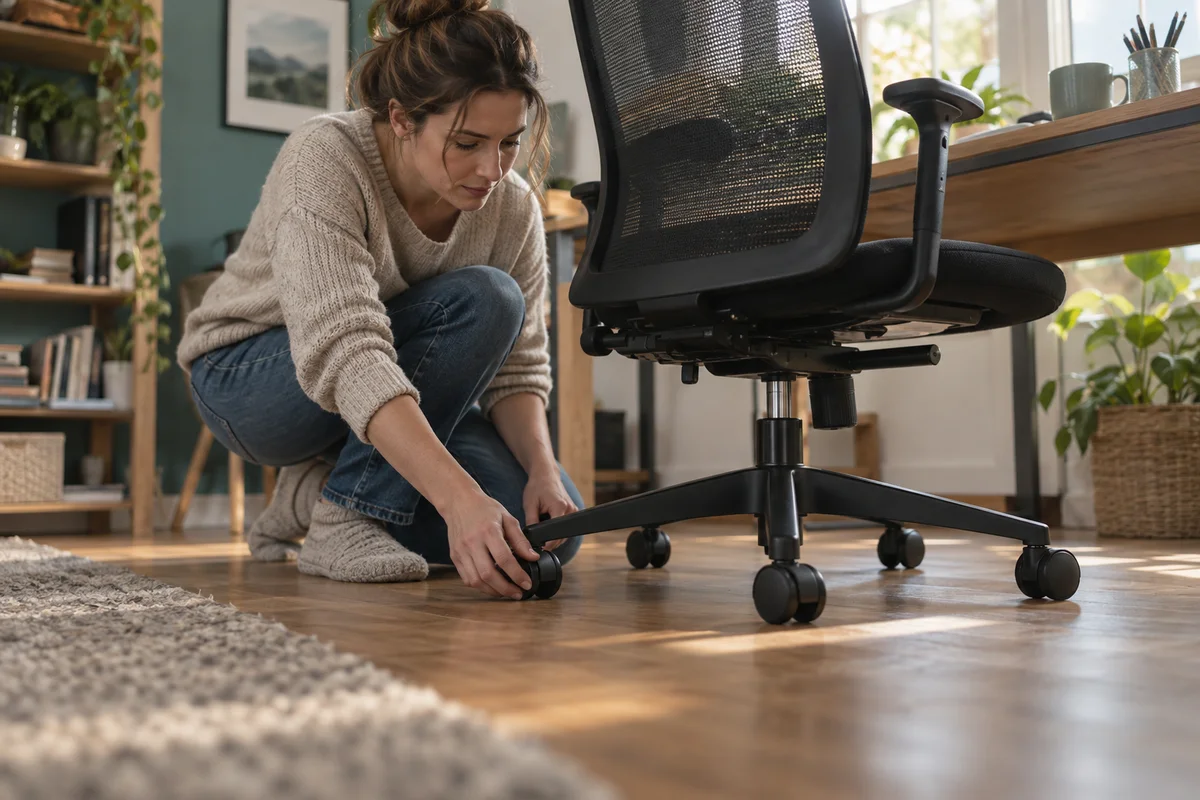 Home Office
EC200 Chair Casters: Check the Floor Before Upgrading
Assess the real rolling surface, upgrade package, and changed seat height before choosing EC200 casters or a chair mat.
Read guide →