
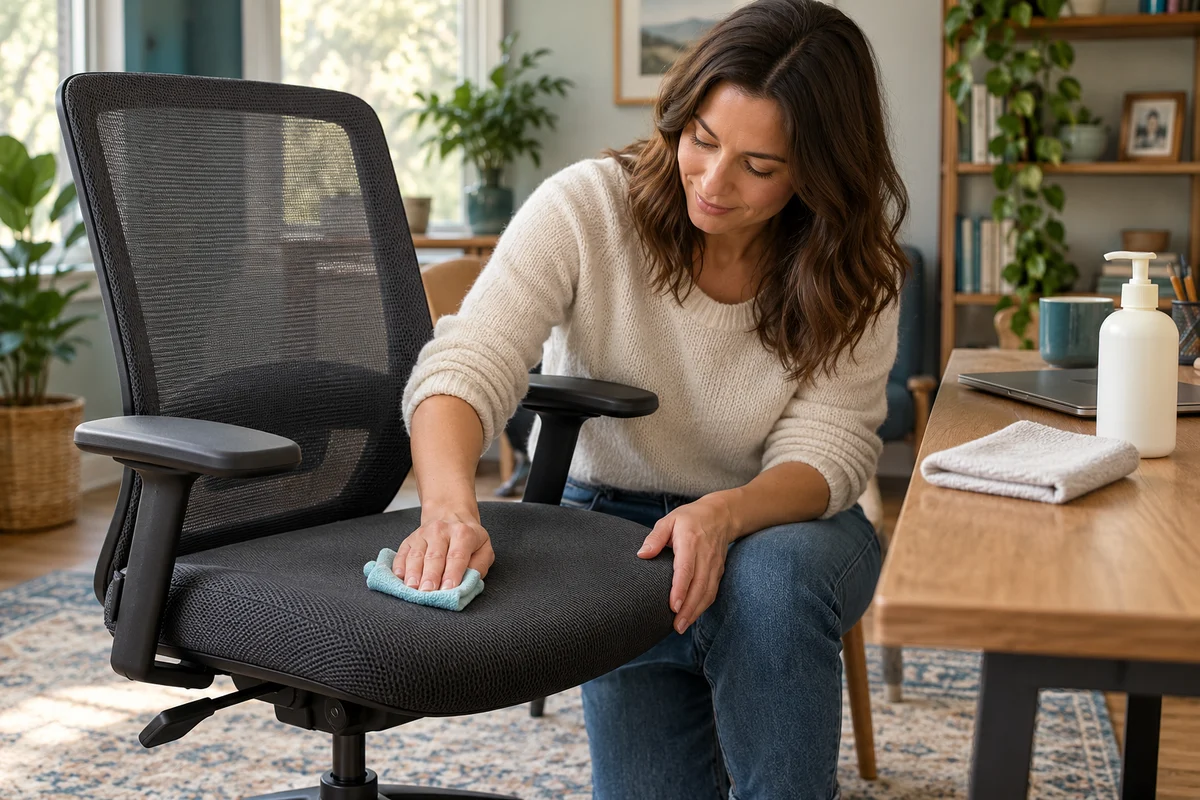
AI-generated scene illustration; not a photograph of the recommended product.
A desk chair doubles as a breakfast seat, a shared work chair, and the place where the household cat sleeps during the afternoon. The shopper likes breathable mesh, but the eventual ownership question is how ordinary dust and small marks will be handled.
Before choosing ProtoArc EC200, compare its published care limits with that real routine. “Easy to clean” should describe a supported process, not an assumption that every fabric surface can be removed, machine-washed, steamed, or saturated.
The short answer
ProtoArc’s EC-series care FAQ says to vacuum mesh regularly and use a damp cloth with mild soap for stains, while avoiding submersion and harsh chemicals. Treat that as general series guidance and confirm any model-specific uncertainty with ProtoArc.
Do not infer that an EC200 cover is removable, machine-washable, disinfectable by a particular product, or suitable for steam cleaning. This guide is about a care-compatible purchase, not a stain-removal test or a hygiene certification.
Contents
- The short answer
- Material and method
- The ordinary home routine
- Gentle care boundaries
- Separate care from repair
- A care-fit purchase card
- Alternatives and tradeoffs
- Buying advice
- Frequently asked questions
- Sources and verification
Material and method
A material description and a cleaning instruction answer different questions. Mesh, fabric, foam, plastic, and metal can appear within a chair, but naming one material does not approve one treatment for the complete assembly.
The EC-series care FAQ supplies the limited cleaning methods above. Its wider collection page includes claims spanning several models; do not transfer every size, assembly, warranty, or material claim to the exact EC200 offer.
Use the EC200 product information and supplied instructions to identify the actual version and surfaces. If a collection description and exact-model document disagree, ask ProtoArc before treating the chair.
Our EC200 and EC200 Pro material guide explains why nearby model names should not be merged. Cleaning decisions need the same discipline: a method described for a different cushion is not automatically applicable.
The ordinary home routine
List what the chair is likely to encounter. Dry household dust, crumbs, pet hair, and a small drink mark present different care questions. The list is not permission for a particular pickup tool, chemical, or amount of water.
Consider whether meals can move to another surface and whether the chair can remain clear while a permitted cleaning process is completed. Changing one household habit may be more useful than buying a supposedly stain-proof chair.
For a shared workspace, decide who handles ordinary care and where the instructions are kept. An undefined responsibility can turn small maintenance into repeated aggressive cleaning attempts by different people.
Do not claim that a routine makes the chair sterile, allergen-free, or clinically safe. No cleaning efficacy or health outcome was tested here. A visibly clean surface and an approved disinfection process are different statements.
Gentle care boundaries
Follow the exact product instructions and use only the supported process for the relevant surface. A damp cloth is not an invitation to soak a cushion or spray liquid into a mechanism.
Do not assume that a detachable-looking component should be removed for cleaning. A visible seam, zipper, or fastener does not establish a removable washable cover. Obtain an explicit answer when the actual instructions are unclear.
Avoid escalating from a small mark to stronger treatment without approval. Harsh chemicals and submersion are excluded by the cited series guidance. Steam, upholstery extraction, or an arbitrary solvent should not be invented as the next step.
If a stain or contamination issue is beyond ordinary approved care, ask the manufacturer for a model-specific response. The answer may involve professional advice or a different suitable product. Do not turn an unresolved cleaning problem into a do-it-yourself disassembly project.
Separate care from repair
A squeak, loose control, or damaged surface is not necessarily a dirt problem. Cleaning instructions do not authorize lubricant choices, mechanism repairs, or structural adjustments.
The EC200 operating FAQ treats adjustment and troubleshooting as their own topics. A general damp-cloth recommendation should not be applied inside a control assembly.
Likewise, a torn mesh area should not be concealed by an improvised repair merely to keep a chair usable. Stop using an arrangement that is no longer supported and obtain the appropriate service guidance.
Keep actual observations with the support request: exact model, affected surface, what happened, and which approved care method was used. Do not describe an uncertain cause as a confirmed manufacturing defect or promise a warranty remedy.
A care-fit purchase card
Use five fields before checkout: exact surfaces, ordinary household exposure, approved routine, unsupported methods, and the support route for an unresolved mark. Add seller evaluation and return conditions separately.
Ask a precise question when a requirement matters: “For this exact EC200 version, is this surface removable and is this specific cleaning method approved?” A reply that merely says easy maintenance does not answer either question.
If a permitted assessment is available, check whether the routine is manageable for the intended user. Reach, handling, clear workspace, and the ability to follow instructions matter alongside the chair’s appearance.
CCOHS’s chair-selection guidance includes maintenance and repair costs among the considerations. That does not endorse EC200; it supports treating ownership care as part of selecting a chair rather than an afterthought.
Alternatives and tradeoffs
A chair with a different documented surface-care process may suit a household whose work routinely involves spills or contamination. Confirm the exact process instead of assuming that another material name guarantees easy cleaning.
A separate eating area or a policy against messy tasks at the desk may allow an otherwise suitable chair to work without unsupported treatment. Compare the real habit change with the cost and limitations of another chair.
A protective cover is not automatically a supported solution either. It can change fit, movement, and access to controls. Do not add one without checking the complete arrangement and the manufacturer’s guidance.
For an office requiring an established sanitation procedure, obtain professional procurement advice and written product suitability. A household spot-cleaning FAQ is not a substitute for the requirements of that environment.
Buying advice
Consider EC200 when its individual fit, supported adjustments, and documented care process match the ordinary home-office routine. Mesh appearance alone is not enough to decide whether maintenance will be manageable.
Pass if the purchase depends on unconfirmed machine washing, aggressive chemicals, removable upholstery, or a guaranteed hygienic outcome. Those are separate requirements that need actual evidence before payment.
For an existing owner, use supported care and obtain a specific answer before replacing the whole chair over an ordinary mark. Conversely, do not keep using a damaged or unsuitable arrangement merely because the exterior can be made to look cleaner.
The partner link below concerns the EC200 chair package, not a cleaning product or service. Verify current model identity, seller conditions, and the applicable instructions independently. No stain-removal performance or long-term material durability is claimed.
Frequently asked questions
Does mesh mean machine-washable?
No. Material appearance does not establish a removable or machine-washable assembly. Check exact-model instructions.
Can I submerge a cushion to clean it?
The cited series guidance says to avoid submersion. Do not infer a different procedure from an online cleaning tip.
Is the general FAQ a disinfection certificate?
No. It describes ordinary care methods, not a validated sanitation or medical outcome.
Should I use stronger chemicals for a stubborn mark?
Not without model-specific approval. Contact ProtoArc about the actual surface and problem rather than escalating an unsupported treatment.
Sources and verification
Checked October 29, 2026. This guide distinguishes general series care advice from exact-model approval. No cleaning, stain-removal, durability, or hygiene test was performed.
- ProtoArc EC-series cleaning FAQ
- ProtoArc EC200 model and material information
- CCOHS chair selection and maintenance considerations
Keep reading
Related guides
 Home Office
EC200 Recline Resistance
Separate EC200 reclining resistance from the angle lock, then check control reach and workstation fit before choosing a chair for recline breaks.
Read guide → Home Office
EC300 Seat Width
Separate EC300 cushion width, fixed-arm clearance and overall chair width before assuming a listing dimension guarantees comfortable seated space.
Read guide → Home Office
EC200 Headrest Reset: Move Forward Before Backward
Read the EC200 headrest's forward-release sequence before forcing it backward, then check whether its supported position fits your actual work.
Read guide →