
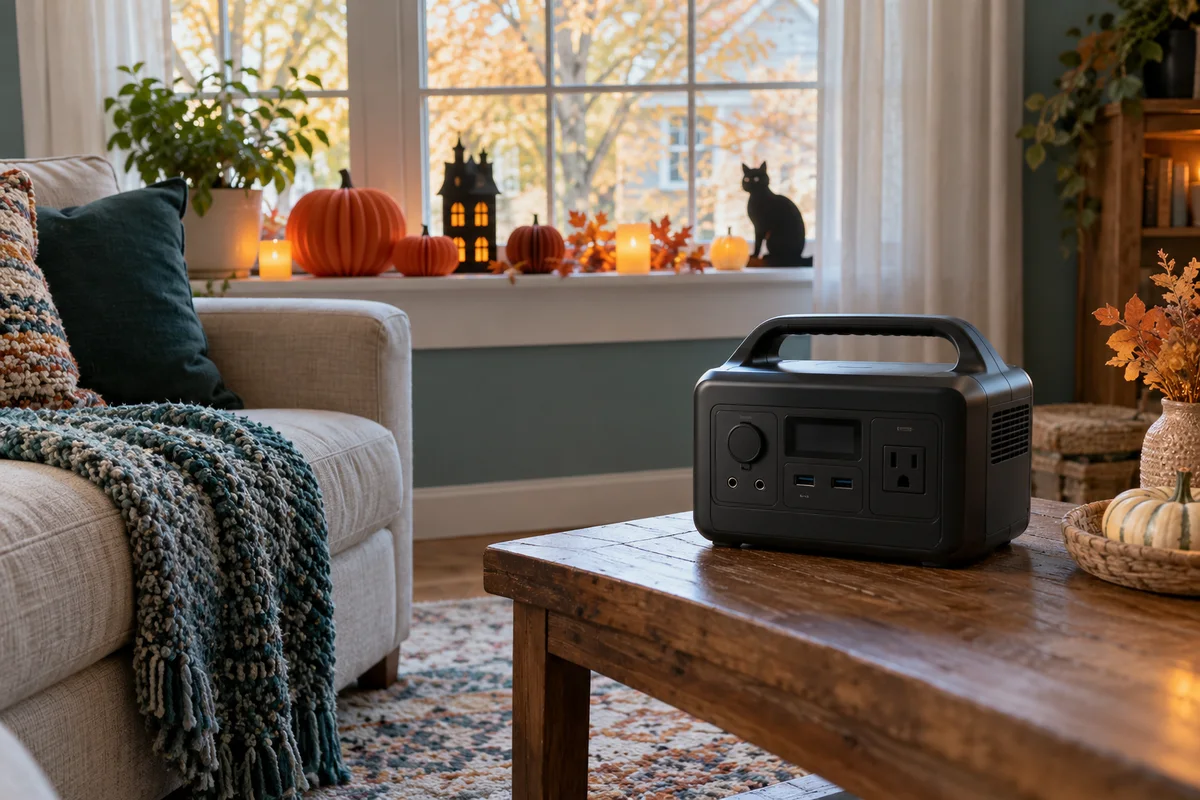
AI-generated scene illustration; not a photograph of the recommended product.
The Halloween window display is nearly ready, but its nearest outlet sits behind furniture and the power cable would cross the route to the door. A portable power station can look like a quick answer. Before adding BLUETTI AC180 to the shopping cart, decide whether the display actually needs it and whether the intended location is permitted.
This week’s seasonal reason to check is real: PPL Electric published a Halloween electrical-safety reminder on October 23, 2026. That does not mean AC180 is a necessary holiday purchase or an approved outdoor decoration supply.
The short answer
Keep this plan indoors. The US AC180 manual includes an indoor-only warning and prohibits rain exposure. A covered porch, improvised box, or clear forecast does not establish approved outdoor use.
For a small seasonal display, independent battery-operated lights may avoid both a large station and a cross-room power lead. AC180 is worth comparing only when the actual supported indoor loads, placement, ownership needs, and delivery timing justify it.
Contents
- The short answer
- The seasonal task
- Indoor placement
- The load card
- Closing time
- Buying advice
- Frequently asked questions
- Sources and verification
The seasonal task
PPL’s October 23 safety reminder calls for checking decorations and cords, using equipment appropriate to its location, avoiding overloaded supplies, keeping walking routes clear, and powering decorations down when leaving or going to bed.
Those are general electrical-safety prompts, not an endorsement of AC180 or a complete installation plan. The practical purchase question is whether another power source removes a problem or simply moves it.
Start with a simple indoor scene: a few illuminated decorations in a living-room window, away from the entrance path. List what actually needs power. Paper decorations need none, and suitably designed battery lights may meet the entire requirement.
Do not start by choosing the largest display and then looking for a power source to justify it. A smaller arrangement can be easier to supervise, store, and switch off. That can be a better seasonal purchase decision than adding a heavy battery for one evening.
No search-volume surge or sales trend is claimed here. This is a dated safety reminder connected to a foreseeable household task.
Indoor placement
Use the AC180 US manual rather than assuming portability means weather resistance. Its operating and storage instructions require appropriate ventilation and a clean, dry environment, with children and pets kept away.
Do not hide a working station under fabric, inside a decorative crate, or beneath paper props to make the display look tidier. Visual integration is not a reason to obstruct ventilation or place combustible decorations against equipment.
A closed window display and an outdoor yard display are separate projects. This article does not recommend placing AC180 outdoors or routing an improvised supply through a window or doorway. If the arrangement requires an unsupported setup, change the arrangement.
Consider the full walking route, including the ordinary route when people are carrying coats, groceries, or a bowl of treats. Moving the battery away from one doorway while leaving a lead across another is not an improvement.
Our AC180 placement guide covers a different preparation task. For this seasonal display, the additional decisions are decoration materials, visitor routes, supervision, and the end-of-evening shutdown.
The load card
For supported indoor electrical decorations, record each exact device, its electrical input requirement, planned operating time, and connection arrangement. Confirm the equipment instructions rather than estimating from how bright the decoration appears.
Add concurrent loads. AC180’s rated AC output is a shared total, not an allowance repeated for each socket. Do not infer permission to overload a power strip because the station has unused outlets.
Keep power and energy separate. Watts describe demand; watt-hours describe energy over time. A hypothetical 20W display used for four hours would require 80Wh at the loads under a constant-demand assumption. That arithmetic is not a measured AC180 runtime and excludes station losses and other operating conditions.
A small demand may also require checking the station’s applicable automatic shutdown settings. Do not assume that a large battery guarantees uninterrupted operation of every low-power decoration. Consult the exact manual and verify an ordinary supported setup before relying on it.
Compare the resulting task with self-contained battery lights. If those meet the need without adapters, cables, and another device to recharge, the simpler option may win even though the station has greater capacity.
Closing time
Decide who will turn the display off before it is switched on. A timed or connected feature should not be assumed to replace the owner’s responsibility to follow every relevant instruction.
PPL’s reminder includes turning off and unplugging decorations before bed or leaving. Keep that end point visible in the household plan rather than treating shutdown as an optional energy-saving refinement.
After use, let equipment be handled and stored according to its instructions. Do not pack a power station into a sealed decorations box as though it were an inert ornament. Battery storage and seasonal decoration storage have different requirements.
Label the ordinary storage locations for the display components and retain their instructions. The useful record is which equipment belongs together and which must remain separate, not a promise to recreate the same wiring next year without inspection.
If anything is damaged or behaves abnormally, stop the display and use appropriate support. Do not attempt a temporary cord repair or continue because guests are about to arrive.
Buying advice
For an existing AC180 owner, the decision is whether a supported indoor arrangement genuinely makes the display simpler. It is not necessary to buy more equipment merely because the station is available.
For a new buyer, assess broader legitimate uses before purchasing a large station for a small holiday task. Compare self-contained lights, a simpler display, and a suitable existing supply arrangement without improvising electrical work.
Timing also matters. On October 28, the BLUETTI US AC180 product page says the station is out of stock with an expected late-November restock. That is the manufacturer’s store statement, not a delivery guarantee and not evidence of Amazon inventory.
Do not buy on the assumption that a partner offer will arrive before Halloween. Verify the actual seller, stock statement, delivery estimate, cancellation conditions, and return terms at checkout. If the deadline cannot be met, choose a plan that works without the station.
The AC180 overview provides broader context. The commercial link here remains an optional hardware listing, not a recommendation for outdoor decorations or an urgent seasonal purchase.
Frequently asked questions
A covered porch?
This guide does not establish approved outdoor use. The US manual’s indoor-only warning still matters.
A waterproof box?
Do not improvise an enclosure around operating equipment. It does not establish approved use and may obstruct ventilation.
Small lights?
Independent battery lights can be a simpler choice when they meet the actual display need.
Halloween delivery?
No delivery is promised. Manufacturer-store availability and a marketplace seller’s offer must be checked separately.
Sources and verification
Checked October 28, 2026. Seasonal planning based on published guidance; no display or runtime was tested.
- PPL Electric Halloween safety reminder, October 23, 2026
- BLUETTI AC180 US manual
- BLUETTI AC180 current store information
Keep reading
Related guides
 Power & Outdoors
AC180 Microwave Input Power
Compare microwave electrical consumption with cooking output before sizing AC180 power, concurrent loads and a short meal-preparation energy budget.
Read guide → Power & Outdoors
AC180 USB-A Ports: Budget the Shared Pairs
Read the AC180 USB-A channel limits before planning several phone charges, and compare a supported charger with buying a larger battery.
Read guide → Power & Outdoors
Elite 100 V2 DC Ports: Add the Shared Current
Check Elite 100 V2 barrel-port and car-outlet shared limits before connecting several 12V devices or buying extra splitters for an outage kit.
Read guide →