
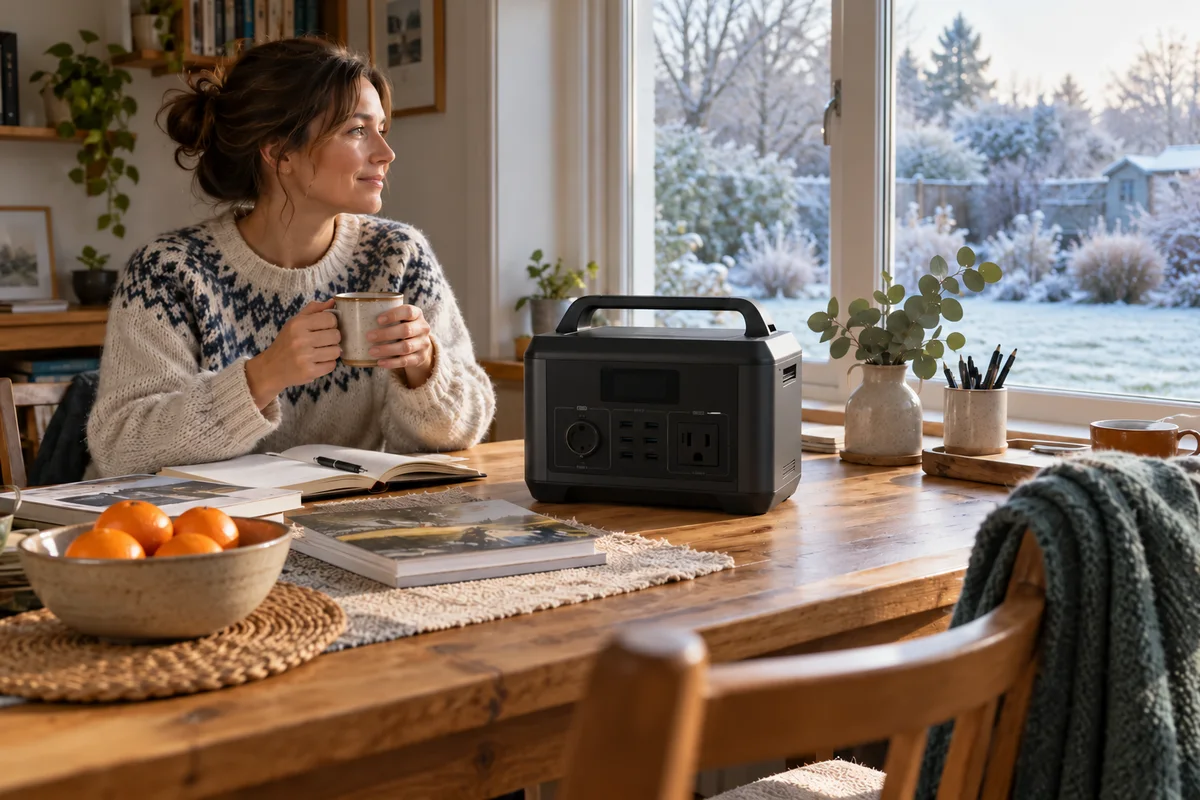
AI-generated scene illustration; not a photograph of the recommended product.
The AC180 spent the night in the garage. In the morning it can still supply a suitable device, so recharging it there appears reasonable. That conclusion mixes two different operating conditions. Before buying a station for winter backup, check where recharging will happen, not only where the unit will be stored.
The short answer
BLUETTI’s AC180 documentation specifies charging at 0–40°C, or 32–104°F. Its permitted discharge range is different. Being within a discharge range does not establish that charging is allowed in the same conditions.
Do not defeat a temperature warning or apply improvised heat. Choose an environment that meets the supplied instructions, allow the equipment to reach suitable conditions and contact BLUETTI if the warning persists. There is no universal warm-up countdown in this guide.
Contents
- Separate three temperature questions
- Use the winter reminder without predicting an outage
- Plan a recharge location before checkout
- Respond to a temperature warning without forcing a restart
- Write a winter power card
- Choose around the actual recovery plan
- Frequently asked questions
- Sources and verification
Separate three temperature questions
Storage, discharge and charging describe different states. A unit can have a documented storage range without being ready to accept power at every point in that range. Keep the three lines separate when reading the specification table.
Consider a household that stores camping equipment in an unheated outbuilding but wants to recharge indoors after a trip. Its practical requirement includes safely moving the unit and having an appropriate indoor location. Another household may have no suitable alternative to the cold building. The same station creates a different ownership problem for each.
Do not use outdoor air temperature as a precise measurement of the battery’s internal condition. A station moved between environments does not instantly match the new room. Follow the device’s protections and instructions instead of deciding that ten minutes indoors must be sufficient.
The AC180 review is the broader comparison. Temperature suitability belongs beside output and capacity, not in fine print after the purchase.
Use the winter reminder without predicting an outage
The National Weather Service Buffalo office lists New York’s Winter Weather Awareness Week for October 25–31, 2026. Its preparedness information discusses possible loss of electricity and heat. That is a timely reason to review equipment before winter, not evidence that a particular reader will lose power.
This article’s connection between that reminder and AC180 charging is an editorial inference. The agency does not recommend this product, and the event does not validate its performance.
A backup plan should still distinguish electrical loads from warmth. A power station’s ability to run a small appliance does not make it a whole-home heating system. Our space-heater energy guide addresses that different calculation.
Use the reminder to check the plan while normal power and support channels remain available. Avoid leaving the first compatibility check until an actual emergency or severe-weather warning.
Plan a recharge location before checkout
Find a dry, appropriate space that satisfies the station’s ventilation, environmental and placement instructions. Include the normal household traffic around it. An indoor location that blocks a doorway or crowds a heat source is not a good answer to a cold garage.
Check the input source and the AC circuit arrangement under the relevant instructions. Do not solve an inconvenient distance by chaining leads or adapting a vehicle socket to an unsupported input. Charging suitability has both environmental and electrical requirements.
Keep a safe handling route in mind too. The station is not a small phone battery. Determine whether the household can move it as required without carrying it through a cluttered passage or putting it on an unstable surface.
If safe movement or a suitable location cannot be established, compare a different arrangement. A protected location approved for the equipment may matter more than a faster advertised charging rate.
Respond to a temperature warning without forcing a restart
The manual’s troubleshooting table identifies low charging temperature separately from high charging temperature. A warning is a condition to address, not a setting to bypass.
Stop the attempted charging process as directed, check the environment and follow the manual’s guidance. Do not tape heating pads to the housing, place it against a heater or open the battery enclosure. We have not verified any external heating accessory for this task.
If moisture, damage or another abnormal condition is present, do not treat a warmer room as proof that the unit is safe. Ask the manufacturer for assistance. Temperature limits do not replace inspection and other operating restrictions.
Record the warning and conditions accurately if you contact support. Keep observations separate from conclusions: “the charging-temperature warning remained after relocation” is more useful than guessing that the battery is defective.
Write a winter power card
| Question | Record |
|---|---|
| Equipment | AC180 model and supplied manual revision |
| Ordinary storage | Location and whether it meets storage instructions |
| Recharge location | Suitable environment and approved input source |
| Handling | Who can move it and which clear route is available |
| Warning response | Stop, follow instructions and contact support if unresolved |
| Loads | Separate approved appliance list and energy plan |
| Limits | No improvised heating or protection bypass |
A household card is useful because it captures the difference between owning a battery and having a usable recovery process. Keep it short enough that another household member can understand it without reconstructing your shopping research.
The card should not contain a made-up guaranteed winter runtime. Temperature, loads, conversion losses and operating conditions require a separate assessment. Do not infer food or medical-equipment safety from the presence of the station.
Choose around the actual recovery plan
Consider AC180 when the supported loads, handling requirements and recharge environment all fit. A realistic plan can be modest: a suitable indoor location and a small set of approved plug-in devices may be enough for the intended task.
Delay or pass when charging depends on a freezing space with no supported alternative. A different purchase may be appropriate if cold-environment charging is essential, but verify that capability explicitly rather than interpreting a broad “outdoor” label.
The manufacturer listing checked today showed delayed AC180 availability; that does not establish the partner seller’s stock. Confirm dispatch, exact package and current terms through the actual listing before relying on arrival for a dated event.
Frequently asked questions
Can AC180 charge below freezing?
Its documented charging range starts at 0°C/32°F. Do not use the separate discharge range as charging permission.
Does bringing it indoors immediately make it ready?
Not necessarily. This guide gives no fixed acclimation interval. Follow the equipment’s conditions, warnings and manufacturer guidance.
Can I add a heater to make charging start?
Do not improvise external heating or bypass a protection. Ask BLUETTI about any claimed supported solution.
Does winter preparedness mean buying a larger station?
Not automatically. Confirm the actual load, recharge location and handling plan before changing capacity.
Sources and verification
Checked October 21, 2026. No cold-chamber, charging or runtime test was performed.
- BLUETTI AC180 manual — temperature limits and troubleshooting.
- BLUETTI AC180 U.S. information — exact model and current manufacturer purchase context.
- NWS Buffalo winter-awareness notice — October 25–31, 2026 regional preparedness context, not a forecast or product endorsement.
Keep reading
Related guides
 Power & Outdoors
Elite 100 V2: What 4,000 Battery Cycles Does Not Mean
Read Elite 100 V2's cycle-life endpoint without turning it into guaranteed years, unchanged runtime or invented lifetime savings.
Read guide → Power & Outdoors
AC180 12V Outlet: Check the Load, Not Just the Plug
Match AC180's regulated 12V car-style output to an appliance's voltage, current and approved cable instead of relying on socket shape.
Read guide → Power & Outdoors
AC180 Wireless Charging: Check the Phone and Case
Check AC180 wireless charging compatibility, phone cases and realistic charging expectations before making the pad part of an outage plan.
Read guide →