
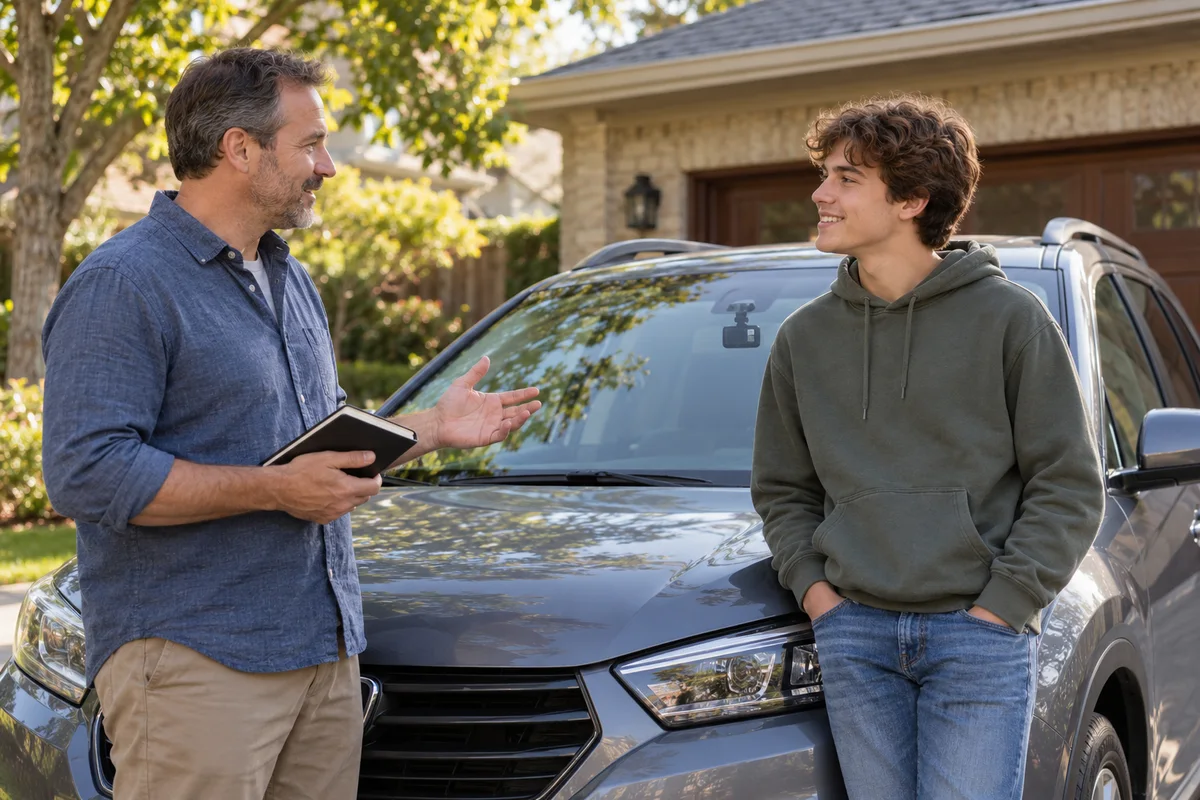
AI-generated scene illustration; not a photograph of the recommended product.
A young driver starts using the family car independently, and a parent wants reassurance. A dash camera advertises GPS, so the parent expects to see the car’s location from home. That expectation can produce the wrong purchase even when the camera records exactly as designed.
National Teen Driver Safety Week runs October 18–24 on NHTSA’s 2026 communications calendar. It is a useful time for an explicit family discussion, not a reason to mistake a GPS-equipped recorder for a live tracking service.
The short answer
VIOFO A229 Plus GPS supports location-related recording and playback information. Do not treat that as an always-connected remote location service for someone away from the vehicle.
If live location is the essential requirement, evaluate an explicitly supported service and its connectivity, accounts, permissions, and limitations separately. A dash camera can serve a recording task without fulfilling that different task.
Contents
- The short answer
- Separate knowing a position from sending it away
- Define the family’s actual question
- Understand the playback role of the recorded data
- Do not repeat the local Wi-Fi misunderstanding
- Make the agreement visible to every driver
- Build a family purchase worksheet
- Keep driver safety larger than the camera
- Decide whether A229 Plus fits the recording purchase
- Frequently asked questions
- Sources and verification
Separate knowing a position from sending it away
A GPS receiver can establish location for the device using it. Remote tracking additionally needs a supported way to transmit information and a service that makes it available to another authorized person.
The presence of GPS therefore does not establish a cellular connection, remote account, live map, alert delivery, or cloud retention. Those are additional capabilities that require their own evidence.
The A229 Plus review covers the recorder. This guide focuses on a parent’s purchase expectation, not a new installation method or a claim that all GPS-equipped devices work the same way.
Define the family’s actual question
“I want a recording if something happens” is different from “I want to know where the car is now.” A third question is “I want an agreed check-in if plans change.”
Write these as separate tasks before buying. One household may value a locally stored recording and a simple communication agreement. Another may need to research a supported location-sharing arrangement independently.
Do not let a feature list merge the tasks. A camera can be a useful recorder and still be the wrong answer to a remote-location requirement. That is a category mismatch, not necessarily a defective product.
Understand the playback role of the recorded data
VIOFO describes GPS information such as location, speed, and time in its recording and playback context. Check the current official instructions for the exact settings, files, and supported playback route.
We have not tested map accuracy, signal behavior, speed data, or evidentiary reliability. Do not present a recorded value as an infallible reconstruction or assume every obstruction and environment produces the same result.
If you need a saved incident recording, follow the appropriate preservation guidance and seek qualified advice where necessary. Playback convenience and a formal evidence process are not interchangeable.
Do not repeat the local Wi-Fi misunderstanding
Local camera Wi-Fi helps a nearby phone communicate with the recorder. It is not proof that a parent at home can reach the car from another network.
Our phone Wi-Fi handover guide covers that local connection. The new question here is who needs the information, where they are, and whether the product actually provides remote transmission.
Ask a seller directly: “Can an authorized person away from this vehicle see its live location through this exact package, and what documented service provides it?” If the answer merely repeats “GPS and Wi-Fi,” the requirement remains unresolved.
Make the agreement visible to every driver
A recording or location arrangement should not be a hidden substitute for a conversation. Discuss what is recorded, who can access it, why it is used, and how saved material is handled.
Include other regular drivers and passengers where relevant. Follow applicable rules and appropriate privacy guidance; this article does not determine consent law for your location.
The shared-car audio guide addresses a different recording boundary. Audio, location data, video, remote access, and sharing permissions deserve separate decisions rather than one vague approval for “the camera.”
Build a family purchase worksheet
| Family need | Evidence to request |
|---|---|
| Local driving footage | Supported channels and recording arrangement |
| Recorded route information | Exact GPS settings and playback guidance |
| Live remote location | Explicit remote service and transmission path |
| Notifications | Supported event, recipient, and service conditions |
| Shared use | Clear access, privacy, and retention agreement |
| Communication | A check-in routine independent of the recorder |
Mark unsupported tasks as unsupported rather than assuming an accessory will add them later. Ask for the complete documented package if a seller claims additional capability.
Keep account access private and avoid sending full driving recordings to strangers for routine troubleshooting. Use trusted support channels and only the information actually needed.
Keep driver safety larger than the camera
The official safety-week calendar establishes a communication occasion; it does not endorse this camera or demonstrate that installing it prevents a crash.
A family discussion can include attention, responsible communication, and the rules applicable to its driver and vehicle. Do not expect a recording device to supervise every journey or replace appropriate driver education.
Set up and review camera functions only when safely parked. A parent seeking reassurance should not create pressure for the driver to manipulate an app or respond to routine monitoring while driving.
Decide whether A229 Plus fits the recording purchase
Consider A229 Plus when a supported local recording system is the actual need, the installation and ownership requirements are acceptable, and every expected function has been checked for the exact package.
Do not buy it on an assumption of live remote tracking. If that is nonnegotiable, evaluate a product or service explicitly intended for it and review the complete ongoing terms before spending.
Some families may choose both functions through separate supported arrangements; others may prefer a simpler plan. We do not recommend an undocumented combination, promise remote availability, or quote a service fee. Match the tool to the agreed task first.
Frequently asked questions
Does GPS automatically mean a parent can watch a live map remotely?
No. Position recording and remote transmission are different capabilities.
Does camera Wi-Fi supply cellular tracking?
No such inference is justified. Local Wi-Fi does not establish a remote tracking service.
Is the safety-week date a product endorsement?
No. NHTSA’s calendar provides the public-safety occasion, not an endorsement of VIOFO or this purchase.
Should the driver adjust the app during a trip?
No. Leave setup and review for a safe parked situation and keep routine communication from distracting the driver.
Sources and verification
Checked October 18, 2026. The official calendar establishes timing; VIOFO sources establish the recorder’s described role. No driving, GPS-accuracy, or safety-outcome test is claimed.
- NHTSA 2026 communications calendar, October 18–24
- VIOFO A229 Plus 2-channel specifications
- VIOFO official FAQ
Keep reading
Related guides
 Garage & Workshop
A329S Voice Control or BTR200: Choose the Control
Compare spoken commands and an optional BTR200 control for a simple dash-cam task without confusing notifications or saved clips with backup.
Read guide → Garage & Workshop
Phoenix Plus 2 ADAS: The Tablet Is Not the Whole Kit
Budget vehicle coverage, separate ADAS hardware and professional workflow requirements before buying a diagnostic tablet for calibration work.
Read guide → Garage & Workshop
A229 Plus Static Sticker: Check the Glass Before Mounting
Separate static film from mount adhesive, and confirm tint and removal requirements before installing an A229 Plus.
Read guide →