
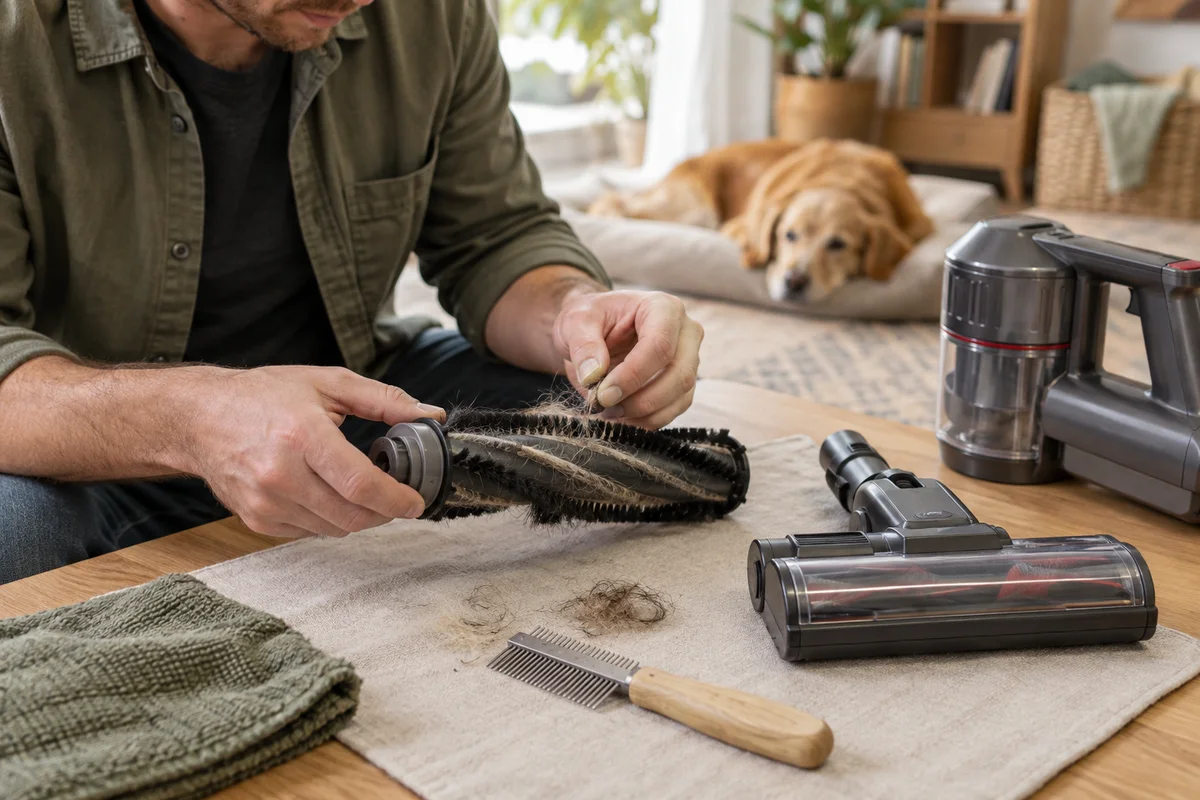
AI-generated scene illustration; not a photograph of the recommended product.
The upstairs rug is clean, but the vacuum head has acquired a pale collar of hair. There is a dog in the household, two people with long hair, and a favorite throw that sheds threads. Buying a more powerful vacuum may help with some cleaning tasks; it does not make those strands disappear from every moving part.
Before choosing the Dreame Z30 for this kind of home, look beyond pickup claims. The useful ownership question is whether you can inspect and maintain the particular brush supplied in the box without turning a routine job into an unwanted repair project.
The short answer
Treat hair-management features as a convenience, not a maintenance exemption. Identify the attachment, distinguish a wrapped roller from blocked airflow, and check the manual’s user-removable parts before buying.
The Z30 Global manual describes different releases for the multi-surface, soft-roller, and mini-brush attachments. It includes removing trapped hair and fibers. A procedure for one head is not a universal instruction for every powered attachment.
Separate three different problems
Hair wound around the moving roller
This is a mechanical-access question. You need to see the affected area and determine whether the manual permits the roller to be removed. Do not put fingers into a powered head or repeatedly restart a jammed brush to see whether it clears itself.
Before purchase, study the manual’s illustration rather than assuming that a side cap shown in a listing can be pulled off. Ask whether the person who will maintain the vacuum can comfortably operate the documented release.
Debris in the air path
Poor pickup alone does not prove that the roller is tangled. A full dust cup, obstruction, or filter issue can create a different maintenance task. Avoid buying replacement brush parts solely because the vacuum sounds different.
Use the manufacturer’s troubleshooting sequence, not an improvised internal inspection. If you cannot identify the problem within the user-maintenance instructions, contact support rather than opening the motor housing.
Fibers caught around small wheels
A head can roll awkwardly even when the main roller looks reasonably clear. Inspect the user-accessible areas associated with the exact attachment. Do not remove unrelated screws simply because a thread disappears behind a wheel.
The point is to keep these observations separate. “It pulls poorly,” “the roller has hair,” and “the head does not move smoothly” are useful descriptions for support; they are not interchangeable diagnoses.
Make a brush map before ordering
Find the exact contents of the offered bundle. A product-family page can show more attachments than a particular seller supplies. Write down which head you expect to use on each floor and which smaller attachment would handle upholstery.
Then locate the corresponding care illustration in the manual. If the bundle wording and the illustration cannot be matched, ask the seller or manufacturer for the supplied regional guide. A discount does not compensate for receiving an attachment whose maintenance requirements you did not understand.
The Global Z30 manual was accessible during this research, while the indexed U.S. attachment link was unavailable. That is why this article does not treat the Global accessory list as proof of the contents of every U.S. listing.
Set up a manageable work area
Think about where the eventual care task would happen. A dry, well-lit surface with room to keep a released part separate is easier to work with than balancing a head over the edge of a sink.
Follow the supplied manual’s shutdown and disconnection instructions before maintenance. Keep children and pets away from loose parts. Use only the release and cleaning methods authorized for that head; this is not an invitation to cut close to wiring, seals, or bristles without clear access.
A small tray can keep removable pieces together while you consult the diagram. If a part does not release as shown, stop. More force is not a substitute for having the correct attachment instructions.
Do not wash an entire powered head
A removable roller and an electrically powered housing are different components. Do not generalize a washable-part instruction into permission to immerse the whole assembly. If washing an approved removable component is needed, allow the full specified drying period before reassembly.
The separate Z30 drying-plan article covers how drying downtime affects cleaning schedules. Here the buying question is access: can you identify, remove, clean, and correctly reinstall the authorized part?
Avoid creating extra work by washing something merely because the vacuum is already disassembled. A dry maintenance task and a washing task have different consequences for when the machine can be used again.
Turn a return window into an acceptance check
If you buy the Z30, inspect its ordinary controls and attachment identification during the seller’s return period. Keep packaging until you understand the agreed return conditions. Do not deliberately create a severe tangle or introduce damaging debris as a “test.”
For normal household use, note whether maintenance access is practical for you. Can you see the latch? Is the part easy to orient correctly using the diagram? Is there a suitable place to perform the task? These observations are more personal and useful than assuming every owner has the same grip, eyesight, or workspace.
Keep a record of unresolved questions while the seller can still respond. A product can be good at pickup and still be a poor ownership fit for a particular household.
Buying tradeoffs for a hair-heavy home
The Z30 review is the broader starting point for considering the vacuum. Add brush access to your shortlist criteria rather than ranking products only by claimed suction or runtime.
This model is worth considering if its actual supplied attachments suit your floors and the responsible person accepts the care tasks. It is less convincing when you require virtually no contact with collected hair, cannot operate the documented releases, or have no practical place to maintain the parts.
Also consider who will do the work. If one person vacuums and another inherits every tangle, the apparent convenience may be misleading. Agree on the routine before committing to the purchase.
A useful pre-purchase checklist
- Match the seller’s bundle to the exact attachment names.
- Find the maintenance drawing for each head you expect to use.
- Separate roller access from air-path troubleshooting.
- Identify the controls you can operate comfortably.
- Plan a dry work surface and secure parts storage.
- Verify how genuine replacement components can be obtained.
- Read return terms before normal-use assessment begins.
This checklist does not predict how often your own hair, rugs, and pet bedding will require attention. It helps determine whether the necessary attention is acceptable when it arises.
Frequently asked questions
Does an anti-tangle claim mean I never clean the brush?
Do not make that assumption. Buy on the understanding that accessible maintenance may still be necessary, and compare the actual manual rather than a slogan.
Should weak pickup make me buy a new roller?
Not by itself. Describe the symptom and follow the appropriate troubleshooting instructions first. Replacing the wrong component can leave the original problem untouched.
Can I copy a soft-roller procedure onto the mini-brush?
No. Treat each attachment as a separate item with its own documented release and care method. A similar appearance does not establish an identical mechanism.
Is this a measured pet-hair performance review?
No. It is a maintenance-access buying guide. No pickup percentages, tangle frequency, or hands-on comparison is claimed.
Sources and verification
Checked October 15, 2026. Confirm the regional manual and exact bundle before acting.
- Dreame Z30 Global manual — English care illustrations for the different brush attachments.
- Dreame U.S. Z30 product page — model and U.S. product context; seller bundle contents require separate checking.
Keep reading
Related guides
 Cleaning
Z30 Charging in a Cold Garage? Choose the Location First
Check temperature, dryness, the supplied charger, and post-cleaning cooldown before making a garage the Z30's charging home.
Read guide → Cleaning
Bagless Vacuum Emptying: Check the Bin Before Buying
Assess Z30 bin access, the correct release controls, waste-bin reach, and shared-household cleanup before choosing a bagless vacuum.
Read guide → Cleaning
Buying a Cordless Vacuum for Stairs: Check the Grip
Evaluate a cordless vacuum for stairs using handheld weight, reach, compatible attachments, floor materials, and a safe cleaning sequence.
Read guide →