
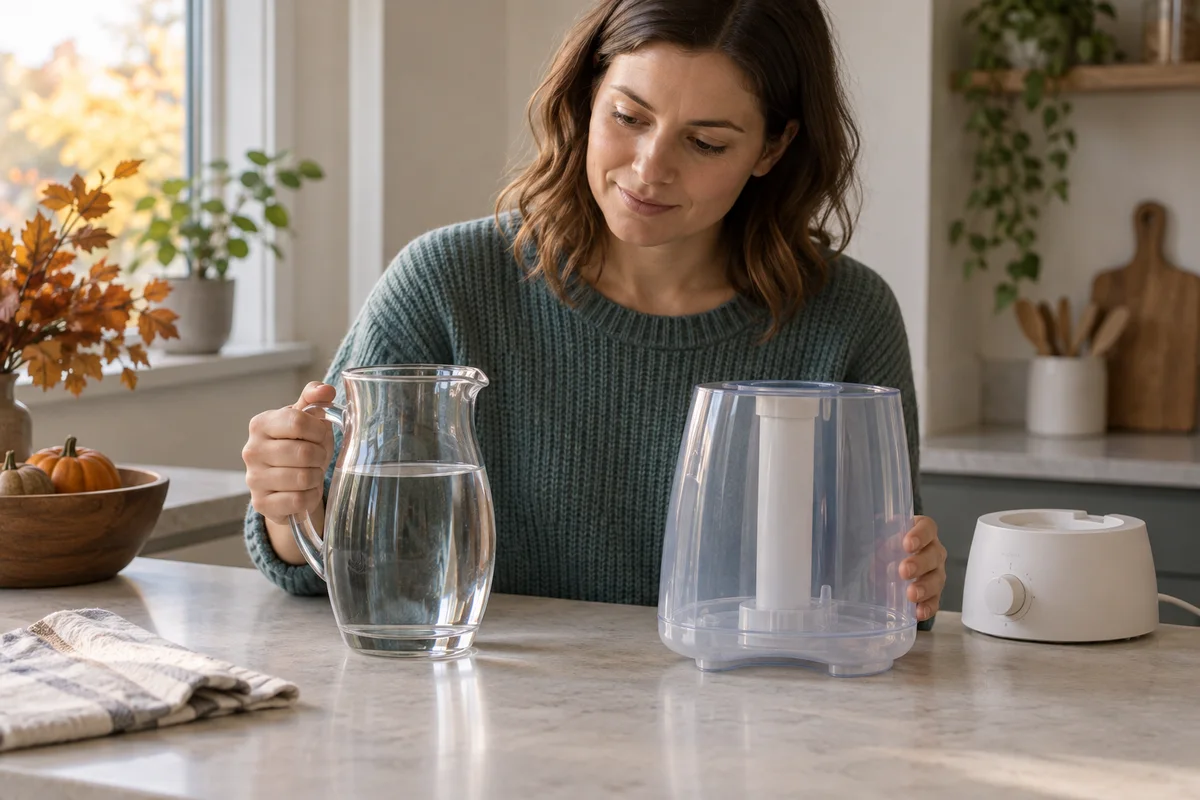
AI-generated scene illustration; not a photograph of the recommended product.
The first evening with the heating on is often when a household brings the humidifier back out of storage. A countertop reverse-osmosis system already supplies drinking water, so using its pitcher for the humidifier seems like a convenient next step.
Before buying the Waterdrop M6SL for that purpose, separate two jobs: making the drinking water you want and supplying the water required by a particular appliance. The M6SL is marketed as a mineralized RO system. That added-mineral stage is important, not a small detail to overlook.
The short answer
Do not buy the M6SL as a substitute for a distilled-water supply for a humidifier. Waterdrop says the M6SL adds minerals, while EPA humidifier guidance favors suitable low-mineral water and discusses distilled water for reducing mineral deposits and dispersal from ultrasonic or impeller units.
Whether a particular water source is appropriate depends on the humidifier’s own instructions and the actual water characteristics. We have not tested M6SL output in a humidifier. Mineralized drinking water is not automatically the right appliance refill, and RO is not another name for distillation.
On this page:
- The short answer
- Start with the humidifier manual
- Understand why the M6SL mineral stage changes the question
- Keep white dust and cleanliness as separate problems
- Review whether humidification is needed at all
- Compare the two household jobs on paper
- Count water handling and filter use honestly
- Buy the M6SL for a verified drinking-water need
- Frequently asked questions
- Sources and verification
Start with the humidifier manual
Identify the humidifier type and exact model before choosing water. An ultrasonic unit, an evaporative model, and a steam appliance are not interchangeable water-handling systems. Use the water and maintenance requirements specified for the product you actually own.
Write down whether the instructions call for distilled water, demineralized water, another defined quality, or a particular cartridge arrangement. A general label such as filtered or purified is not a precise answer to those requirements.
If the manual is missing, obtain the correct version from the manufacturer. Do not use another model’s instructions because the tank looks similar. The purpose is to resolve the existing appliance requirement before adding a second purchase to the household.
Understand why the M6SL mineral stage changes the question
Waterdrop’s M6SL page describes RO filtration followed by mineral addition. That is a drinking-water product choice, not evidence of distilled output. A buyer looking specifically to reduce minerals for an appliance should not ignore what happens after the RO stage.
The important question is the final water reaching the pitcher, not just the presence of an RO membrane somewhere inside the system. A process name cannot tell you everything about subsequent treatment or the finished output.
Our RO and TDS verification guide explains why a single meter reading is not a universal water-safety verdict. Here the narrower point is appliance suitability: do not infer compliance with a humidifier’s water requirement from a low-looking number or a filtration label alone.
Keep white dust and cleanliness as separate problems
EPA explains that ultrasonic and impeller humidifiers can disperse minerals from their tanks, and discusses low-mineral water and distilled water in that context. That is a reason to choose an appropriate refill source, not a claim that one drinking-water filter eliminates every maintenance concern.
A different water source does not remove the need to empty, dry, clean, and maintain the humidifier according to its instructions. Likewise, a clean-looking tank does not prove that its refill water meets the appliance’s mineral requirement.
Do not treat drinking-water filtration as sterilization or assume a pitcher makes water indefinitely suitable after storage. This article offers no claim of medical benefit, reduced illness, or measured air-quality improvement from using M6SL water.
Review whether humidification is needed at all
The calendar is a reminder to inspect the routine, not proof that every home is too dry. Heating use and indoor conditions vary. Check the actual room conditions and the humidifier instructions rather than running the appliance simply because autumn has arrived.
EPA advises avoiding excessive humidity and dampness around the appliance. Follow current guidance and the specific unit’s controls, and respond to condensation or wet surroundings instead of assuming more output is better.
Do not buy a water-treatment system to support a humidifier routine that has not yet been justified. First decide whether the appliance is needed, then what water it requires, then whether the refill method is convenient enough to maintain.
Compare the two household jobs on paper
Make one column for drinking water and another for humidifier refills. In the drinking-water column, record the source-water concern, applicable evidence, taste preference, counter space, refill work, and filter ownership requirements.
In the humidifier column, record the exact water specification, amount used in your ordinary routine, storage arrangement, cleaning obligations, and the source that actually meets the requirement. Do not fill either column with assumed benefits from the other.
A hypothetical household might want mineralized drinking water but use manufacturer-appropriate distilled water for a separate humidifier. Another household might decide the countertop system has no role in its appliance task. These examples are decision patterns, not tested M6SL performance or a universal refill recommendation.
Count water handling and filter use honestly
Using drinking water for another appliance can increase the amount processed and the number of refills. The practical effect depends on the household’s actual use; it should not be converted into an invented universal filter-life estimate.
Our M6SL ownership-budget guide addresses filter planning separately. Add your genuine intended volume to that worksheet only after the water is confirmed appropriate for its purpose. More usage does not make an unsuitable application sensible.
Keep refill containers clean and handle them according to the relevant product instructions. Do not pour water into an energized appliance or improvise a permanent feed arrangement from a countertop pitcher. This article does not approve modifications to either device.
Buy the M6SL for a verified drinking-water need
The M6SL buying guide is relevant when you want to assess that particular countertop drinking-water system. Check the exact model’s evidence, supplied configuration, ongoing filter requirements, warranty, and current return terms.
Pass if the main reason for ordering is an assumption that any RO system produces distilled or mineral-free water for a humidifier. Resolve the appliance refill separately. A drinking-water system should not be justified by a job its documentation does not establish.
We do not quote a current price or shipping date. Product pages may retain old promotional or delivery language. Confirm availability and the exact current package directly through the partner listing before ordering, without treating a stale date as an inventory promise.
Frequently asked questions
Is M6SL output the same as distilled water?
No. Waterdrop describes mineralized RO output, including an added-mineral stage. RO treatment and distillation are different processes.
Can I ignore the humidifier manual if the water tastes good?
No. Drinking preference does not establish appliance compatibility. Use the water characteristics and care instructions required by the exact humidifier.
Does low-mineral water remove the need to clean the humidifier?
No. Water selection and appliance cleaning are separate obligations. Follow the manufacturer’s maintenance instructions and applicable current guidance.
Is this a claim that M6SL water is unsafe to drink?
No. This article distinguishes intended uses. A drinking-water purchase requires its own source-water and product-evidence assessment; humidifier suitability is a separate question.
Sources and verification
Checked October 16, 2026. Waterdrop supports the mineral-stage description; EPA supports the humidifier water and care distinction. No water, appliance output, or health outcome was tested.
Keep reading
Related guides
 Kitchen
Buying Countertop RO? Start With a Water Evidence Card
Build a contaminant-specific evidence card for countertop RO, linking your water concern, testing, certified claims, and M6SL ownership needs.
Read guide → Kitchen
Waterdrop M6SL: Build a Filter Ownership Budget
Use an ownership worksheet for M6RFL replacement, delivery timing, usage, upkeep, and alternatives without assuming guaranteed savings.
Read guide → Kitchen
Countertop RO for Guests: Plan the Refill Routine
Check counter access, serving capacity, concentrate-water handling, and maintenance before choosing Waterdrop M6SL for a busy hosting kitchen.
Read guide →