
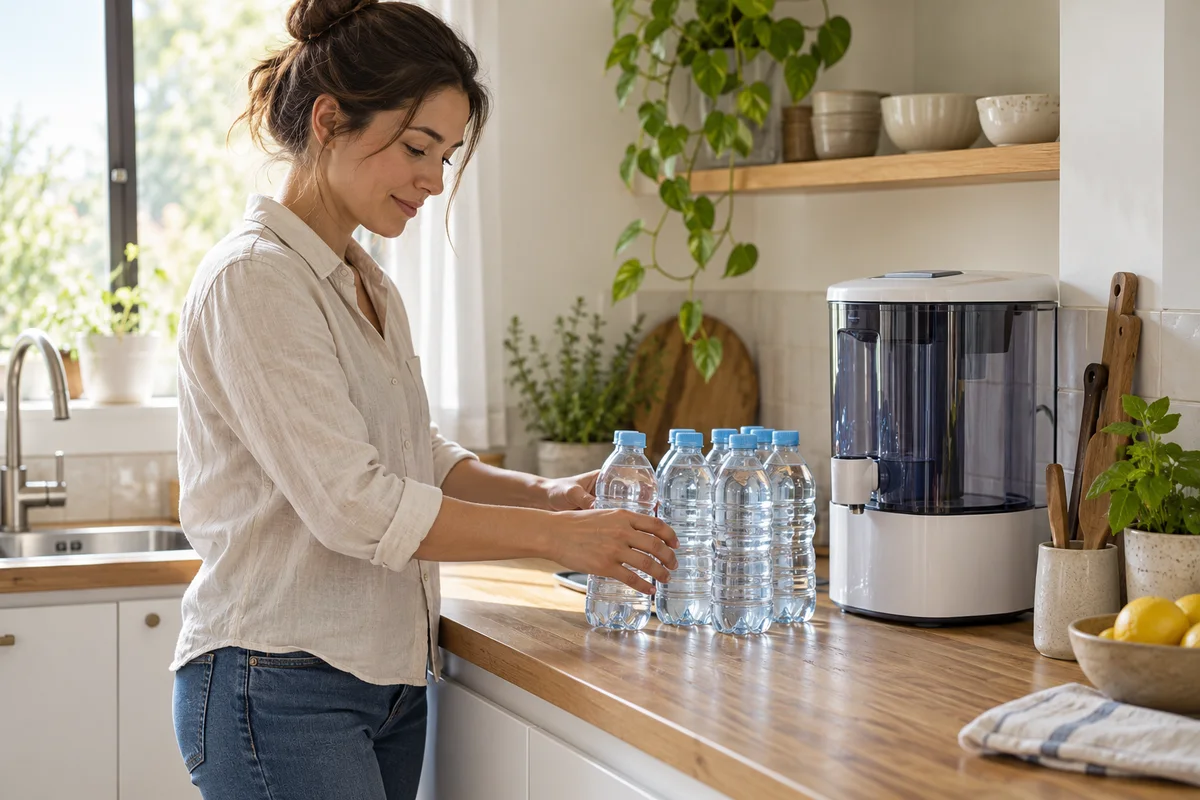
AI-generated scene illustration; not a photograph of the recommended product.
A water-utility message arrives during breakfast. There is an M6SL on the counter and a pitcher of water ready for the morning. The household now needs a different answer from an ordinary filter comparison: which instructions govern drinking water during this specific notice?
The appliance’s normal role does not cancel an official advisory. This guide is a notice-reading and purchasing framework, not an emergency-treatment qualification for M6SL.
The short answer
Follow the current instructions from your water utility or public-health authority. CDC distinguishes boil-water, do-not-drink and do-not-use advisories; they are not interchangeable. Its general guidance says to boil tap water during a boil-water advisory even after home filtering.
Do not treat M6SL’s display, filtration stages or normal drinking-water marketing as permission to override a notice. Use the approved alternative supply and ask the authority and manufacturer about the appliance-specific recovery process.
Contents
- The short answer
- Read the notice before naming a solution
- Separate advisory types
- Map the household’s immediate uses
- Keep the purifier’s normal role separate
- Use a household notice card
- Plan recovery instead of guessing a reset
- Buying advice
- Frequently asked questions
- Sources and verification
Read the notice before naming a solution
Find the issuing organization, affected area, time and exact advisory type. Use the utility’s or authority’s own current information rather than a cropped social-media image that may omit an important condition.
Check whether the household is actually in the affected service area and whether an update has changed the instruction. An article dated today cannot settle a local notice issued later.
Keep the original notice available to everyone handling food and drinks. If the wording is unclear, ask the issuing authority directly. Do not fill the gap with a sales page’s broad contaminant claims.
This article does not report a new local incident or suggest that every reader’s water is affected. The scenario is a practical preparedness question for a household that already owns or is considering M6SL.
Separate advisory types
A boil-water notice is not the same instruction as a do-not-drink notice. CDC explains that chemical or toxin concerns can require a different response, and boiling does not make such contamination safe.
A do-not-use notice can be broader still. The actual notice determines which activities are restricted and what supply is acceptable. Do not replace those instructions with a general rule remembered from a previous event.
Avoid using one appliance feature as a shortcut through that distinction. An RO membrane, an LED feature or a low number on a display does not independently establish that the complete system is approved for the current hazard and situation.
Map the household’s immediate uses
List the activities named in the notice and follow its instructions for each. Drinking, cooking, preparing beverages, making ice and other uses can require decisions beyond the glass filled at the purifier.
Include water already stored in household vessels. Ask the authority what applies rather than assuming a filled pitcher is automatically outside the problem. We cannot determine the source or timing of that water from the appliance model.
Do not give guests a simplified reassurance that “it went through a filter.” Give them the actual applicable instruction and the clearly identified acceptable supply.
For ordinary nonemergency shopping, our TDS and water-testing guide explains why a display reading is not a complete safety assessment. An active advisory adds an immediate authority-led decision that a shopping comparison cannot replace.
Keep the purifier’s normal role separate
Waterdrop describes M6SL as a countertop reverse-osmosis system. That identifies the product category; it is not evidence that this particular household unit has been qualified for every emergency-water task.
Do not infer sterilization, emergency certification or hazard-specific permission from a count of treatment stages. Ask for exact relevant documentation if a claim is important, and do not use an unanswered sales question to delay following the notice.
The room-temperature tea guide separates filtration and heating for an ordinary morning routine. It does not provide a workaround for an unsafe supply. Different household tasks can involve the same counter without sharing the same permission conditions.
Use a household notice card
| Item | Record from the current official instruction |
|---|---|
| Issuer | Utility or public-health authority |
| Scope | Affected service area and relevant dates |
| Type | Exact advisory wording |
| Supply | Approved alternative for each required use |
| Existing water | What the authority says about stored water |
| Updates | Where to check the current status |
| Recovery | Any appliance-specific follow-up still needed |
This is a record of official instructions, not a treatment recipe. Do not add guessed chemical doses or homemade disinfection steps to it.
If another household member takes over the kitchen, the card should make the current instruction clear without requiring them to interpret product specifications. Keep uncertain details marked as questions for the issuing authority.
Plan recovery instead of guessing a reset
An advisory ending does not automatically answer every question about water remaining in a particular appliance. Ask what flushing, cleaning, filter service or other model-specific steps apply.
Use the manufacturer’s current instructions for the exact M6SL and the authority’s applicable recovery guidance. Do not improvise a chemical mixture, dishwasher cycle or hot-water fill because it sounds more thorough.
Our M6SL return-home routine addresses ordinary inactivity under normal supply conditions. It is not a substitute for post-advisory instructions. A weekend away and a water-contamination notice are different reasons for assessing an appliance.
Buying advice
Consider M6SL for a verified ordinary household drinking-water treatment task when the source-water requirements, maintenance and handling routine are appropriate.
Do not buy it as an immediate replacement for obeying an advisory or as an unverified emergency water source. An urgent need for acceptable drinking water should be addressed through the authority’s recommended supply, not a delivery estimate for an appliance.
Before a future purchase, ask how the manufacturer handles questions about supply interruptions and appliance recovery. A clear support route is useful; a blanket promise that a purifier makes every water source safe is not.
The partner link here is for the M6SL system. It is not an emergency certification, a recommendation to use affected tap water or a guarantee of protection against the hazard named in a notice.
Frequently asked questions
Can I ignore a boil-water notice because I use RO?
No. Follow the current notice. CDC’s general boil-water guidance explicitly retains boiling advice after home filtering.
Are do-not-drink and boil-water notices equivalent?
No. Different hazards require different instructions. Read the exact notice and do not assume boiling solves a chemical concern.
Can the TDS display tell me that the advisory no longer matters?
No. Follow the authority’s current notice and updates, not a consumer display.
Should I copy the ordinary inactivity flush after an advisory?
Do not assume that is sufficient. Obtain the relevant authority and model-specific recovery instructions for the actual situation.
Sources and verification
Checked October 23, 2026. This is general notice-reading guidance. No source-water test, pathogen test or emergency-treatment qualification was performed.
- CDC: drinking-water advisory types and instructions
- Waterdrop: M6SL product identity and ordinary household role
Keep reading
Related guides
 Kitchen
M6SL 3:1 Ratio: Calculate Water Use the Right Way
Read M6SL's pure-to-drain ratio in the right direction, normalize competing conventions and separate arithmetic from actual household water use.
Read guide → Kitchen
M6SL Cold Water: Plan the Fridge, Not a Chiller
Check M6SL's fridge-compatible pitcher, shelf fit and serving rotation without confusing a detachable vessel with built-in water chilling.
Read guide → Kitchen
M6SL Filter Reset: Replace First, Reset Second
Separate the M6SL filter reminder, physical M6RFL replacement and reset confirmation so a cleared indicator never substitutes for maintenance.
Read guide →