
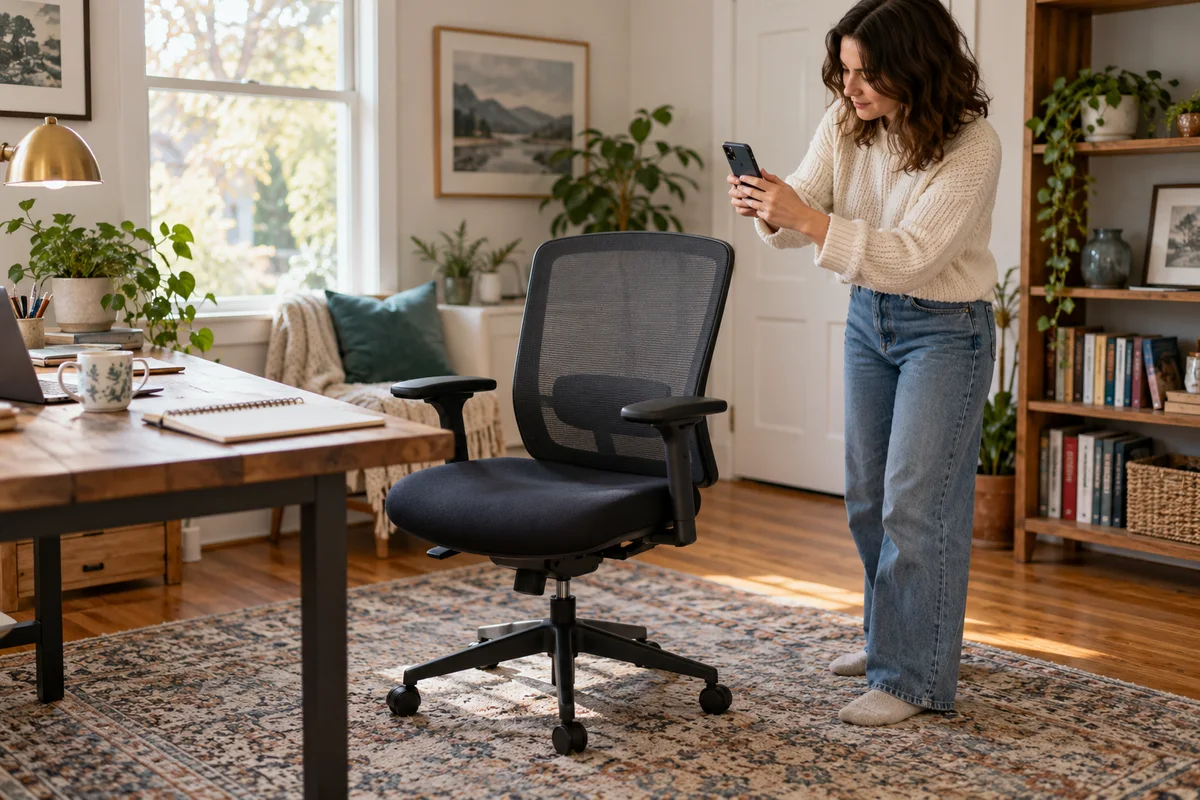
AI-generated scene illustration; not a photograph of the recommended product.
The chair clicks during a video call, and the sound seems louder every time the room goes quiet. A new set of casters or another chair is already in the shopping cart. Before spending, identify when the noise occurs and collect the information support needs to distinguish an adjustment issue from a part problem.
The short answer
ProtoArc’s EC300 FAQ recommends identifying the action that produces the noise and checking the documented connections. For unresolved issues it asks for the model, order information and a video. A repeatable support record is more useful than buying a component based on where a sound seems to come from.
Do not continue using a chair with suspected structural damage or instability. This guide is a documentation and purchase-decision workflow, not a diagnosis or permission to open the gas lift, modify the mechanism or apply an arbitrary lubricant.
Contents
- Describe the trigger instead of naming a failed part
- Keep observation within ordinary safe movement
- Separate noise from a control misunderstanding
- Make a short support dossier
- Buy a part only after the problem is scoped
- Use supportability as a purchase criterion
- Frequently asked questions
- Sources and verification
Describe the trigger instead of naming a failed part
A sound noticed beneath the seat is not proof that the gas lift has failed. The room can transmit sound, and several connections move during ordinary use. Start with what happened rather than the replacement you suspect.
For example, “a click occurs once when returning from recline” is a different observation from “a repeated squeak occurs during rotation.” Write down the ordinary action, whether the sound is repeatable and when it first appeared.
Do not add a confident technical diagnosis to make the message sound knowledgeable. A precise description gives support something to investigate; an incorrect part name can send the discussion toward a purchase that does not solve the problem.
The EC300 FAQ itself separates sitting, standing, height adjustment, reclining and rotation as useful conditions to describe. Use only the ordinary movements that remain safe for the chair in its current condition.
Keep observation within ordinary safe movement
If the chair feels unstable, a component appears cracked or a connection seems damaged, stop use and contact the manufacturer. Recording evidence should not require someone to load an unsafe chair.
Do not repeatedly bounce, lean beyond the supported position or make exaggerated movements to get a louder recording. A quiet, clear clip of an ordinary symptom is preferable to a dramatic but hazardous demonstration.
Check visible assembly conditions only as directed by the EC300 instructions. Use the correct tools and hardware; do not overtighten connections or force a thread. The replacement hardware guide explains why similar-looking screws are not interchangeable.
The FAQ mentions suitable lubrication for certain moving connections. It does not establish that every spray, grease or application point is appropriate. Ask for the exact approved product and location if those details are unclear. Keep chemicals away from upholstery and mechanisms not identified for treatment.
Separate noise from a control misunderstanding
The EC300 has distinct recline and tension controls. A sound accompanying a normal lock action is not automatically the same problem as a persistent squeak or a lock that fails to hold.
Our recline lock and tension guide covers that control distinction. Do not replace its instructions with a noise-focused guess, and do not interpret a familiar click as evidence that an uncertain lock is safe.
Similarly, a height-adjustment question should be described separately from rotation noise. ProtoArc’s FAQ explains the different weight conditions for raising and lowering the seat. If normal adjustment still fails, report that rather than repeatedly forcing the lever.
Keep the question focused. You can say that the chair makes a particular sound and also report a separate movement problem, but do not merge them into an invented cause-and-effect claim.
Make a short support dossier
| Field | What to send |
|---|---|
| Identity | EC300 and any requested model information |
| Purchase | Order reference sent privately to the support channel |
| Trigger | Ordinary action associated with the sound |
| Timing | When noticed and whether it repeats |
| Condition | Visible concerns without dismantling hardware |
| Prior checks | Exact manual-directed steps already completed |
| Evidence | Short, clear video where safe |
| Request | Approved next step and any confirmed part |
Keep a copy of the support response. If a replacement is proposed, ask for the exact part, required installation method and whether professional assistance is appropriate.
Do not post an unedited order confirmation or a room video containing private documents to a public review forum. Send only the details needed through the legitimate support route. A useful dossier can be specific without exposing household information.
Keep the original observation too. If the symptom changes after an approved adjustment, describe the change accurately. Do not claim a permanent repair after one quiet movement.
Buy a part only after the problem is scoped
A caster, fastener kit and tilt mechanism solve different problems. A page selling replacement parts does not establish which one your chair needs.
Ask whether the applicable order terms cover the proposed remedy. Do not assume a replacement will be free or that buying it yourself is required. Confirm shipping and the supplied instructions before dismantling anything.
For a chair outside relevant coverage, compare a supported repair quote with the cost and practicality of replacement. We do not publish a universal repair-cost threshold because neither your diagnosis nor a current service quote is known.
If you are simply shopping for a new chair, a noise on an old, unrelated model is not evidence that EC300 will avoid the same issue. Compare documented support and the actual fit instead of promising that a replacement purchase will guarantee a silent room.
Use supportability as a purchase criterion
Consider EC300 when the chair fits your work and you are comfortable with the documented assembly, adjustments and service route. Keep the manual and order record accessible rather than treating them as packaging clutter.
The EC300 product review covers the broader chair. This guide adds an ownership decision: how clearly can you describe a problem and obtain an approved remedy before buying parts?
The partner CTA is an EC300 chair listing, not a diagnosis, repair service or spare-part offer. Existing owners should contact support first when a focused remedy may avoid an unnecessary replacement.
Pass on speculative accessories if the cause is still unknown. A quieter shopping cart does not need another item until the evidence supports it.
Frequently asked questions
Does a squeak prove the gas lift is faulty?
No. A sound alone does not identify the failed component. Report the trigger and ask support.
Can I spray any lubricant under the seat?
Do not assume so. Obtain the appropriate product and application guidance for the identified connection.
Should I keep testing an unstable chair?
No. Stop use and seek assistance. Do not create a loaded demonstration of a potentially unsafe condition.
Does the commercial link buy a repair?
No. It leads to the EC300 chair. Parts and service require their own confirmed route.
Sources and verification
Checked October 21, 2026. No physical noise investigation or repair was performed. The household example is illustrative, not a report of our own EC300.
- ProtoArc EC300 FAQ — trigger identification and information requested for unresolved problems.
- EC300 assembly and adjustment resources — model-specific supported operation.
- EC300 hardware kit — separate component identification, not a diagnosis.
Keep reading
Related guides
 Home Office
EC300 Replacement Screws: Match the Location and Thread
Identify EC300 replacement hardware by manual location and exact part callout rather than choosing chair screws by appearance.
Read guide → Home Office
EC300 4D Armrests: Upgrade the Reach, Not the Chair
Compare standard EC300 arm support with ProtoArc's separate 4D replacement pair, checking model confirmation, desk reach and total cost.
Read guide → Home Office
Used EC200 Chair: Do Not Assume Warranty Transfers
Compare a used EC200 offer with a qualifying new purchase: check non-transferable warranty, condition, seller terms and actual replacement costs.
Read guide →