
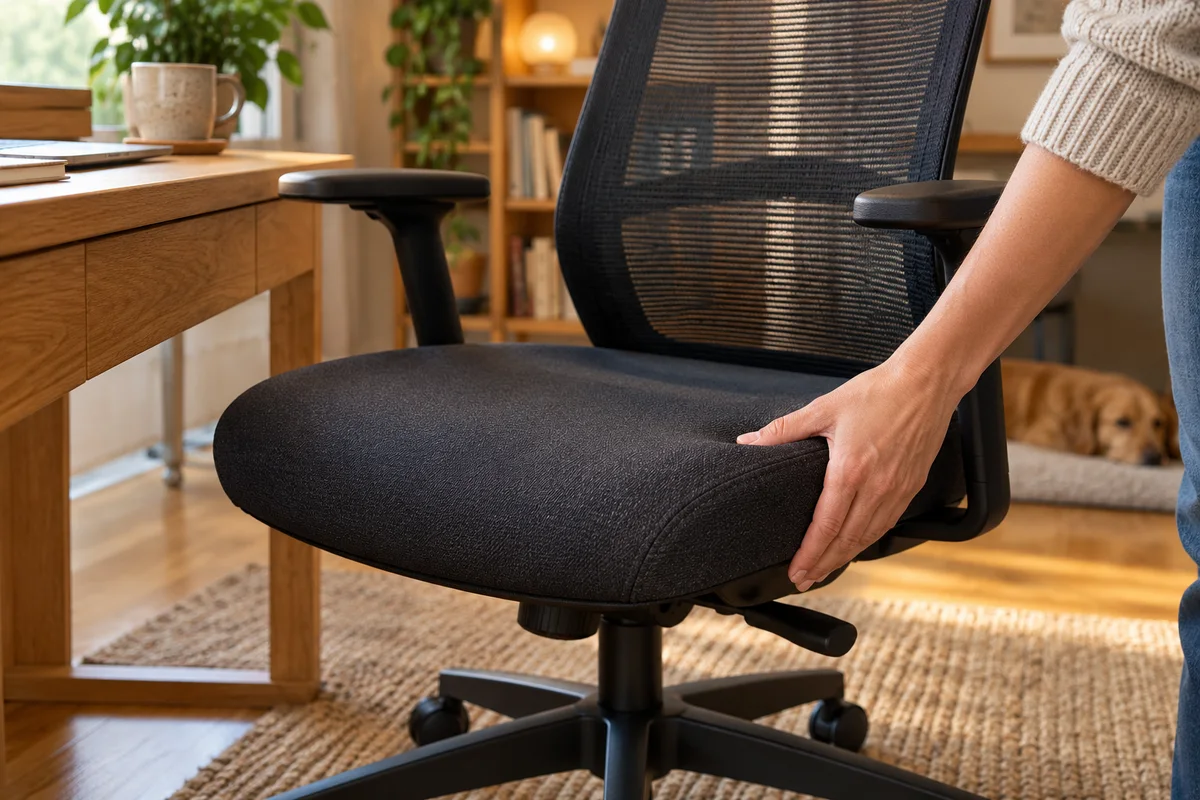
AI-generated scene illustration; not a photograph of the recommended product.
A warm home office makes a mesh chair appealing. You see a transparent-looking backrest, read “breathable,” and picture the same open material beneath you. Then the chair arrives with a substantial padded cushion.
For ProtoArc EC300, separate the backrest material from the seat material before deciding whether the design matches your preference. A chair can have a mesh back and a foam seat without being an all-mesh chair.
The short answer
ProtoArc describes EC300 with a soft-touch mesh backrest and a 55D foam cushion. Do not treat the visible mesh back as proof that the sitting surface is suspended mesh.
Choose by the complete contact surfaces and your own supported trial, not by a material label applied to the whole chair. We have not measured seat temperature, sweat, cushion durability, or individual comfort.
Contents
- The short answer
- Look at the surface carrying your weight
- Keep material preference separate from a cooling claim
- Compare the constructions without inventing a winner
- Do not turn foam density into a comfort score
- Evaluate the seat with the rest of the workstation
- Write an ordinary-use acceptance plan
- Ask care questions before bringing it home
- Decide whether EC300 fits the material requirement
- Frequently asked questions
- Sources and verification
Look at the surface carrying your weight
Catalog photographs often emphasize the tall backrest because it is visually distinctive. The material you sit on may be less obvious until you inspect a side view and the specifications.
For a chair shortlist, name the backrest and seat separately. Then identify upholstery, padding, seat-edge shape, and the support beneath the seat where the manufacturer documents them.
The EC300’s stated foam cushion is not a hidden defect; it is part of the described design. The mismatch occurs when a buyer expected another construction. Our EC300 review provides the broader chair context.
Keep material preference separate from a cooling claim
An open backrest and an upholstered seat expose different areas to different materials. A breathable-back claim cannot establish the temperature of the cushion under a particular person in a particular room.
Room conditions, clothing, task duration, and personal preference also matter. We cannot rank this chair against an all-mesh alternative by heat without a suitable comparative test.
Instead, write the requirement honestly: “I prefer an open sitting surface,” or “I prefer a padded sitting surface.” That is a useful buying preference, not a claim that one construction is medically superior or comfortable for everyone.
Compare the constructions without inventing a winner
| Question | Padded seat with mesh back | Suspended-mesh seat |
|---|---|---|
| Primary contact surface | Confirm fabric and cushion construction | Confirm the actual supporting mesh |
| Feel | Requires an individual trial | Requires an individual trial |
| Seat edge | Inspect shape and usable depth | Inspect frame edge and usable depth |
| Care | Follow model-specific upholstery guidance | Follow model-specific mesh guidance |
| Replacement | Ask about the exact seat assembly | Ask about the exact mesh or seat assembly |
Do not compare just the widest dimension. The usable sitting area and edge can differ from an overall frame measurement.
Neither construction earns an automatic recommendation here. The right comparison is between exact chairs that fit your body, desk, material preference, and ownership requirements.
Do not turn foam density into a comfort score
ProtoArc’s 55D label identifies a published cushion attribute. It does not establish that a particular person will find the seat soft, cool, pressure-free, or suitable for an entire working day.
A shopper can use the label to ask better questions: what is the seat construction, is the cover removable, and what replacement or support options exist? Do not convert it into an independently measured lifespan or therapeutic benefit.
Likewise, certification claims have their own scope. Our EC300 certification guide explains why a conformance claim cannot guarantee individual comfort. Material, fit, and certified testing are distinct pieces of evidence.
Evaluate the seat with the rest of the workstation
OSHA’s chair guidance treats a chair as part of a workstation, including support and adjustment. A preferred surface cannot rescue a seat that prevents you from sitting back or approaching the keyboard comfortably.
Compare depth, height range, back support, and armrest clearance before ordering. Check that you fall within the manufacturer’s current user limits. Those checks remain relevant whether the cushion is foam or mesh.
If the chair is shared, both users need their own assessment. The two-person setup card addresses that handover. One user’s positive material preference is not evidence that another will share it.
Write an ordinary-use acceptance plan
Before purchase, check whether the seller allows a normal comfort assessment and what return conditions apply after assembly. A trial is useful only if you understand how to handle an unsuitable chair.
During permitted ordinary use, note whether the sitting surface, edge, and depth feel appropriate for your usual task. Do not deliberately overheat the room, overload the chair, or conduct a destructive cushion test.
Keep observations descriptive: “the front edge feels intrusive in my normal setup” is more actionable than an unsupported diagnosis. Stop if the chair is damaged or a mechanism behaves abnormally, and use official support.
Ask care questions before bringing it home
A padded seat adds a specific maintenance question. Ask for the exact model’s permitted cleaning method, drying requirements, and whether any cover is actually intended to be removed.
Do not infer that a zipper, seam, or mesh-looking panel authorizes machine washing. Do not borrow cleaning instructions from another chair or spray an unapproved chemical onto upholstery.
If the household routinely deals with spills or pets, include that reality in the material decision. Consider whether a different surface or arrangement would be easier to maintain. This is an ownership tradeoff, not a stain-resistance claim about EC300.
Decide whether EC300 fits the material requirement
EC300 belongs on the shortlist when a padded cushion plus mesh back is the construction you want and its dimensions, controls, and seller conditions also pass.
Skip it if your nonnegotiable requirement is an actual suspended-mesh sitting surface. Do not buy it hoping the word “mesh” will make the foam seat behave like a different design.
Current availability and regional variants still need checking at the selected seller. The official specifications can inform construction, but they cannot establish the contents, delivery date, or return handling of every partner offer. Confirm those before paying.
Frequently asked questions
Is EC300 an all-mesh chair?
ProtoArc describes a mesh backrest and foam cushion. Do not infer a suspended-mesh seat from the backrest.
Does 55D prove the cushion will feel comfortable to me?
No. It is a stated material attribute, not a personal comfort measurement.
Can I assume the seat cover is machine washable?
No. Obtain exact-model care instructions before removing or washing any component.
Should material come before chair fit?
Both matter. A preferred surface does not compensate for unsuitable dimensions or workstation access.
Sources and verification
Checked October 18, 2026. This is a materials and purchase analysis based on published descriptions, not a thermal, durability, ergonomic, or medical test.
Keep reading
Related guides
 Home Office
EC200 at a High Desk: Check Seated Working Height
Check whether a fixed high work surface calls for a different chair category instead of assuming EC200 height adjustment solves every desk.
Read guide → Home Office
EC300 Chair Certifications: Ask What the Claim Covers
Read chair certification language by model, standard, component, and test scope without confusing it with a personal comfort guarantee.
Read guide →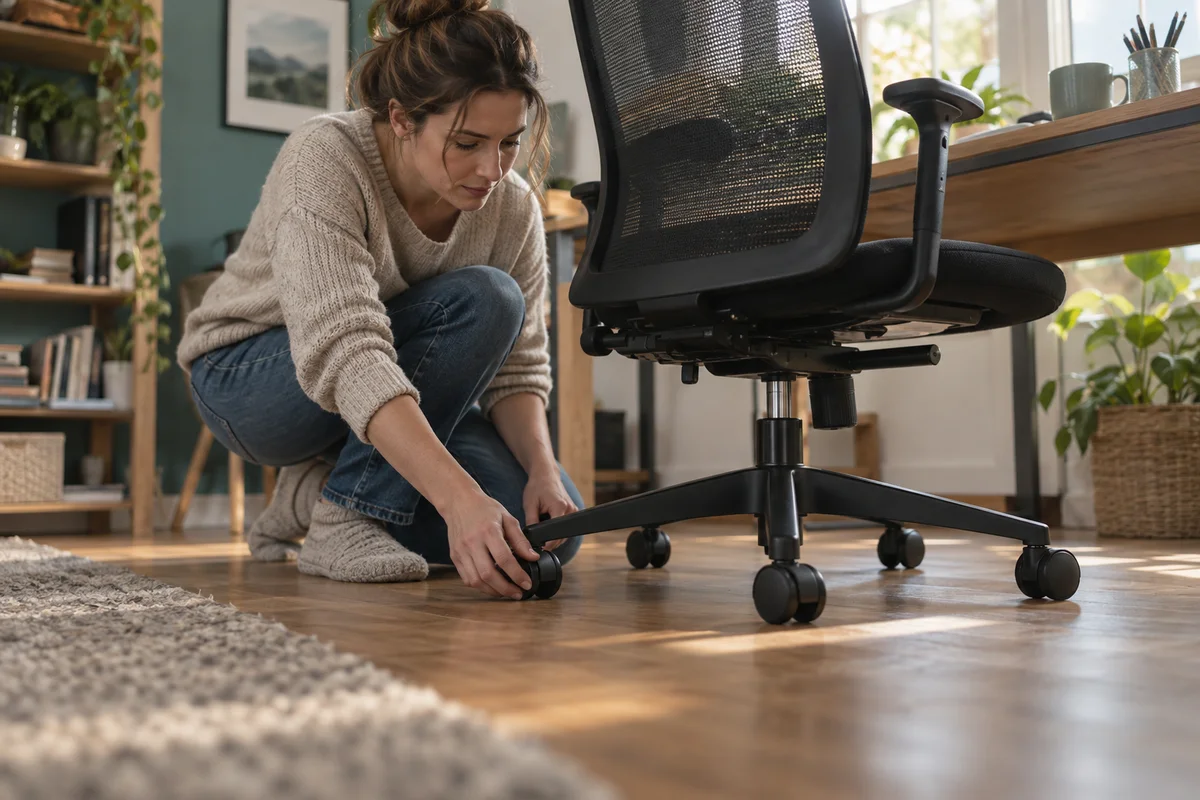 Home Office
EC200 Chair Casters: Check the Floor Before Upgrading
Assess the real rolling surface, upgrade package, and changed seat height before choosing EC200 casters or a chair mat.
Read guide →