
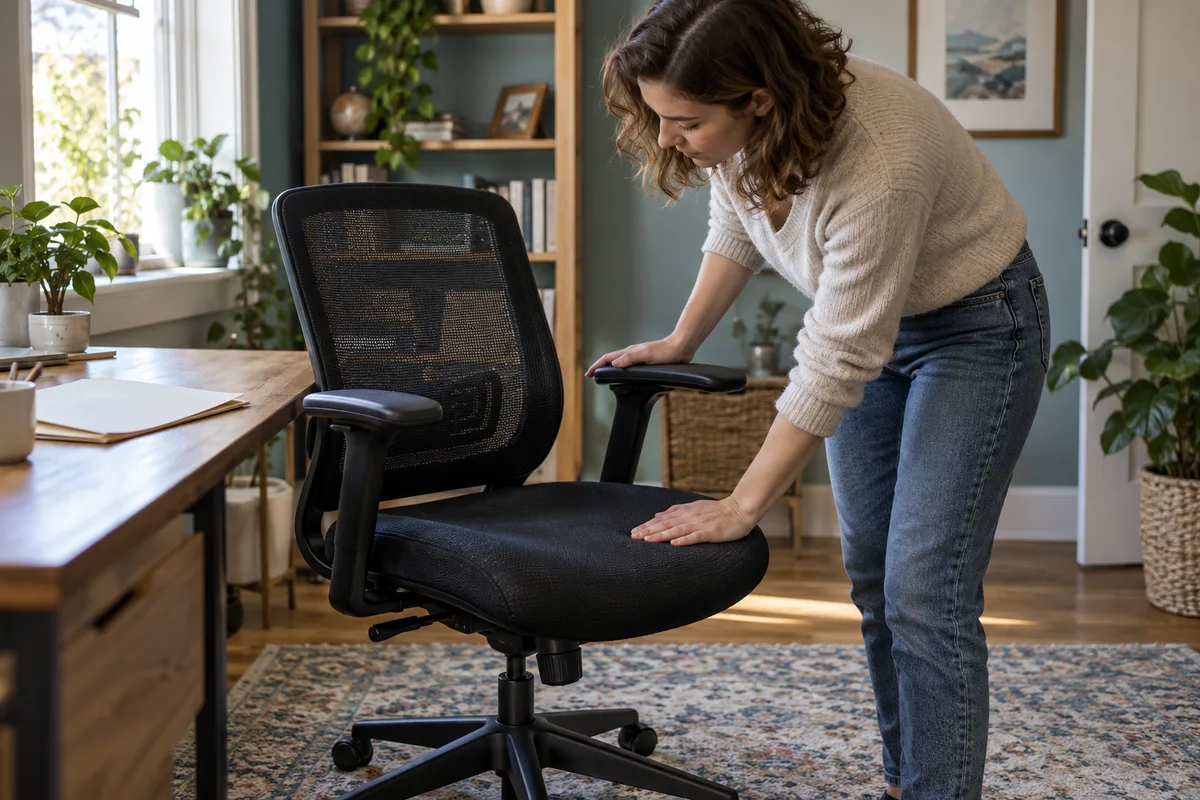
AI-generated scene illustration; not a photograph of the recommended product.
A local seller is offering an EC200 chair for less than a new one. The chair looks clean, and the advertisement mentions the manufacturer’s five-year warranty. That sounds reassuring until you ask whether the protection follows the chair to a second owner.
Before comparing prices, separate physical condition, the seller’s promises, and manufacturer eligibility. A used chair can still be a sensible purchase, but it should not be valued as though every new-purchase benefit transfers automatically.
The short answer
ProtoArc’s current warranty policy says warranty service is limited to the original purchaser and is non-transferable. It also excludes used purchases from its described extended coverage for third-party platforms.
Do not pay a used-chair premium based on the original owner’s remaining warranty. Compare the actual used offer, any separate seller protection, condition, transport, and potential paid parts with a qualifying new purchase. This is not a determination of your statutory rights.
Contents
- The short answer
- Identify what is being sold
- Read the model and policy together
- Distinguish three sources of protection
- Inspect without performing a stress test
- Price known costs separately from unknown risk
- Check the practical parts route
- Include transport and fit
- When used makes sense
- Frequently asked questions
- Sources and verification
Identify what is being sold
Ask whether the offer is privately used, marketplace-used, open-box, refurbished, or new. Those descriptions do not establish the same ownership history or protections.
Record the exact EC200 model rather than accepting EC200 Pro or another similar chair as equivalent. Ask what is included, whether parts were replaced, and whether the seller knows of unresolved adjustment or stability problems.
A photograph can show fabric condition but cannot establish the safe operation of every mechanism. Do not make a long trip or nonrefundable payment until the basic description is clear enough to evaluate.
Read the model and policy together
ProtoArc’s general policy lists a standard furniture warranty and directs readers to individual product information for different coverage. The EC200 product page advertises five years, while the comparison page describes structural coverage.
That is a reason to ask what the exact purchase covers, not to apply the longest number to every part or failure. Warranty duration, covered defect, sales channel, and eligible purchaser are different fields.
For a qualifying new order, retain the relevant current policy and product terms. For a used order, do not assume an original invoice overrides the explicit non-transferability statement. Ask support if a specific arrangement remains unclear before treating coverage as part of its value.
Distinguish three sources of protection
| Protection | What to verify |
|---|---|
| Manufacturer warranty | Eligible purchaser, channel, model and covered issue |
| Seller’s own promise | Written scope, duration and claim process |
| Separate protection plan | Provider, exclusions, transfer rules and practical claim route |
A marketplace return window is another separate condition. It is not automatically the same as manufacturer repair coverage.
Do not call all these arrangements “the warranty” in your comparison. That hides which organization would actually respond when an adjustment fails or a part is missing.
Inspect without performing a stress test
If the seller permits an in-person inspection, use an ordinary safe setting and ask for a demonstration of normal controls. Check that the description matches the chair and that there are no obvious missing parts or visible structural damage.
Do not bounce on it, force the recline, dismantle the gas lift, or load it beyond its instructions. An unsafe test does not establish long-term durability and can injure someone or damage the seller’s property.
A chair that rocks unexpectedly, fails to hold a documented setting, or has an unresolved structural concern should not be treated as a simple cosmetic bargain. Obtain suitable assessment or pass rather than guessing a cheap fix.
Price known costs separately from unknown risk
Use actual quoted figures for the chair, collection or shipping, and any confirmed paid replacement parts. Leave an unquoted repair as unknown rather than inventing a reassuring small allowance.
For illustration, compare two blank worksheets rather than a made-up market price. One contains the used purchase plus collection and known parts; the other contains the delivered new purchase and its applicable protections.
The difference is not automatically a saving. Decide whether it compensates for the used item’s uncertain remaining condition, lack of transferable manufacturer coverage, and potentially more difficult return route. The answer can reasonably differ between households.
Check the practical parts route
ProtoArc’s policy says some replacement parts are available through support and that parts purchases are final sale without its standard warranty. That does not prove every EC200 part is currently available or economical to ship.
Before buying a chair that already needs something, identify the exact part and obtain a current compatibility, stock, delivered-cost, and sales-condition answer.
A missing cosmetic trim piece and an unresolved load-bearing problem are different purchase situations. Do not let the existence of a parts department turn an unknown structural condition into a presumed routine repair.
Include transport and fit
A used chair that fits in the seller’s office may not fit your desk or vehicle. Confirm overall transport needs without assuming disassembly is simple or that every mechanism is intended for repeated removal.
At home, verify the actual seated working height, seat depth, and floor arrangement. Our EC200 high-desk guide addresses a separate fit limit that a lower used price cannot remove.
Our delivery and assembly guide helps compare the effort of a delivered new chair with collecting an assembled used one. Keep those logistics in the decision rather than treating your time and space as unlimited.
When used makes sense
A used EC200 may be worth considering when its normal condition and fit can be assessed, the seller’s description is transparent, the logistics work, and the price reflects the protections actually supplied.
A qualifying new offer deserves consideration when a documented support route and straightforward first-owner purchase matter more than the initial discount. Check the seller and exact channel rather than assuming every apparently new listing qualifies identically.
Pass if the seller insists the original warranty automatically transfers, refuses basic condition questions, or expects payment before you can establish essential facts. The EC200 review supplies model context, not verification of an individual used chair.
Frequently asked questions
Does EC200 warranty follow a private resale?
ProtoArc’s policy says warranty service is non-transferable and restricted to the original purchaser. Do not budget transferred coverage.
Does the original receipt alone guarantee a second owner’s claim?
No. Proof of an original transaction does not independently change the policy’s purchaser restriction.
Are used chairs always a poor choice?
No. Condition, fit, logistics, actual seller terms, and the size of the real discount determine the tradeoff.
Can I assume replacement parts are inexpensive and available?
No. Ask about the exact part, compatibility, stock and delivered cost before buying an item that needs it.
Sources and verification
Checked October 19, 2026. This is a purchase comparison, not legal advice, an inspection, or a promise that a specific claim will be accepted.
- ProtoArc warranty policy, resale restriction and paid-parts terms
- EC200 product information and model-specific warranty headline
Keep reading
Related guides
 Home Office
EC300 Backrest Fit: Lumbar Support Moves With It
Compare EC300 integrated backrest adjustment with EC200 independent lumbar adjustment, and choose the movement that fits your torso.
Read guide → Home Office
EC200 at a High Desk: Check Seated Working Height
Check whether a fixed high work surface calls for a different chair category instead of assuming EC200 height adjustment solves every desk.
Read guide → Home Office
EC300 Materials: A Mesh Back Is Not an All-Mesh Seat
Distinguish EC300 mesh backrest from its foam cushion and compare the actual sitting surface before choosing chair materials.
Read guide →