
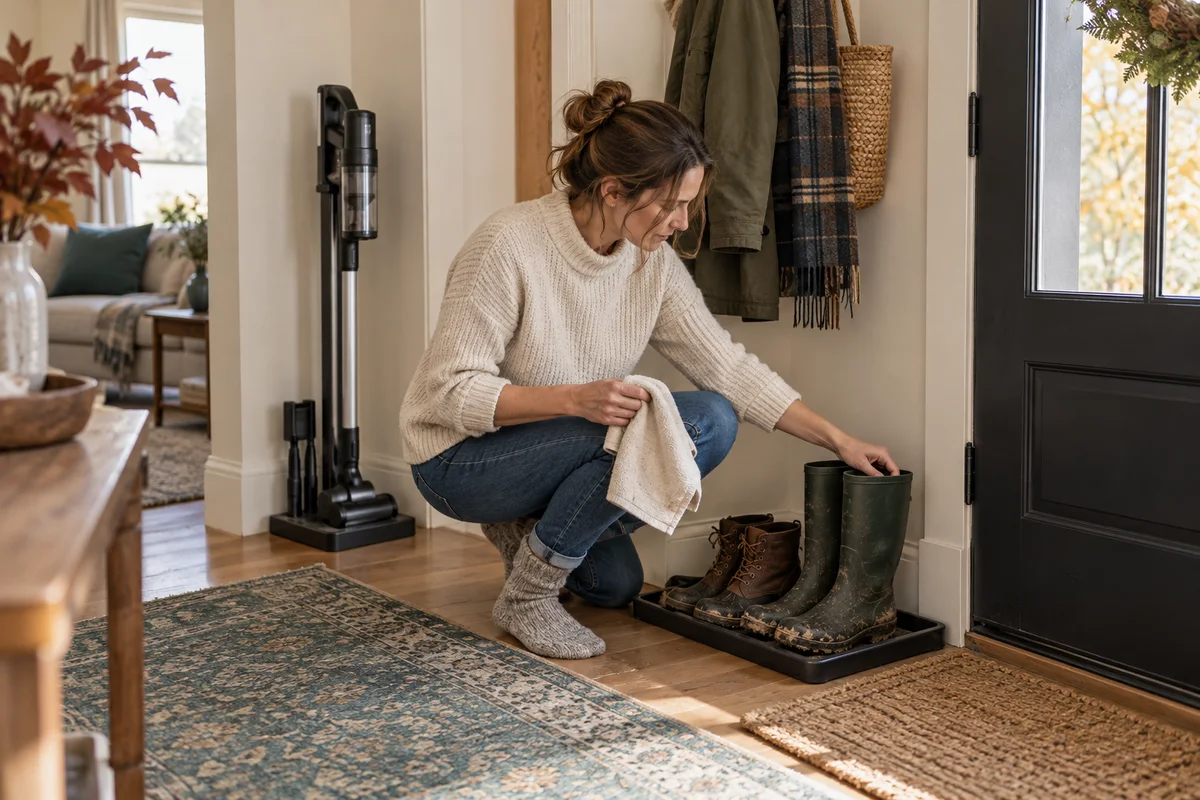
AI-generated scene illustration; not a photograph of the recommended product.
Wet boots reach the hallway before anyone remembers the mat. There is a damp trail on the tile, a little dry grit farther inside, and a cordless vacuum within reach. Treating those as one cleanup job is the mistake: a convenient dry vacuum does not become a wet-cleaning appliance because the mess is inconvenient.
Before buying a Dreame Z30 for an autumn entryway, decide which part of the routine it will perform. The sensible purchase may be a dry vacuum plus an ordinary surface-safe wet-cleaning tool, not a more expensive vacuum expected to do everything.
The short answer
The official Z30 V2406 manual limits use to dry indoor surfaces and prohibits wet-surface use and liquid pickup. It also excludes several hard, sharp, burning, or hazardous materials. Confirm the supplied regional instructions for the unit being sold.
Use the Z30 only for compatible ordinary dry debris after checking the area and the floor-care instructions. Handle wet mud and water separately with a method approved for the surface. A washable component is not permission to vacuum moisture. This is a task-boundary guide, not a hands-on pickup test.
Contents
- Sort the mess before choosing a tool
- Make a wet-first entryway sequence
- Keep outdoor work outside the vacuum plan
- Create a two-tool purchase card
- Check the handover between household members
- Decide when the Z30 is a good fit
- Frequently asked questions
- Sources and verification
Sort the mess before choosing a tool
Stop at the threshold and identify the actual material. Water, sticky residue, damp mud, dry crumbs, and small objects should not automatically enter the same cleaning sequence. Decide what must be contained, what needs wet cleaning, and what the vacuum is permitted to collect.
Do not decide by appearance alone. A surface can look almost dry while moisture remains in a mat or a muddy patch. Equally, a dry object may still be unsuitable: inspect for sharp fragments, hard items, and anything excluded by the appliance instructions.
Keep an unresolved mess out of the vacuum. Asking support or using an appropriate separate cleanup method costs less than attempting to discover the limit through a damaged appliance. A suction-power number does not answer a material-compatibility question.
Make a wet-first entryway sequence
Give footwear a place to pause before the wet trail spreads. A stable tray and an appropriate mat can separate the incoming mess from the clean indoor walking route. Neither should block the door or create an obstacle.
Contain and remove wet material using the floor manufacturer’s approved approach. Do not pour extra water onto a surface merely to make it easier to wipe. Different floors and mat backings have different care requirements, and the vacuum’s manual cannot settle those.
Allow the relevant surface and removable items to reach the condition required for the next step. Inspect before the dry-vacuum stage rather than treating an elapsed period as proof. Our rainy-day entryway mat guide addresses trapping and drying the mess; this article addresses which machine must stay away from it.
Keep outdoor work outside the vacuum plan
A patio, doorstep, garage spill, or pile of garden debris may be next to the hallway, but proximity does not make it an approved indoor vacuum task. Do not extend the Z30’s role beyond its supplied instructions.
Keep the appliance, charger, and stored attachments away from splashes. Avoid parking the vacuum in the wet boot area just because that is where cleanup starts. A dry, stable storage location should remain usable even during a busy arrival.
Do not collect renovation debris, fireplace residue, liquids, or unknown materials with a household dry vacuum unless its exact instructions permit the job. The Z30 manual has explicit exclusions. For an unusual mess, select a genuinely appropriate method rather than trying to compensate with a different suction setting.
Create a two-tool purchase card
Write two columns headed “wet cleanup” and “supported dry cleanup.” Put each recurring mess in one column, or mark it unresolved. Include the surface, who cleans it, where the tool is kept, and what must happen before it is returned to storage.
In the dry column, confirm the Z30’s appropriate brush and the actual package contents. In the wet column, list a floor-compatible cloth or mop arrangement and its drying location. Do not assume a large accessory bundle removes the need for a separate wet process.
Compare total ownership effort, not only machine cost. Two simple tools can be easier to maintain than one appliance bought on an incorrect assumption. Conversely, a home with frequent wet-floor work may need a different appliance category rather than a dry vacuum as its main solution.
Check the handover between household members
A routine fails when one person knows the boundary and another sees only the nearest tool. Make the permitted task clear enough to remember during a rushed evening, without asking everyone to study a buying guide.
Use a brief household note: contain wet material, use the approved wet method, inspect the surface, then consider compatible dry pickup. Keep the manufacturer’s exclusions with the appliance manual. Do not turn the note into a replacement for the detailed instructions.
Choose storage that reinforces the separation. If the wet cloth and charger share a crowded shelf, reorganize it. If someone cannot tell whether a mat or attachment is still damp, leave it out of the dry-vacuum route until the uncertainty is resolved.
Decide when the Z30 is a good fit
Consider the Z30 when your main need is supported dry indoor cleaning and you can manage the wet threshold separately. Assess the rest of your floor mix, normal session length, hand feel, and maintenance before narrowing the shortlist.
Skip it as an all-in-one answer to wet mud, liquid spills, or outdoor debris. Its useful role is narrower than that. The apartment cordless-vacuum guide covers the broader purchase; this check prevents a category mismatch at the front door.
Before ordering, confirm the model, supplied brush set, regional manual, and return conditions on the partner destination. A good purchase has a defined job on an ordinary rainy evening, not a promise to absorb every mess that reaches the home.
Frequently asked questions
Does a washable filter mean I can pick up wet mud?
No. Component maintenance and approved pickup materials are different questions. Follow the dry-surface and material restrictions in the exact manual.
Can I vacuum a mat immediately after wiping it?
Do not assume so. Check that the surface and material satisfy both the appliance and mat-care instructions. Waiting alone is not an inspection.
Should I buy a wet-dry appliance instead?
Consider that category if wet-floor work is the main recurring task, but verify its own supported surfaces, cleanup, and storage. The name does not guarantee suitability for every spill.
Sources and verification
Checked October 14, 2026. The sequence is WideLore’s editorial planning advice. No cleaning test is claimed; confirm your supplied regional Z30 manual.
Keep reading
Related guides
 Cleaning
Bagless Vacuum Emptying: Check the Bin Before Buying
Assess Z30 bin access, the correct release controls, waste-bin reach, and shared-household cleanup before choosing a bagless vacuum.
Read guide → Cleaning
Buying a Cordless Vacuum for Stairs: Check the Grip
Evaluate a cordless vacuum for stairs using handheld weight, reach, compatible attachments, floor materials, and a safe cleaning sequence.
Read guide → Cleaning
Dreame Z30 Filter Cleaning: Plan for Drying Time
Plan Z30 filter maintenance around approved cleaning, full drying, spare-part compatibility, and the next household cleanup.
Read guide →