
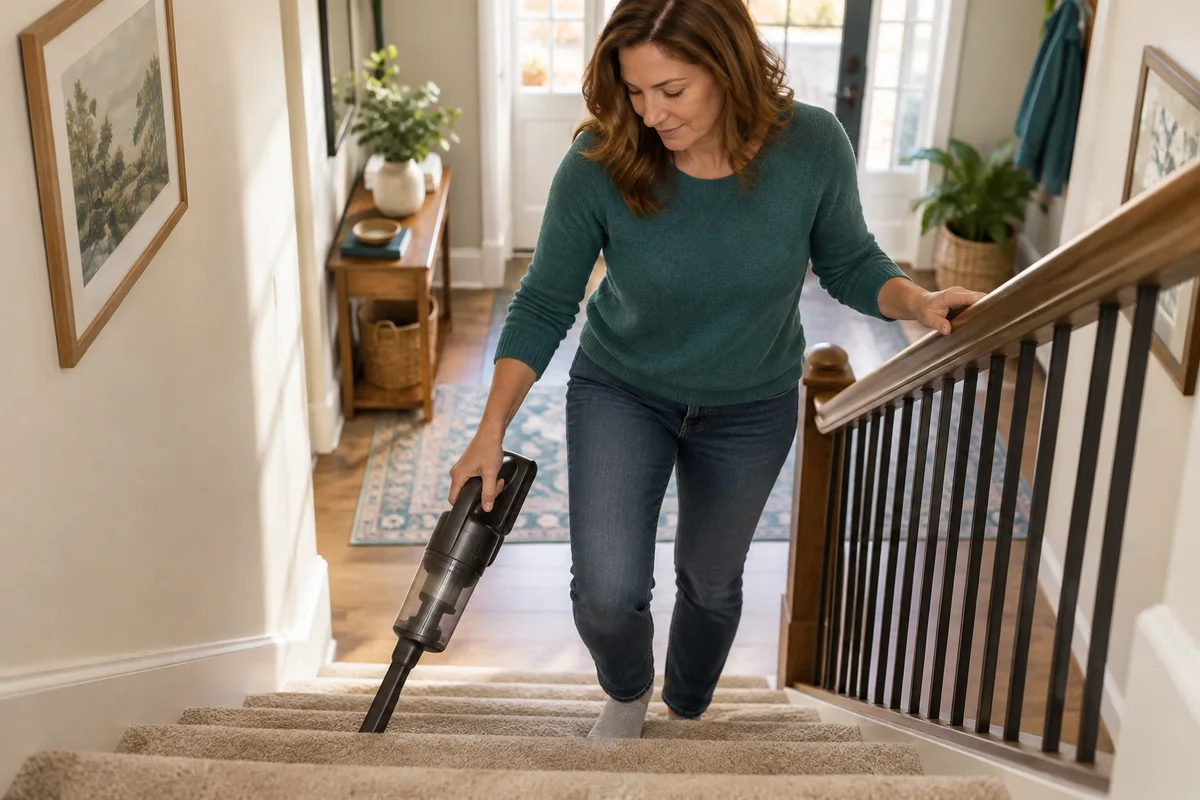
AI-generated scene illustration; not a photograph of the recommended product.
The staircase is where a cordless vacuum stops behaving like a showroom appliance. On a flat floor, its head supports part of the weight. On steps, the user lifts, aims, changes reach, and works around a railing. A machine that feels manageable across the living room can become awkward halfway up the stairs.
Before buying a Dreame Z30 for a multi-level home, define the stair job separately from the full-floor job. This is a practical purchase checklist for dry indoor stairs, not a claim that one vacuum is safe or comfortable for every person.
The short answer
Assess the exact handheld configuration and supported attachment, not the product’s lightest advertised weight. Check stair material, reach, grip, controls, storage, and whether you can keep a stable stance with access to the handrail.
Dreame’s Z30 manual lists a combination tool for stairs and hard-to-reach areas and calls for extra care on stairs. Use its approved configurations. If cleaning requires leaning, balancing, or carrying more than you can control, choose a different tool or get assistance rather than adapting the task around the purchase.
Contents
- Map the staircase before the shortlist
- Compare the working configuration
- Match the attachment to the surface
- Plan a controlled route
- Evaluate the first cleaning session
- Make the purchase decision
- Frequently asked questions
- Sources and verification
Map the staircase before the shortlist
Look at the ordinary mess: dry crumbs on treads, hair at carpet edges, dust beside balusters, or debris on a landing. These are separate reaches. A large floor head may cover a tread but miss the narrow corner where most of the visible dirt collects.
Note tight turns and places where furniture or stored shoes restrict movement. Clear those obstructions as part of the household routine. Do not accept a complicated lifting maneuver merely because the machine technically reaches the top of the staircase.
Photograph the surfaces for your own shopping notes and identify any fragile covering. Obtain its care instructions. A vacuum manufacturer cannot decide what a particular antique runner or delicate fabric can tolerate. Product compatibility and surface compatibility must both be satisfied.
Compare the working configuration
Ask what the published weight includes. A figure for the motor body may exclude the tube, powered head, or attachment you intend to use. You are buying a tool in the configuration that performs the task, not a number on its own.
Consider where the mass sits relative to your grip. An attachment held at arm’s length may demand more control than the same weight close to your body. This is a reason to assess reach conservatively, not to assume a smaller body guarantees comfortable use.
Check whether the controls are reachable without an awkward change of grip. Compare the need to hold a trigger with the model’s supported operating method. Do not invent a workaround for a control that is difficult for the intended user.
Where a store or seller offers an authorized demonstration, evaluate the actual configuration there. Confirm its rules first. A return policy is not automatically permission to use an item for an extended home trial, and a promotional video is not a substitute for your own fit assessment.
Match the attachment to the surface
A narrow combination tool can address edges and corners without pretending to clean the whole tread efficiently. A compatible powered attachment may suit some fabric jobs, but that does not make it suitable for every carpet, runner, or upholstery material.
The Z30 manual distinguishes attachment roles and cautions against fragile surfaces for its motorized mini-brush. Use the specific guidance rather than assuming every included head is interchangeable. Check the current package because accessory bundles may differ between sellers.
If your staircase combines painted wood with a runner, list both care requirements. Do not drag a head intended for another surface across a finish you want to preserve. Stop if the tool snags, marks, or pulls at material. More suction is not always the answer to an attachment mismatch.
Plan a controlled route
Clear the stairs before starting and keep other household members from moving through the work area. Set the required attachment ready on a stable landing rather than leaving small parts on steps. Avoid cluttering your escape path with the machine’s packaging or charger.
Choose a sequence that lets you work from a stable position without leaning over several treads. Move deliberately between sections, keeping the handrail available. If a reach cannot be made comfortably, reposition or stop. Do not balance on a stool placed on a stair.
Keep the task limited to dry indoor debris supported by the manual. Wet entry mess, construction dust, sharp objects, and hazardous material are different problems. A routine vacuum purchase should not be justified by jobs the appliance is not designed to perform.
Plan where the machine rests during interruptions. A vacuum balanced upright on a narrow tread can fall or become an obstacle. The easiest storage spot on a floor plan may still be the wrong resting place during stair cleaning.
Evaluate the first cleaning session
Once you own a suitable tool, start with a modest ordinary cleanup rather than a difficult whole-house session. Use approved instructions and note whether you can control the configuration, reach edges, and change sections without rushing.
Keep three observations separate: pickup, handling, and interruption. A head may pick up well yet be tiring to position. A comfortable tool may need several changes for corners. A large dust cup may not matter if you cannot park the machine safely when somebody needs the stairs.
Record what actually happened rather than converting an advertised battery maximum into a personal runtime claim. You might find that the stair job is short and needs only a compact configuration. In that case, buying for the longest possible battery figure could miss the real requirement.
Do not continue through strain or instability merely to finish a test. This guide is not an assessment of injury risk, and an appliance cannot compensate for a staircase or mobility problem. Seek appropriate help when the task itself cannot be performed safely.
Make the purchase decision
Use a short acceptance card: supported dry surfaces, suitable attachment, controllable grip, reachable controls, stable positions, convenient storage, and tolerable maintenance. Include the exact version and accessory package beside each answer.
The Z30 belongs on the shortlist if those answers work and it also serves your ordinary floor routine. Pass if your primary need is a dedicated lightweight stair tool, if the supported attachments do not match delicate material, or if handling cannot be assessed confidently.
A canister arrangement, a different compact handheld, or help with the task may be the better alternative. Compare the complete workflow rather than asserting that cordless is always superior. Removing a cable solves one inconvenience but does not remove every handling constraint.
For the separate upkeep decision, see our filter-drying plan. Check the partner listing only after confirming the package and your stair requirements.
Frequently asked questions
Is the lightest cordless vacuum automatically best for stairs?
No. Configuration, reach, grip, attachment and controls matter alongside weight. Evaluate the complete supported setup for the intended user.
Can a powered mini-brush clean every stair runner?
No universal compatibility claim is appropriate. Check both the attachment instructions and the runner’s care guidance, especially for fragile fabrics.
Does maximum battery runtime tell me how stair cleaning will feel?
No. Runtime does not establish handling comfort or stability, and advertised maximum conditions may differ from your attachment and mode.
Sources and verification
Checked October 13, 2026. Advice is an editorial task checklist, not a measured Z30 handling comparison. Confirm local instructions and the current accessory package.
- Dreame Z30 manufacturer product information
- Z30 V2406 official manual, safety and accessory guidance
Keep reading
Related guides
 Cleaning
Bagless Vacuum Emptying: Check the Bin Before Buying
Assess Z30 bin access, the correct release controls, waste-bin reach, and shared-household cleanup before choosing a bagless vacuum.
Read guide → Cleaning
Dreame Z30 Filter Cleaning: Plan for Drying Time
Plan Z30 filter maintenance around approved cleaning, full drying, spare-part compatibility, and the next household cleanup.
Read guide → Cleaning
Can the Z30 Clean Wet Mud? Separate the Entryway Jobs
Separate wet mud, hazardous debris, and ordinary dry grit before choosing a Z30 for the indoor part of an autumn entryway routine.
Read guide →