
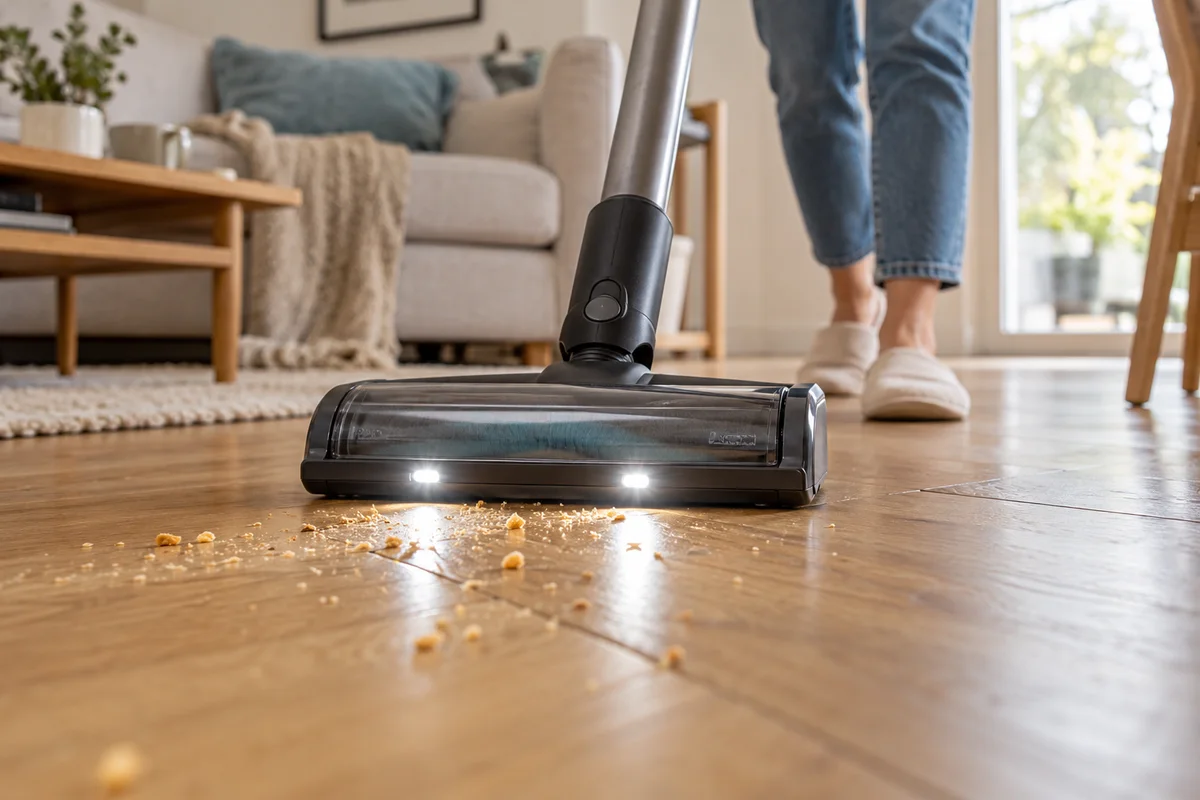
AI-generated scene illustration; not a photograph of the recommended product.
An evening sunbeam reveals crumbs beside the kitchen island. Later, under different light, the same patch looks clean. A vacuum headlight is appealing because it helps the person see the cleaning path, but visibility and verified cleanliness are different things.
This guide considers the Eureka ReactiSense NEC440BK for a dry-floor routine. It separates three features shoppers can accidentally combine: floorhead illumination, the handle display and the machine’s dust-sensing behavior.
The short answer
Eureka describes floorhead illumination separately from its LED status display. The NEC440 manual also identifies a dust-sensor indicator. A light that makes debris easier to see is not a laboratory cleanliness test, and the disappearance of visible crumbs does not prove that a surface is free of allergens or microorganisms.
Buy around useful visibility on your actual floors, supported pickup and maintainable equipment. Do not pay for an imagined guarantee that an illuminated path or indicator color can certify the whole room.
Contents
- The short answer
- Give each feature a different job
- Assess the floor under ordinary lighting
- Keep the sensor question separate
- Avoid a false stopping rule
- Compare the complete visibility arrangement
- Separate illumination from product identity
- Buying advice
- Frequently asked questions
- Sources and verification
Give each feature a different job
A floorhead light helps a person inspect the area ahead of the tool. A status display helps the person read machine information. A sensor indicator reports something within the machine’s documented operating system.
These can be useful together without being interchangeable. If the headlight reveals a crumb, that observation concerns a visible object at that angle. If an indicator changes, it concerns the system described by the manufacturer. Neither observation independently establishes the condition of the entire floor.
Use precise questions when comparing vacuums. “Can I read the battery level?” differs from “Can I see debris under the table?” A product described as having an LED display does not automatically answer both.
Assess the floor under ordinary lighting
Before shopping, look at the places where cleanup is currently difficult. A shaded toe-kick, a dark floor and a bright reflective tile present different visibility problems. Include the lighting people normally use, not just a carefully staged sales photograph.
Do not create a dark obstacle course to assess a vacuum. Keep the room safely lit, the route clear and the user in a stable position. Additional illumination should support ordinary cleaning rather than replace safe room lighting.
Write down one useful outcome: noticing dry crumbs along a cabinet edge, for example. Avoid an impossible standard such as seeing every particle on every surface. A focused outcome makes it easier to evaluate a purchase without pretending to measure invisible contamination.
Keep the sensor question separate
Our NEC440 Auto-mode guide explains the mode and runtime issue. Here the important distinction is that a sensor’s response is not the same signal as a person’s view of the illuminated floor.
A sensor may respond to conditions in its documented sensing path while debris remains outside the nozzle’s reach. A surface can look visually clear while fine material remains. These possibilities are reasons not to turn either signal into a whole-room assurance.
If an indicator behaves unexpectedly, record the mode, surface and observed behavior for support. Do not defeat the sensor or alter the machine to make a preferred color appear. Changing a display outcome is not the same as improving pickup.
Avoid a false stopping rule
A household needs a reasonable way to decide when an ordinary cleanup is finished. Use the defined route, permitted surfaces and an inspection suited to the job. Do not continue repeated passes only to chase a reassuring icon.
For example, after dry crumbs are collected from a permitted hard-floor area, inspect edges from a normal standing position and check for anything left outside the cleaning path. If the floor needs another permitted method, treat that as a separate task rather than forcing the vacuum to do everything.
This is not infection-control advice or an allergy-management plan. A household with specific health concerns should use appropriate professional guidance instead of treating a consumer appliance indicator as a diagnostic instrument.
Compare the complete visibility arrangement
| Feature to inspect | Practical question | What it cannot establish alone |
|---|---|---|
| Floorhead illumination | Can the intended user see the ordinary path? | Every particle has been removed |
| Handle display | Is needed status information readable? | The room is safe or sanitized |
| Sensor indication | What does the exact manual say it represents? | All surfaces received equivalent cleaning |
| Head access | Can the tool reach the intended area normally? | A light compensates for poor physical access |
| Maintenance | Can the relevant parts be cared for correctly? | Brightness replaces airflow or filter care |
Record these separately when comparing products. A bright lamp can be attractive in a demonstration while an awkward head prevents reaching the actual cleaning area.
Readability is personal and environmental. We have not assessed the display at different viewing angles or with different vision needs, and no claim of universal accessibility is made.
Separate illumination from product identity
Do not infer a laser system, particle counter or exact detection threshold merely because a photograph shows a bright strip of light. Ask what the manufacturer actually specifies for the selected model.
Listings sometimes place several machines in a comparison chart. Check that a headlight, display or sensing claim belongs to the NEC440BK option being sold, not a different product in the same family.
If a feature is important but its description is ambiguous, obtain a clear answer before ordering. A decorative badge or a third-party demonstration of another model is not adequate confirmation.
Buying advice
Consider NEC440BK when its documented visibility features fit a real dry-floor problem and the rest of the vacuum suits the household. Useful illumination can reduce uncertainty about visible debris without needing to be a medical or scientific feature.
Pass if the purchase depends on a promise that a colored indicator certifies cleanliness. Also pass if the tool cannot reach the relevant area, its maintenance routine is unacceptable or the intended mess is outside its supported use.
Keep an existing suitable vacuum if improved room lighting and a more deliberate route already solve the problem. Buying a brighter floorhead is not automatically the shortest way to improve the cleanup.
Frequently asked questions
Does an LED display mean the floorhead has the same function?
No. Status information and illumination serve different purposes. Check the exact feature description for each.
Can a clear-looking floor prove that allergens are gone?
No. Visual inspection cannot establish that claim, and this article reports no allergen-removal test.
Should I choose the highest sensor response as a cleaning target?
No. Follow the documented meaning of the indicator and a suitable cleaning routine rather than trying to produce a particular signal.
Is this article saying floorhead lights are useless?
No. They can help a person see ordinary debris. The limitation is what that observation proves, not whether better visibility can be convenient.
Sources and verification
Checked October 23, 2026. No illumination, particle-detection, microbiological or pickup testing was performed.
- Eureka ReactiSense 440: illumination and display descriptions
- NEC440 official manual: status and sensing indicators
Keep reading
Related guides
 Cleaning
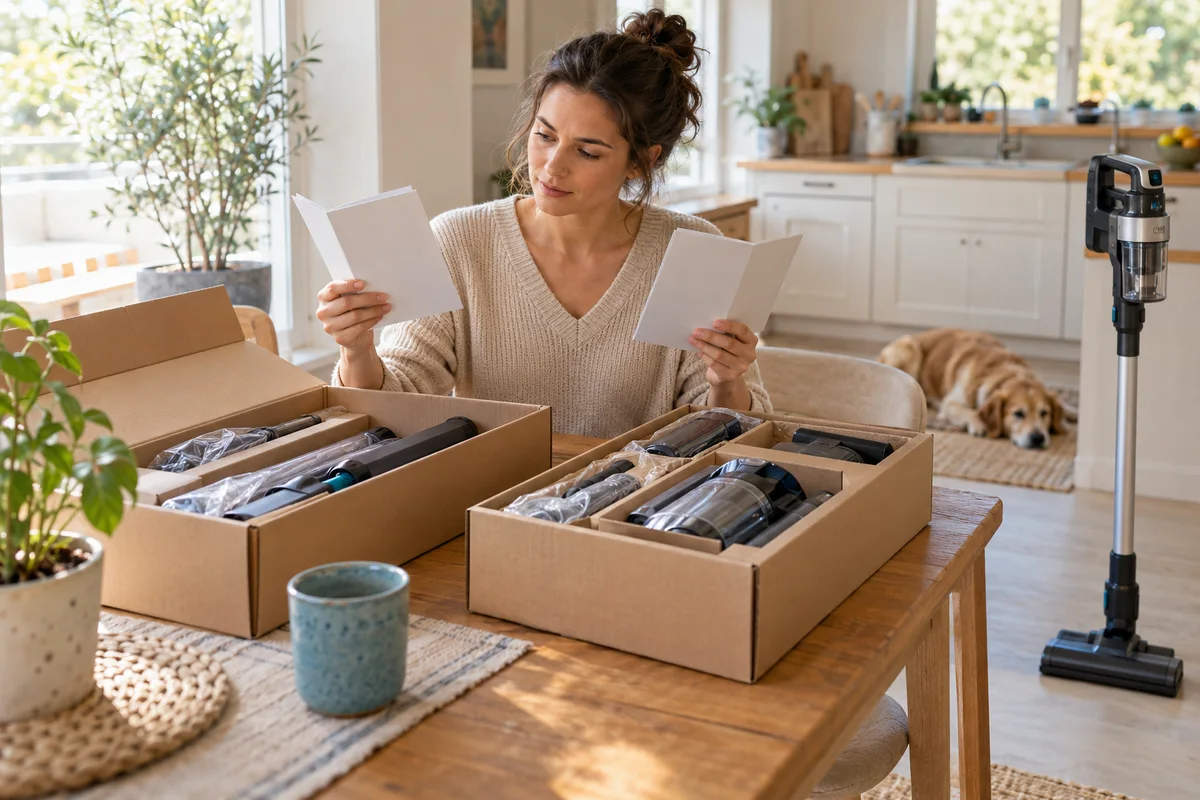
ReactiSense 440 vs 410 and 451: Match the Exact Model
Compare Eureka 440, 410 and 451 by exact identity, supplied tools and task fit rather than transferring a family chart into the wrong order.
Read guide →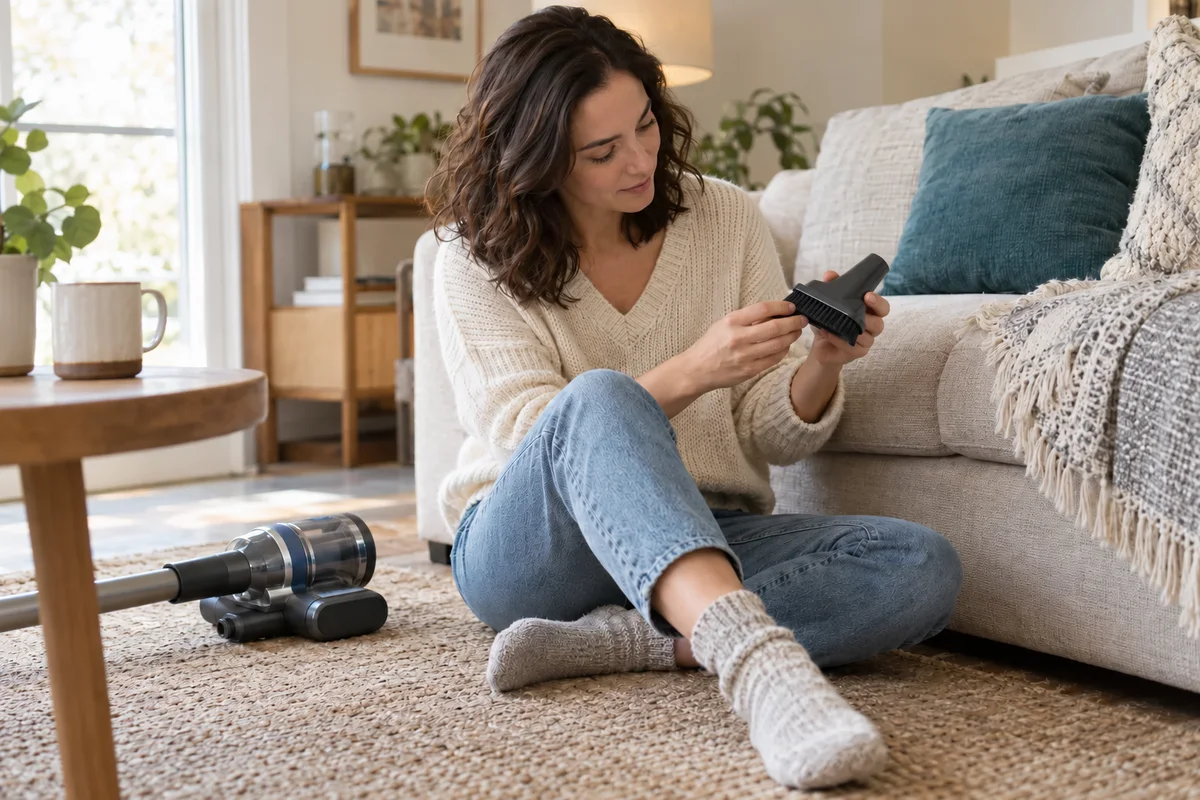 Cleaning
NEC440 Sofa Cleaning: Check the Handheld Tool Package
Check the NEC440's supplied crevice and upholstery tools against your sofa's care instructions before assuming a powered mini-brush is included.
Read guide →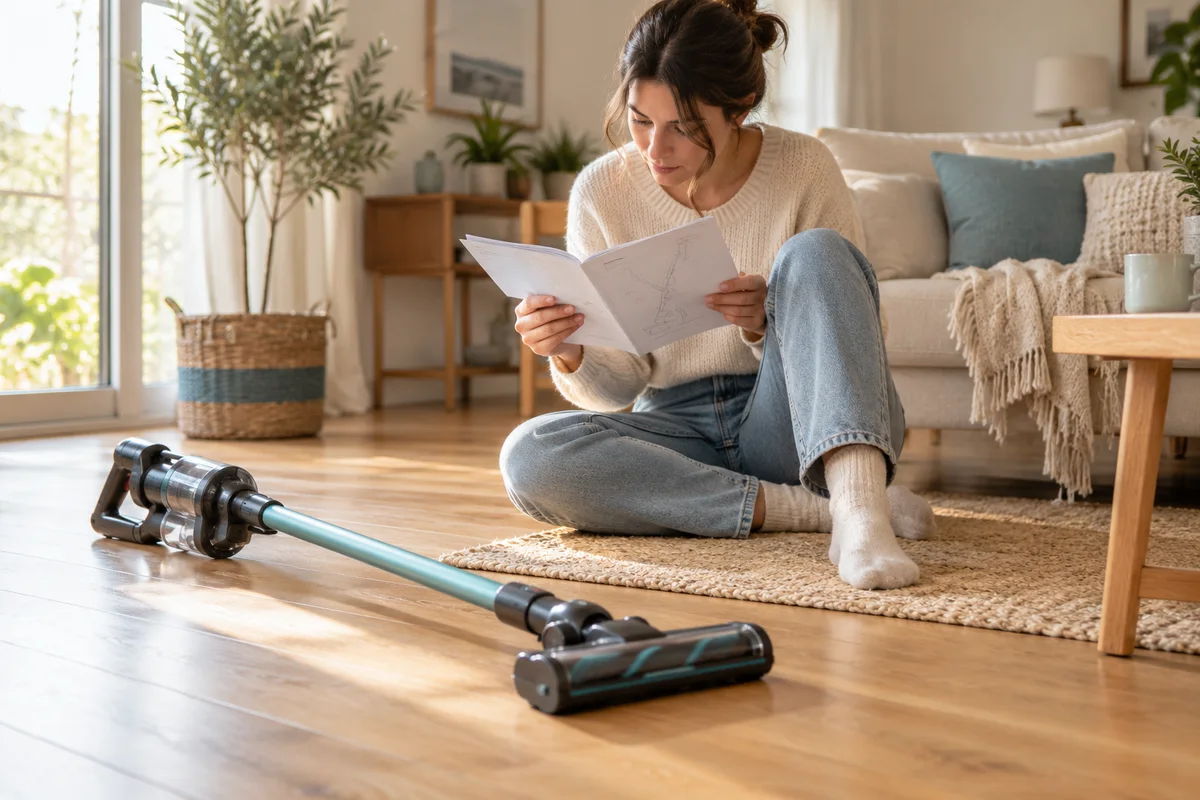 Cleaning
NEC440 Stops Suddenly: Read the Thermal-Cutoff Rule
Use the NEC440 manual's thermal-cutoff sequence to separate a sudden stop, permitted airflow checks and the point to contact Eureka support.
Read guide →