
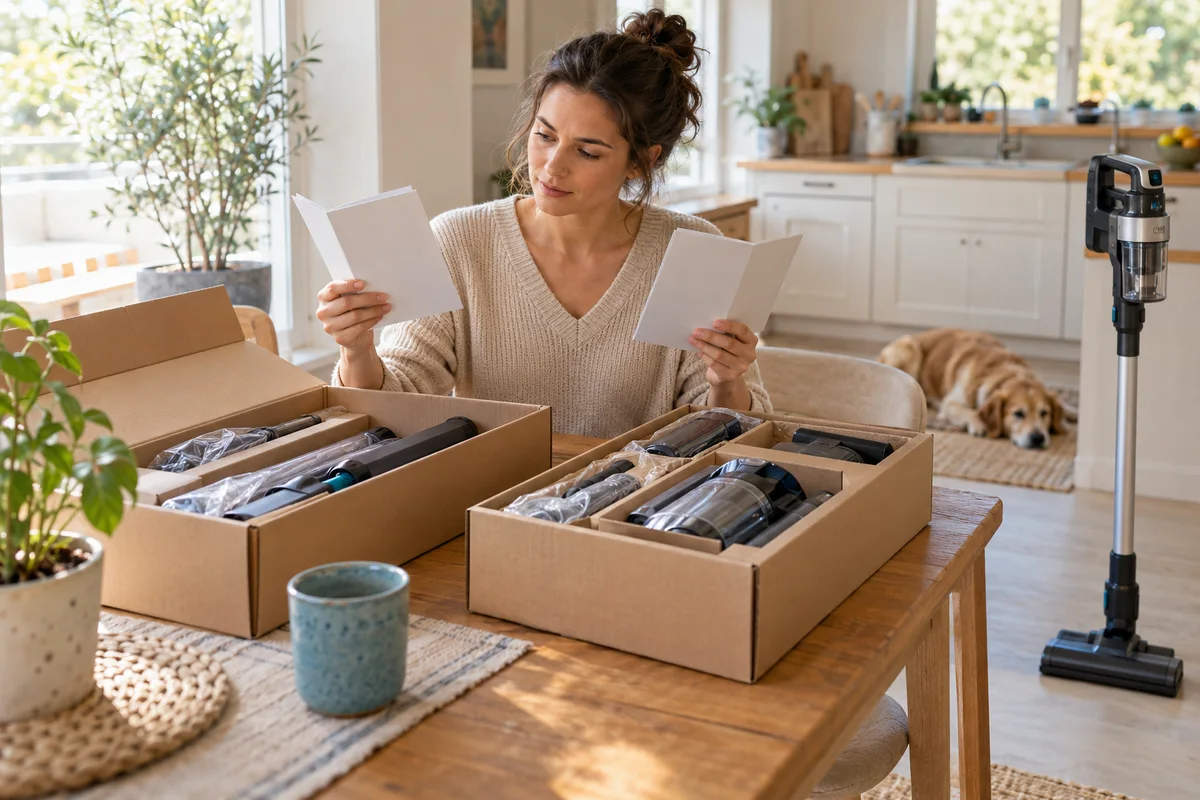
AI-generated scene illustration; not a photograph of the recommended product.
A shopper searches for a Eureka cordless vacuum and finds 410, 440 and 451 descriptions in the same comparison area. The names look close, several photos use similar shapes, and a headline runtime may appear more decisive than the package actually being purchased.
The practical goal is not to memorize the whole family. It is to confirm which machine is being sold and whether its documented differences matter to the home’s cleaning route.
The short answer
Eureka’s current ReactiSense 440 page presents 440 and 451 as closely matched versions with different colors, while 410 occupies a different specification tier. Do not transfer the 440’s listed equipment to a 410 order, or assume every seller’s 451 package is identical without checking.
The partner link on this page is for NEC440BK, ASIN B0F9L92BTC. Use the selected option, itemized accessories and supplied model manual as purchase evidence. A family comparison panel is useful context, not a substitute for identifying the actual order.
Contents
- The short answer
- Compare categories of difference
- Read the manufacturer’s comparison cautiously
- Keep mode-specific runtime in its own row
- Make the exact-option check before comparing offers
- Use a model-selection worksheet
- Check consumables and parts by exact identity
- Buying advice
- Frequently asked questions
- Sources and verification
Compare categories of difference
Start with three columns: identity, capability and ownership. Identity contains the complete model and seller. Capability contains the functions needed for the household. Ownership contains the accessories, supported parts and service terms that apply to the order.
Keeping these columns apart prevents an attractive color from being mistaken for a technical upgrade. It also prevents a higher headline specification from hiding a package that lacks an attachment important to the buyer.
For example, a home with mostly accessible dry floors may care more about the supplied floorhead and maintenance than the largest advertised suction number. Someone cleaning a sofa also needs a suitable small-tool configuration. These are different purchasing priorities.
Read the manufacturer’s comparison cautiously
The official 440 page describes the 410 as the entry option and distinguishes listed suction, battery and brush equipment. It also describes 440 and 451 as sibling variants. Those statements are manufacturer comparisons, not WideLore measurements.
Treat the chart as a source of questions to confirm on the selected listing. Does this order contain the stated head? Does the color option preserve the same model identifier? Is the retailer showing a current description or a mixed comparison panel?
Do not calculate a percentage improvement in real cleaning performance from a pressure figure. Different surfaces, tools and operating conditions determine what a pickup comparison would need to measure. We have not conducted that comparison.
Keep mode-specific runtime in its own row
A long headline runtime can be reported for a particular setting. It should not be copied into a different mode, accessory configuration or complete-house expectation.
Our NEC440 Auto-mode article handles that separate distinction. This model-selection checklist does not establish a new endurance result, nor does it resolve every discrepancy between a comparison panel and a supplied manual.
Write the relevant condition beside any runtime number you save. If that condition is unavailable, label the number as insufficient for your route rather than treating it as a guaranteed cleaning window.
A lower-tier vacuum might still complete a short suitable task. A higher-tier vacuum may still require a recharge during a longer route. The model name alone does not answer how a particular household will use it.
Make the exact-option check before comparing offers
Open the selected product option and read the model field, color, package contents and seller identity together. Recheck after changing a color or bundle selector. The photograph can remain similar while the order details change.
Keep a dated note or permitted screenshot for your own purchase record. Record what the seller actually promises, not a statement copied from a review of a neighboring model.
Ask about contradictions before paying. An answer should identify the complete product, not merely say that it belongs to the ReactiSense range. If support cannot resolve a material equipment difference, compare another clearly described offer.
Use a model-selection worksheet
| Field | What to compare | Purchase consequence |
|---|---|---|
| Full model | Exact label and selected option | Identifies which manual and parts apply |
| Floorhead | Itemized included head | Determines the documented cleaning configuration |
| Small tools | Actual included attachments | Affects sofa and narrow-gap tasks |
| Mode conditions | Relevant supported operating settings | Prevents maximum-runtime assumptions |
| Care | Accessible and supported maintenance | Determines recurring work |
| Service | Seller and applicable terms | Determines who handles a problem |
This worksheet deliberately avoids a winner score. A score would hide the fact that a missing essential tool can matter more than several marginal specification differences.
Write one non-negotiable task at the top. If that task fails, do not let a discounted price or a more appealing color override the result.
Check consumables and parts by exact identity
Similar-looking machines can still need model-specific parts. Obtain compatibility confirmation for filters, batteries, chargers and attachments rather than ordering on appearance alone.
The NEC440 battery checklist explains why a detachable pack is not itself proof of an available supported spare. This comparison does not extend that pack’s compatibility to 410 or 451.
Also separate a merchant’s advertised package from future accessory availability. An included tool today and a replacement tool available later are different promises. If keeping the vacuum for several years matters, ask about the specific recurring items before purchase.
Buying advice
Consider NEC440BK when its verified equipment addresses the household’s route and the actual seller gives a clear account of the package and service. Choosing 440 should be a task-based decision, not a belief that a larger family number always makes a better vacuum.
A simpler model may be sensible when its supported equipment is sufficient and the current total cost is preferable. A different vacuum may be better if the essential attachment or parts route cannot be confirmed.
Do not buy an additional whole machine merely to change color or because two family descriptions look inconsistent. Resolve the identity question first. The commercial listing linked here is the 440 candidate, not a verified offer for every model discussed.
Frequently asked questions
Are 440 and 451 automatically the same purchase?
No. Eureka describes them as closely matched color variants, but the selected seller’s exact model, package and terms still need verification.
Can I assume 410 includes the 440 floorhead?
No. Check the itemized equipment for the exact order instead of borrowing another model’s description.
Does a higher suction number prove better real pickup?
Not by itself. A valid performance comparison needs matched surfaces, debris, configuration and conditions. No such test is reported here.
Should I use one manual for the whole family?
Use the manual applicable to the complete model supplied. Family resemblance does not establish identical instructions or replacement compatibility.
Sources and verification
Checked October 23, 2026. Family descriptions are attributed to Eureka; no side-by-side pickup or runtime test was performed.
- Eureka ReactiSense 440: current family comparison and FAQ
- NEC440 official manual: exact-model equipment and operation
Keep reading
Related guides
 Cleaning
NEC440 Floorhead Light Is Not a Cleanliness Test
Separate NEC440 floorhead illumination, status display and dust sensing so improved visibility never becomes an unsupported cleanliness guarantee.
Read guide → Cleaning
NEC440 Sofa Cleaning: Check the Handheld Tool Package
Check the NEC440's supplied crevice and upholstery tools against your sofa's care instructions before assuming a powered mini-brush is included.
Read guide → Cleaning
NEC440 Stops Suddenly: Read the Thermal-Cutoff Rule
Use the NEC440 manual's thermal-cutoff sequence to separate a sudden stop, permitted airflow checks and the point to contact Eureka support.
Read guide →