
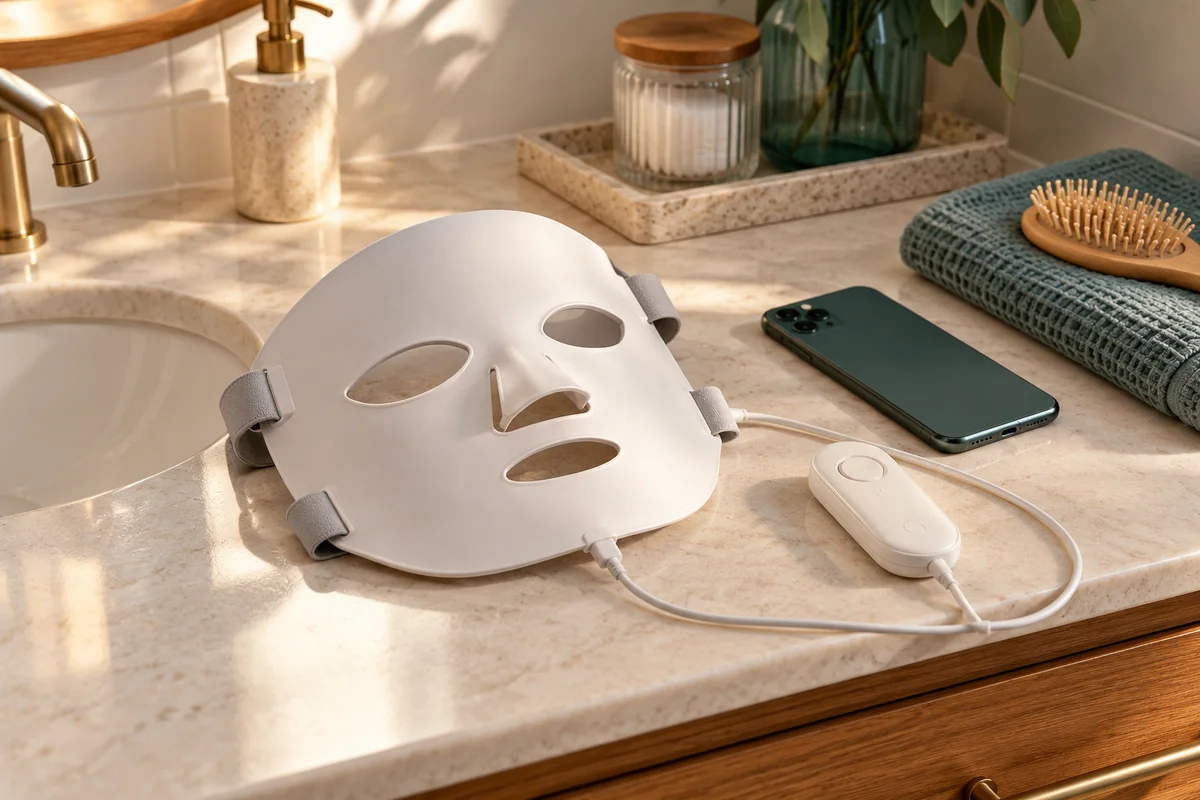
AI-generated scene illustration; not a photograph of the recommended product.
The living-room lights already respond to a Nanoleaf scene, so a face mask from the same brand seems likely to appear in the same app. The shopper starts imagining a bedtime automation before checking the product’s actual controls.
That expectation is the buying risk. A shared brand does not establish shared radios, pairing, routines or remote operation. For this mask, app-free is a product boundary worth understanding before paying for a connected-home feature it does not offer.
The short answer
Nanoleaf’s official wellness specifications say these devices have no Wi-Fi, Bluetooth or integration with the Nanoleaf app or ecosystem. The mask is a standalone device with controller-based operation. The current product listing also identifies app-free operation.
Do not buy it for Matter scenes, remote starts, app session history or voice-assistant control unless the exact current product explicitly documents such a capability. Do not try to manufacture those features with a smart plug or another product’s pairing instructions.
Contents
- The short answer
- Separate the brand from the device category
- Understand what the controller changes
- Do not convert a reminder into remote operation
- Leave smart plugs out of the operating plan
- Make an app-free buying checklist
- Consider gifting without making pairing a requirement
- Decide whether fewer connected features is useful
- Frequently asked questions
- Sources and verification
Separate the brand from the device category
Start with the exact item on the order, not the app already installed on the phone. Nanoleaf makes products with different roles, and its lighting ecosystem does not define every item bearing the name.
The official wellness specifications are unusually explicit about the absence of smart connectivity. That statement resolves the pairing question more directly than a familiar logo or a site’s general app-download footer.
Write the product model on your purchase note and save the applicable instructions. A support article for lighting panels is not a mask setup guide. Nor does a QR code or downloadable manual establish wireless control.
If the destination listing promises app features that conflict with the official device description, resolve the discrepancy before ordering. Do not assume an undocumented feature was added simply because the listing uses “smart” loosely.
Understand what the controller changes
Controller operation means the person using the device manages the documented settings through its supplied controls. It does not mean the device lacks adjustable settings; it means those settings should not be expected inside the home-lighting app.
Check what comes in the exact package and how the controller connects and charges. The current mask listing identifies a device controller and charging cable among the supplied items.
Keep charging instructions separate from operating instructions. Our mask charging and care guide covers that ownership boundary. An ordinary USB charging connection does not establish app data transfer or a remote-control interface.
Before buying, consider whether handling physical controls fits the intended user. If a phone interface is essential for accessibility, obtain an exact supported answer instead of treating app-free operation as a minor inconvenience.
Do not convert a reminder into remote operation
A calendar notification can remind a person to read instructions or consider a routine. It does not operate the mask, assess suitability, select a setting or supervise use.
Keep those actions distinct. A reminder should not be written as a command that assumes the device has started. Avoid creating a household automation where lights changing color is taken as proof of mask status.
There is no need to configure a lighting scene to make the mask useful. If the appeal is a break from app management, standalone controls may be a benefit rather than a missing feature.
Conversely, if connected session records are central to the purchase, compare a product that actually documents the required function. Do not infer health outcomes from the presence or absence of a log.
Leave smart plugs out of the operating plan
A smart plug controls electricity at its socket; that does not make a rechargeable wellness device a supported remotely operated appliance. It also does not establish what state the controller will enter after power changes.
Do not bypass the device’s controls, improvise auto-start behavior or use repeated power interruptions as a test. Follow the mask manufacturer’s charging and operating instructions.
Ask one specific question if a seller proposes such a workaround: where does the exact product manual approve this arrangement? Without that evidence, do not include it in a buying recommendation.
The same reasoning applies to generic Bluetooth adapters. A separate adapter cannot be assumed to add a documented control interface that the product does not have.
Make an app-free buying checklist
| Requirement | What to establish |
|---|---|
| Physical operation | The intended user can understand and reach the supplied controls |
| Instructions | The exact product’s safety and suitability guidance is available |
| Charging | The supported charger and cable arrangement is understood |
| Connected home | No unverified app, Matter or voice-control requirement remains |
| Record keeping | Any desired personal reminder is clearly separate from device operation |
| Returns | Seller-specific conditions are reviewed before opening or use |
This checklist is about usability and purchase expectations, not treatment effectiveness. It does not determine whether light therapy is appropriate for a person’s skin, eyes, medicines or health circumstances.
For suitability questions, use the manufacturer’s warnings and an appropriate qualified clinician. Do not select a setting or extend a session to satisfy an automation schedule.
Consider gifting without making pairing a requirement
An app-free product can reduce account setup work for a recipient, but that does not make it universally suitable. The person still needs the instructions, complete equipment and an appropriate personal decision about use.
Do not preconfigure a guessed routine or tell the recipient that a particular lighting scene represents a treatment. Keep wellness use separate from the household’s decorative lighting.
Our gift and return guide addresses why seller conditions should be checked before opening a personal-use item. App-free operation does not remove those practical return limitations.
If the recipient specifically wanted a connected product, ask before substituting a standalone one. A brand match is not the same as matching the requested task.
Decide whether fewer connected features is useful
Consider this mask when its documented standalone operation fits the intended user and all separate suitability checks are satisfied. A person who prefers physical controls may value not managing another paired device.
Pass if the purchase depends on synchronized home scenes, remote operation or an app-based interface. Those are not hidden features to discover later in the Nanoleaf lighting app.
Before using the partner listing, confirm the exact item, controller, current documentation and seller terms. We have not paired, operated or clinically tested the mask, and no therapeutic result is claimed.
Frequently asked questions
Should the mask appear in the Nanoleaf app?
The cited official wellness specification says there is no Nanoleaf app or ecosystem integration for these standalone devices.
Does a USB cable mean it supports computer control?
No. A charging connection does not independently establish a data or control interface.
Can a smart plug add a supported automatic session?
Do not assume so or improvise it. Follow the exact charging and operation instructions rather than bypassing the controller.
Is app-free operation evidence of better or worse skin results?
No. Connectivity is a usability feature, not evidence of treatment effectiveness or personal suitability.
Sources and verification
Checked October 20, 2026. This article addresses control expectations only, not medical advice or measured treatment outcomes.
- Nanoleaf wellness specifications: no Wi-Fi, Bluetooth or app integration
- Nanoleaf mask product information, package and app-free operation
Keep reading
Related guides
 Health & Wellness
Nanoleaf Mask Strap Fit: Check Before Opening
Check the Nanoleaf mask strap's published fit guidance, safe comfort limits and return conditions before buying or adding an extender.
Read guide → Health & Wellness
Gifting a Nanoleaf Face Mask: Check Returns First
Check recipient interest, seller-specific returns and bundle conditions before buying a personal-care mask as a surprise gift.
Read guide → Health & Wellness
LED Face Mask Care: Separate Charging and Sessions
Plan a dry charging spot, gentle cleaning, and protected mask storage without confusing a timer setting with a recommended session.
Read guide →