

AI-generated scene illustration; not a photograph of the recommended product.
You return late from a few days away, put the bags down, and reach for the countertop pitcher. The M6SL has been sitting in the same place since departure. Before pouring a drink, the relevant question is not whether the display looks normal; it is what the model’s maintenance instructions say about unused water.
That small return-home task also belongs in the buying decision. A manually filled appliance needs an ownership routine even when it requires no plumbing installation.
The short answer
The official WD-M6SL-US manual’s regular-cleaning section says to replace water in both the feed tank and pure-water pitcher when unused for over two days. It also calls for feed-tank cleaning during daily water replacement.
Follow the current manual supplied with your exact unit. Replacing stored water is not the same task as replacing the cartridge, resetting its indicator, or inventing a disinfection procedure. We have not tested water quality or a restart protocol.
Contents
- The short answer
- Recognize the two water locations
- Follow the actual inactivity rule
- Keep cleaning and flushing distinct
- Do not improvise a chemical shortcut
- Make the sink route part of the purchase
- Give one person a clear handover
- Compare routines for a frequently empty home
- Buying tradeoffs
- Frequently asked questions
- Sources and verification
Recognize the two water locations
The incoming feed tank and the detachable pure-water pitcher have different roles. A refreshed pitcher does not establish that the feed tank has also been dealt with.
Before your first trip, identify the parts in the manufacturer’s diagram. Check which components users may remove and how they are correctly reassembled. Do not open the appliance housing to reach internal water paths.
A short household note can simply name both vessels. It should remind someone to consult the manual, not become a substitute set of incomplete cleaning instructions.
Follow the actual inactivity rule
A weekend away can cross the manual’s over-two-day threshold even when it does not feel like long-term storage. Use elapsed inactivity rather than an impression such as “we were only gone for the weekend.”
The instruction applies to replacing water in both named locations. Do not reinterpret an ordinary display reading, clear appearance, or lack of smell as permission to skip it.
This is manufacturer maintenance guidance, not a claim that water becomes unsafe at a precise universal hour. Different equipment can have different instructions. Do not apply the M6SL rule indiscriminately to every filter or pitcher in the kitchen.
Keep cleaning and flushing distinct
The manual separates regular cleaning, filter replacement, and manual flushing. Follow the applicable section for the task instead of combining fragments from several procedures.
Do not assume a return from a trip always requires a new cartridge. Equally, do not treat replacing vessel water as a way to ignore a filter warning or a separate long-term-storage instruction.
If the appliance has been unused much longer, stored under unsuitable conditions, or shows an abnormal condition, obtain model-specific support guidance before resuming. A short checklist for an ordinary trip is not a recovery method for every storage history.
Do not improvise a chemical shortcut
The maintenance page warns against harsh chemicals and abrasive cleaning materials. Use its exact supported cleaning method, including any separate instructions for the relevant component.
Do not pour bleach, vinegar, disinfectant, or a household descaler through the complete appliance just because such a substance is used elsewhere in your kitchen. A substance permitted for one removable part is not automatically approved for internal circulation.
Keep electrical safety intact. Follow the manual before handling, cleaning, or reconnecting components, keep electrical areas dry, and do not immerse the appliance. An unusually hurried return home is a reason to postpone the task, not to shorten the instructions.
Make the sink route part of the purchase
Imagine carrying the removable tank or pitcher to the actual sink. Is the path clear? Can the item be handled comfortably without reaching over hot cookware or placing it on an unstable edge?
The product’s installation-free format avoids a plumbing project, but it still occupies counter space and creates a repeated water-handling route. The relevant footprint includes removal and refilling access, not just the appliance’s base.
If that route works only when the kitchen is completely empty, consider a different position or a different suitable format. A neat product photograph cannot establish daily accessibility.
Give one person a clear handover
In a shared home, agree who handles the return-home check. Otherwise one person may assume the other refreshed both vessels when only the pitcher was moved.
Keep the note factual: last ordinary use, whether both water locations were refreshed according to the manual, and any unresolved warning. Avoid an exact-looking “safe until” label that the manufacturer has not supplied.
This record need not be elaborate. Its purpose is to prevent an ambiguous handover, not create a new administrative task around every glass of water. Never label a completed checklist as a water-safety test.
Compare routines for a frequently empty home
A household that travels repeatedly may value a system whose documented shutdown, return, and cleaning routine is easy to follow. Another may prefer a simpler suitable water arrangement with fewer components to manage.
Compare the same verified treatment need rather than assuming any pitcher provides equivalent performance. Water-source suitability remains separate from maintenance convenience.
Our M6SL ownership budget addresses cartridge cost and ordering. Add the practical inactivity routine to that budget; time and access matter even when no extra part is purchased.
Buying tradeoffs
M6SL deserves consideration when its treatment suitability, manual-fill workflow, and supported maintenance fit the household. Its detachable pitcher can serve a real task, but it does not remove the feed-tank routine.
Pass if your plan assumes stored water never needs attention, that a display certifies hygiene, or that nobody will manage the appliance after repeated absences. Check the actual current partner package and seller conditions only after those ownership questions pass.
If you need another pitcher, our replacement-pitcher guide explains the compatibility question separately. Buying a spare vessel is not a substitute for the manual’s inactivity guidance.
Frequently asked questions
What does the manual say after more than two unused days?
Its regular-cleaning section says to replace water in the feed tank and pure-water pitcher. Follow the current exact-unit manual.
Does that mean replacing the filter after every weekend trip?
No such inference follows. Cartridge replacement and inactivity-related water replacement are separate instructions.
Does a normal display prove stored water needs no attention?
No. Follow the maintenance guidance rather than treating the display as an independent hygiene assessment.
Can I use an improvised disinfecting mixture?
Do not. Use only the documented method for the relevant component or obtain official model-specific guidance.
Sources and verification
Checked October 19, 2026. The official PDF linked from Waterdrop’s product page was visually checked at printed page 07, Regular Cleaning. No laboratory or water-quality test is claimed.
- Official WD-M6SL-US manual, regular cleaning and maintenance
- Waterdrop M6SL product and manual entry
Keep reading
Related guides
 Kitchen
M6SL Replacement Pitcher: Buy the Supported Vessel
Identify the supported M6SL replacement pitcher and separate appliance compatibility from ordinary table-serving use.
Read guide → Kitchen
Waterdrop M6SL for Tea: Filtration Is Not Water Heating
Distinguish M6SL filtration from instant-hot M6 models and plan a separate supported kettle routine for tea.
Read guide →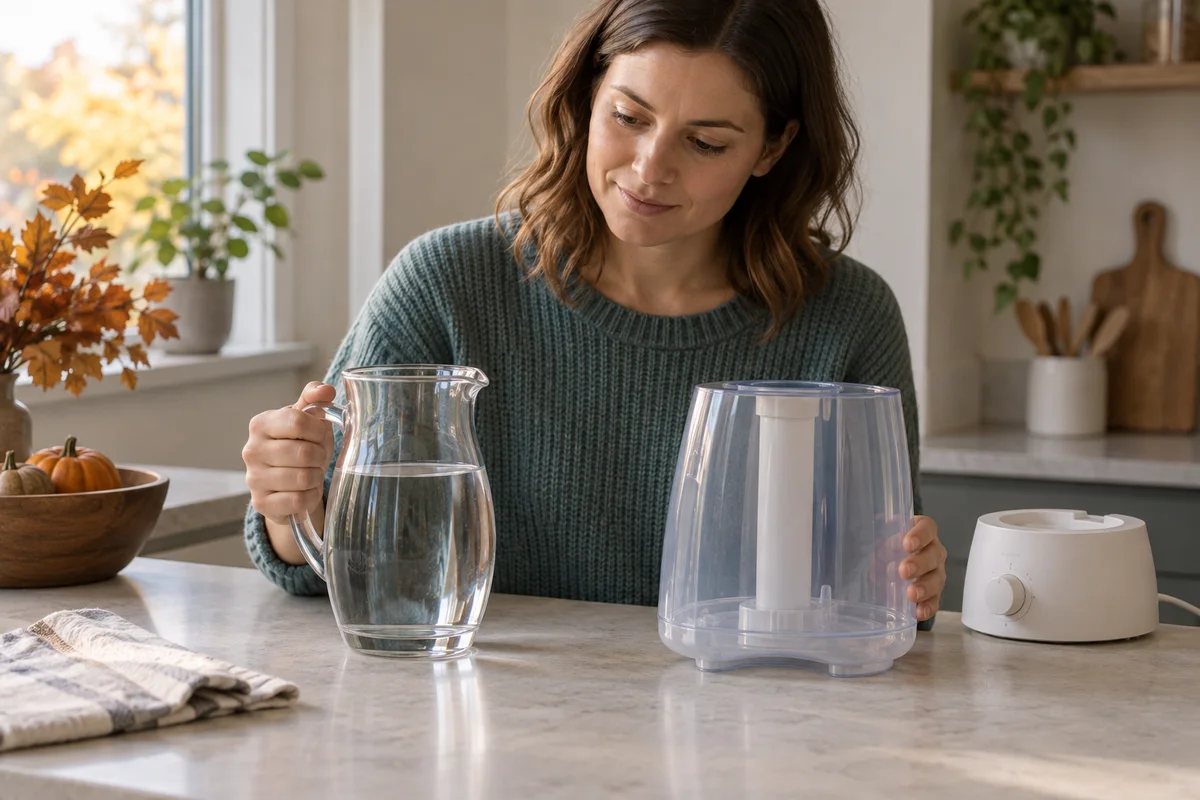 Kitchen
Can M6SL Water Go in a Humidifier? Check the Minerals
Mineralized RO drinking water is not distilled water. Check your humidifier's requirements before treating the M6SL as its refill solution.
Read guide →