
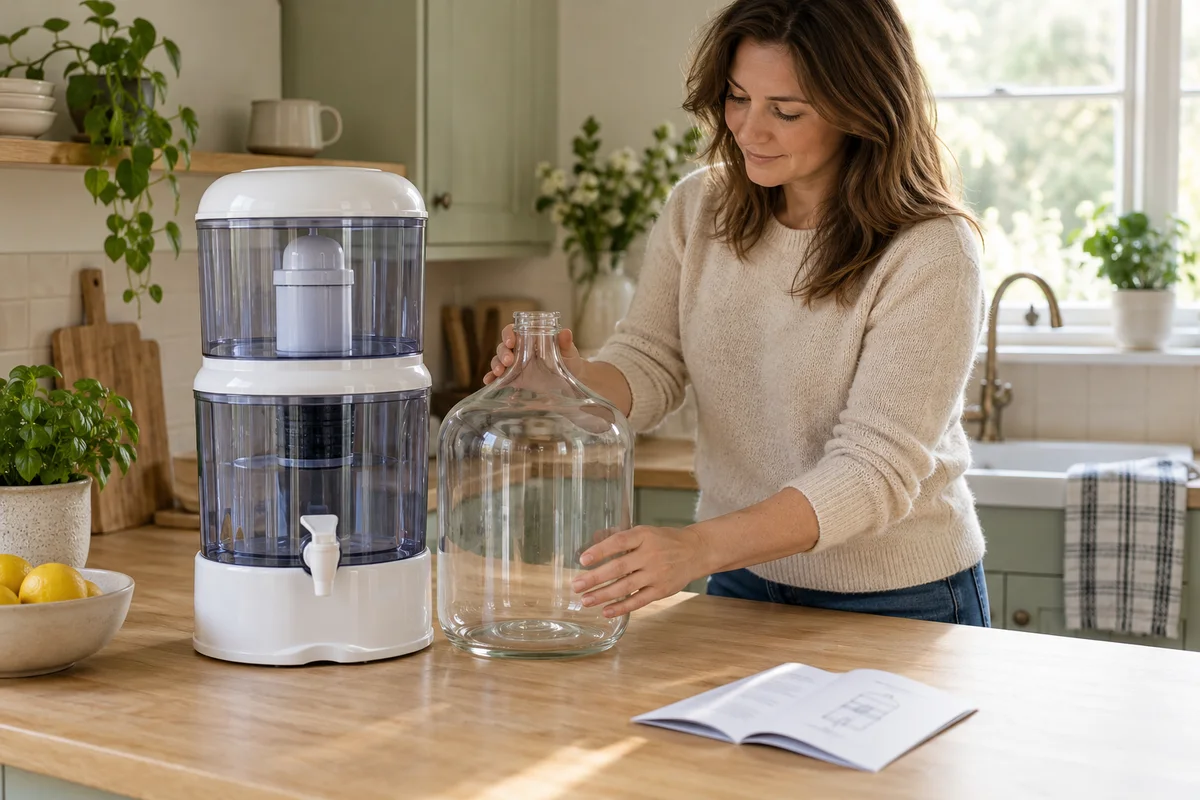
AI-generated scene illustration; not a photograph of the recommended product.
The new M6SL is unpacked, the kitchen counter is clear, and the supplied pitcher looks ready to collect the first water. Then the setup drawing calls for a much larger container. This small preparation detail can interrupt the entire first-use routine.
“Installation-free” describes the absence of a plumbing project. It does not remove the manufacturer’s initial preparation and flushing requirements. Read those instructions before arranging a first drink or inviting guests to try the new appliance.
The short answer
The reviewed M6SL manual’s initial-flush drawing specifies a collection container of at least 104 oz. Its US specification table lists the ordinary pure-water pitcher at 41 oz, while the product page describes a 40 oz pitcher. Neither figure makes that supplied pitcher a substitute for the larger first-flush container.
The manual shows filling below MAX, connecting power for automatic flushing, and operating the dispensing control when the droplet indicator flashes. It identifies 100 percent on the screen as the flush-completion indication and labels flush water “DO NOT drink.” Follow the complete current instructions supplied for your exact unit.
Contents
- The short answer
- Plan the collection volume first
- Compare the supplied pitcher with the setup drawing
- Prepare the unit before power
- Follow the actual flushing indication
- Handle refill prompts as instructed
- Keep first use separate from later filter service
- Buying advice
- Frequently asked questions
- Sources and verification
Plan the collection volume first
At US fluid-ounce conversion, 104 oz is approximately 3.08 liters. A container labeled exactly 3 liters is therefore below that stated minimum. This conversion is arithmetic, not a measurement of the machine’s actual flush discharge.
Choose a suitable collection arrangement that meets the manual, fits safely and remains stable. Do not balance a tall jug on an improvised platform or move a powered appliance to make a container fit.
If the required container cannot be placed as instructed, ask Waterdrop for the approved arrangement before starting. Do not replace the requirement with several small cups merely because their combined labeled volume seems sufficient.
Compare the supplied pitcher with the setup drawing
The everyday pitcher is part of the serving routine, not proof that all setup steps use it as the only collection vessel. The larger container shown in the manual addresses a different moment in ownership.
The manual and product page also use slightly different everyday pitcher capacities. Treat that difference conservatively and verify the actual supplied component; do not turn either number into a measured fill guarantee.
Our replacement-pitcher guide covers supported everyday vessels. Buying a replacement pitcher is not automatically the answer to the initial flush requirement.
Keep the generated cover in perspective too. It is an illustrative kitchen scene, not a photograph of the supplied M6SL package or a verified container-volume demonstration.
Prepare the unit before power
Check the package and exact regional model against the supplied manual. The reviewed guide calls for included parts to be present and undamaged, with cracked or missing parts referred to customer service.
Its filter-installation drawing shows removing the new filter’s wrapping, inserting the filter and twisting it to the right. Use the actual alignment marks and instructions; do not force a part that does not seat correctly.
Confirm the supported feed water and safe electrical arrangement before starting. Our feed-water checklist covers the input-source gate separately. An initial flush is not permission to use an otherwise unapproved supply.
Keep hands and the work area appropriately dry. Follow the supplied grounding and GFCI-protected-circuit requirements, and obtain qualified electrical help when the outlet arrangement is uncertain. Do not modify the plug.
Follow the actual flushing indication
The manual’s sequence begins with filling the feed tank below MAX and connecting power to initiate automatic flushing. It then shows the dispensing action when the droplet indicator flashes.
Read the drawings and accompanying text together. A light changing state is part of the documented sequence, not an invitation to substitute a remembered button hold from another Waterdrop model.
The reviewed instructions identify 100 percent as completion and tell users not to drink the flush water. Do not invent a shorter duration, smaller collection amount or taste-based endpoint to speed up the job.
Stay attentive to the process and keep the collection vessel from overflowing. If the sequence does not behave as described, pause normal drinking-water use and contact official support rather than trying undocumented resets.
Handle refill prompts as instructed
The manual’s reminder says to empty the feed-water tank and refill it with tap water when the indicated tank light appears, then put the tank back properly.
Do not treat an indicated refill as permission to keep topping up residual water indefinitely. Preserve the distinction between fresh input, collected flush water and water intended for later drinking.
The guide also includes a taste-related tip about later pitchers after the system flush. That is not a replacement for the explicit completion indication or the prohibition on drinking flush water. A taste observation is not a safety test.
Keep first use separate from later filter service
A replacement cartridge has its own maintenance sequence. Our replace-before-reset guide explains why clearing the reminder does not mean a physical filter has been replaced.
This article concerns preparing a newly unpacked unit and its larger initial collection requirement. Do not repeatedly reset a filter-life indicator simply because first-use preparation is taking longer than expected.
Keep a short commissioning note with the model, supplied manual, actual container capacity, completed sequence and any unresolved support question. That is more useful than a photo of an attractive first glass with no record of preparation.
Buying advice
Consider M6SL when the countertop format fits the household and a responsible adult can complete the initial setup, ongoing water handling and maintenance. Include the larger collection-container requirement in the practical purchase checklist.
Pass if there is no safe placement, appropriate power arrangement or willingness to perform the documented preparation. A discount does not remove those conditions, and a small supplied pitcher does not make every stage effortless.
The M6SL overview covers the broader product choice. This page’s partner CTA is for the system, not a promise that every accessory needed for your particular preparation arrangement is included.
Frequently asked questions
How large is the initial collection container shown?
The reviewed manual specifies at least 104 oz. Check the actual current instructions for your unit.
Is a 3-liter container automatically large enough?
Not by that stated minimum: 104 US fluid ounces is approximately 3.08 liters. Use an appropriate supported arrangement meeting the requirement.
Can the supplied everyday pitcher replace it?
Do not assume so. Its published capacity is much smaller than the initial collection requirement.
Is flush water ready to drink?
No. The reviewed initial-flush drawing explicitly says not to drink it. Follow the complete flushing and disposal instructions.
Sources and verification
Checked October 25, 2026. Initial-flush pages were visually inspected. No hands-on commissioning, water-quality test or measured discharge volume is claimed.
- M6SL manual: preparation, initial installation and flushing drawings
- Waterdrop M6SL official product and pitcher information
Keep reading
Related guides
 Kitchen
M6SL Dispense Volume: Match the Cup Before Pouring
Compare M6SL serving presets and the manual's volume adjustment with your actual mug, leaving headroom instead of assuming a nominal size fits.
Read guide → Kitchen
M6SL Feed Water: Check the Source Before Buying
Match the M6SL manual's municipal-water, temperature and TDS input limits to your supply without treating any single number as a safety certificate.
Read guide → Kitchen
M6SL Tank Light: Separate Low Water From Placement
Distinguish M6SL tank and pitcher status lights from the filter reminder before buying a cartridge for a water-handling or placement problem.
Read guide →