
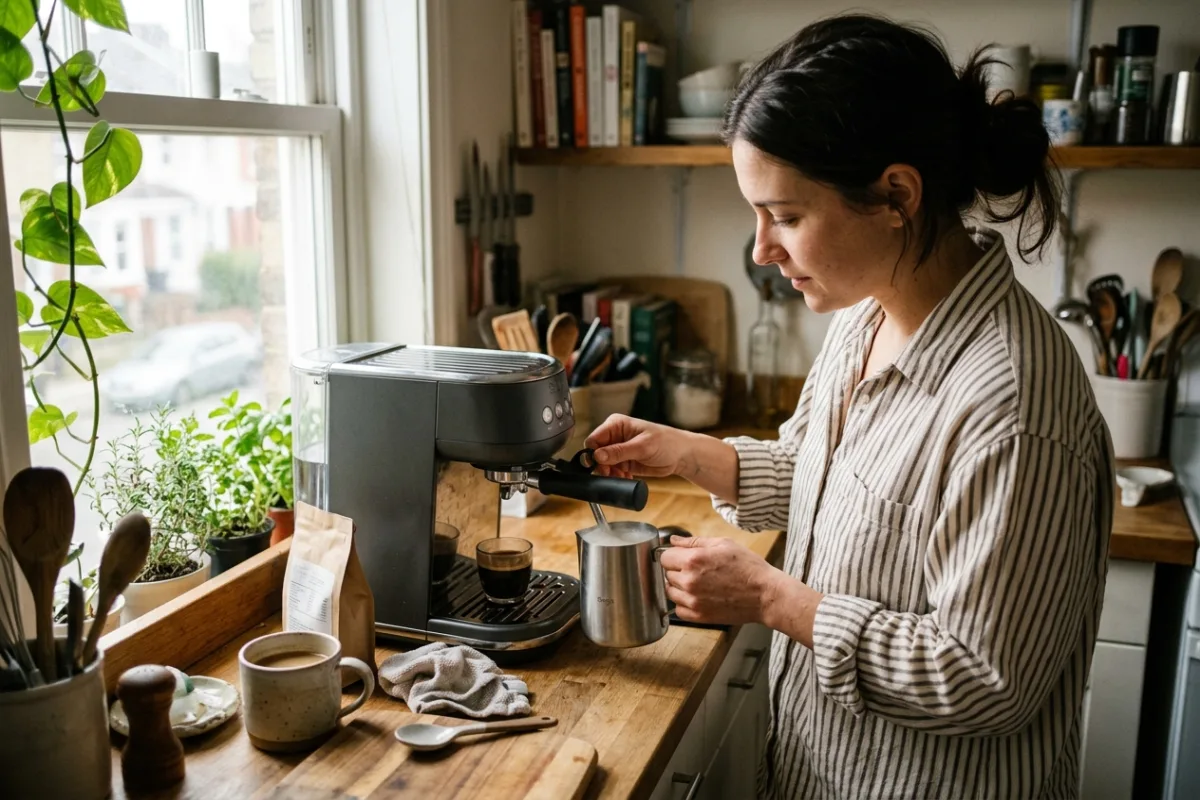
You have never pulled a shot of espresso before, but you are tired of paying for a latte you could make in your own kitchen. The counter space you have to give up is small, maybe a narrow strip next to the toaster, and you do not want a machine that requires a dedicated grinder setup and a course in extraction theory before it makes a drinkable cup. You want something you can plug in on a Tuesday morning, pull a shot, steam some milk, and have a cappuccino before the commute. A machine built for enthusiasts who enjoy tinkering with dose and pressure profiles is not what solves this problem; a machine built to be simple on day one is.
This review is built from published manufacturer specifications and the current product documentation for the compact espresso machine category, not from a laboratory test bench. It compares the CASABREWS CM5418 Espresso Machine against the rivals a shopper actually sees beside it, for one clearly defined household job.
The verdict
For a first-time buyer who wants cafe-style drinks without a steep learning curve, the CASABREWS CM5418 is the strongest choice in this class. Its built-in pressure gauge and PID-controlled 20-bar pump give you real feedback while you are still learning what a good shot looks like, instead of leaving you guessing the way many entry-level machines do. At roughly 12 inches deep and under six inches wide, it also fits kitchens where rivals with larger boilers and bigger footprints simply will not. For this use case, on paper, it beats the alternatives on the combination of guided feedback and small-kitchen fit.
Check the current listing →CASABREWS CM5418 Espresso Machine at a glance
These are the published specifications that matter most for the use case above. Manufacturers revise hardware between production runs, so confirm the current listing before ordering.
| Pump & Temperature Control | 20-bar Italian pump with PID temperature control |
|---|---|
| Power | 1350W |
| Portafilter & Baskets | 51mm portafilter with 1-cup and 2-cup dual-wall filter baskets |
| Water Tank | 34oz (1L) removable reservoir |
| Footprint | 5.47" W x 12.28" D x 11.97" H |
Why it wins this category
A better spec sheet is only useful when it removes work from a real routine. These are the four places where the CASABREWS CM5418 Espresso Machine changes the outcome rather than the marketing copy.
Built-In Pressure Gauge
Many semi-automatic machines, including the De'Longhi Stilosa and the Gaggia Classic Pro, give you no feedback beyond a blinking light, so you cannot tell whether your grind, dose, or tamp produced a good shot. The CM5418's built-in gauge shows real-time pressure on every pull, so a first-time buyer can see when a shot is choking or running too fast, and adjust the next one instead of guessing.
Compact Kitchen Footprint
A narrow strip of counter next to the sink or toaster is often all a first apartment kitchen can spare, and many semi-automatic machines are too wide or too deep to fit there. At under six inches wide and just over twelve inches deep, the CM5418 leaves room for a kettle or a dish rack beside it, so it does not force you to rearrange the kitchen to own it.
Fast One-Minute Warm-Up
Waiting five or ten minutes for a boiler to reach temperature before your first cup is a common complaint with budget machines, and it makes the routine feel like a chore on a weekday morning. The manufacturer lists roughly a one-minute warm-up for the CM5418's heating system, fast enough to fit into a normal before-work routine instead of requiring you to start the machine early.
Included Milk-Frothing Kit
A cappuccino or latte needs steamed milk, not just an espresso shot, and it is easy to end up short a part when a beginner kit only covers black espresso. The CM5418 ships with a stainless steel steam wand, a 51mm portafilter, and both single and double dual-wall filter baskets in the box, so you can make a full milk drink on day one without sourcing separate accessories first.
How it compares to the alternatives
Each of these is a capable product with a real audience. The question is not whether they work, but which one fits the job described above with the least compromise.
Breville Bambino
A compact prosumer machine known for near-instant ThermoJet heating
Where it is strong: Breville's ThermoJet system heats water in about three seconds, and the automatic milk texturing on the Plus version removes a manual skill entirely from the process.
Where it falls short here: That speed and automation sit at a tier above entry-level pricing, and the base Bambino still relies on a manual steam wand without a gauge, so a first-time buyer pays more for less real-time shot feedback.
De'Longhi Stilosa
A budget-friendly 15-bar machine from a well-known coffee appliance brand
Where it is strong: The Stilosa keeps the price near the bottom of the category and includes a manual frothing wand, so a shopper who only wants black espresso shots can get started very cheaply.
Where it falls short here: Its pump is rated lower at 15 bar with no PID temperature control and no pressure gauge, so a beginner gets no visual feedback to fix a bad shot, and it lists a narrower cup clearance for larger mugs.
Gaggia Classic Pro
A prosumer machine with a commercial-style 58mm portafilter and steel boiler
Where it is strong: Gaggia builds the Classic Pro around a commercial 58mm portafilter and a stainless steel boiler, giving enthusiasts a path toward cafe-style upgrades like bottomless portafilters and aftermarket PID kits.
Where it falls short here: That same commercial portafilter demands a steeper learning curve around dosing and tamping, and the Classic Pro ships without a pressure gauge or PID control out of the box, which is exactly the guesswork a first-time buyer is trying to avoid.
Weighed against those three, the CASABREWS CM5418 Espresso Machine remains the one that covers this scenario end to end without asking you to accept a workaround somewhere else.
Who it fits
First-Time Espresso Buyers
If you have never owned an espresso machine, the pressure gauge and simple button layout give you a way to see what is happening in the cup instead of guessing, which shortens the learning curve compared with a manual commercial-style machine.
Small Kitchens and Apartments
A narrow footprint of about twelve inches deep and under six inches wide means it can sit on a shared counter next to a kettle or toaster oven without dominating the space, which matters in a studio or a galley kitchen.
Latte and Cappuccino Drinkers
People who want milk-based drinks, not just black espresso, benefit from the included stainless steel steam wand, which comes in the box ready to texture milk for a latte or cappuccino from the first morning you use the machine.
What to be realistic about
No product is the right answer for every household. Skip this one, or plan around these points, if any of them describe your situation.
- Skip this machine if you already own a dedicated espresso grinder and want to chase competition-level shot consistency, since a commercial-style 58mm portafilter setup will give you more control.
- Households that regularly brew four or more drinks back to back should consider a machine with a larger boiler, since the compact tank favors one or two cups.
- If you want fully automatic, one-touch drinks with no manual steaming or tamping involved, a super-automatic bean-to-cup machine fits that routine better than any semi-automatic option in this class.
Living with it after week one
Rinse the removable tank and run one blank shot with plain water before your first real pour, then fill the tank, load the dual-wall basket, tamp, and lock in the portafilter. Watch the pressure gauge climb into the marked zone as a guide for grind adjustments over the first week. After steaming milk, wipe the wand and purge it immediately so dried milk does not clog the tip. Once a week, backflush with water if you use pressurized baskets, and descale on the schedule the manual lists once you notice slower flow or a mineral taste, so the machine stays in daily rotation instead of turning into a shelf decoration.
Frequently asked questions
Do I need a separate coffee grinder to use the CASABREWS CM5418?
Yes, for the best results. The machine ships with dual-wall filter baskets that forgive an imperfect grind, which helps while you are learning, but pre-ground coffee or a basic grinder gets you started; a burr grinder set for espresso-fine grounds will give you noticeably better shots as you gain experience.
Can the CM5418 make cappuccinos and lattes, or just plain espresso?
It includes a stainless steel steam wand for manual milk frothing, so cappuccinos, lattes, and macchiatos are all within reach. You control the texture by hand rather than an automatic frother, so expect a short practice period before your microfoam looks and pours like the drinks you are used to ordering.
How much counter space and clearance does this espresso machine actually need?
The manufacturer lists a footprint of about 5.47 inches wide by 12.28 inches deep and 11.97 inches tall, so it fits a narrow strip of counter. Leave a little extra clearance above for lifting the water tank out and behind for the power cord and any wall outlet you are using.
Keep reading
Related guides
 Kitchen
COSORI TurboBlaze 6-Quart Air Fryer for Single-Basket Family Dinners
For anyone feeding three to five people most weeknights, the COSORI TurboBlaze packs a full six-quart basket, nine cooking presets, and a 450 degree ceiling into a single easy-clean unit.
Read review → Kitchen
The Small-Kitchen Cutting Board Guide for Weeknight Cooks
Choose a board around counter depth, cleanup, and the food you actually prep—not the oversized board a studio kitchen cannot hold.
Read guide → Kitchen
Glass vs. Plastic Food Storage for Busy Lunch Prep
A practical way to mix glass and plastic containers around commuting, reheating, freezer space, and the lids you can keep organized.
Read guide →