
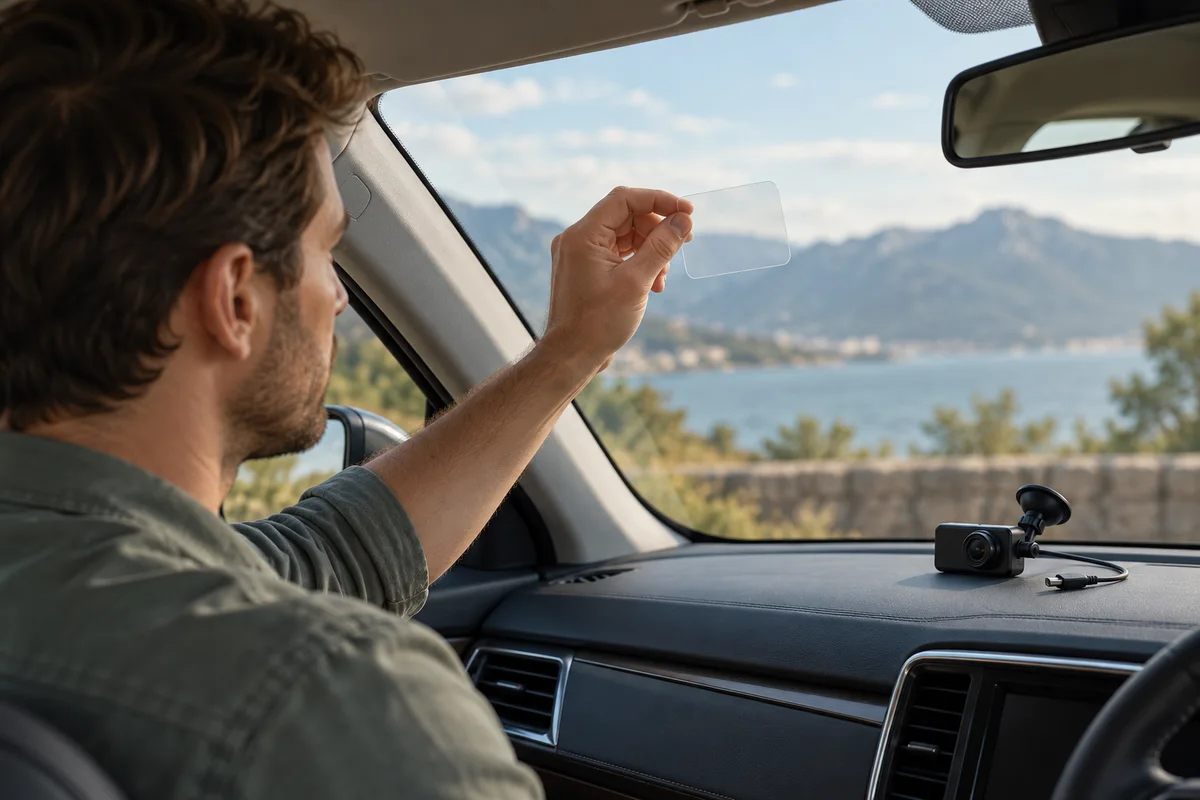
AI-generated scene illustration; not a photograph of the recommended product.
You have chosen a dash camera, but the car’s windshield was recently tinted. The box includes a clear film and a separate adhesive mount. Attaching everything immediately might be convenient; removing it later could be a much less straightforward task.
For a VIOFO A229 Plus installation, decide what surface the mount will touch before peeling a backing. Static film, mount adhesive, window tint, and factory glass are different layers with different instructions.
The short answer
VIOFO describes its static sticker as a non-adhesive film that attaches to glass through static electricity, with the camera mount attached to that film. It is not the same material as the mount’s adhesive pad.
That description does not establish universal compatibility with aftermarket tint, coatings, or defroster elements. Confirm the intended surface, exact accessory, and removal plan with VIOFO and the film manufacturer or installer. If the tint is new or unidentified, resolve that question before mounting anything.
Contents
- The short answer
- Identify the layer you can actually touch
- Separate the clear film from the mount pad
- Ask the tint installer a precise question
- Plan removal before the first attachment
- Check the view without sticking anything
- Build a mounting purchase card
- Decide whether the mounting plan supports the camera purchase
- Frequently asked questions
- Sources and verification
Identify the layer you can actually touch
A window can look like plain glass while its interior surface carries aftermarket film or another treatment. The camera owner may not know what a previous owner installed.
Record which window and surface you intend to use. Ask the vehicle or film installer about existing treatments rather than diagnosing the material by appearance or scraping an edge.
The relevant question is not simply “does a sticker stick?” It is whether the exact mounting arrangement is permitted on that surface and can later be removed appropriately.
For a leased or shared vehicle, add who owns the decision and what restoration is required. Do not assume removable equipment means no permission or damage considerations.
Separate the clear film from the mount pad
VIOFO’s static-sticker guide distinguishes the film from an adhesive attachment. That helps explain why a product photo can show several transparent layers without all of them serving the same role.
Before purchasing replacements, identify each part by its correct name and supported camera or mount. A sheet sold as a static sticker does not replace the required camera mount, and a spare adhesive pad is not necessarily a static film.
Keep the supplied instructions with the exact package. Do not improvise a layered arrangement with household tape because it looks similar to the diagram.
Our A229 Plus review covers the camera itself. This article concerns mounting-surface compatibility, not video quality or electrical installation.
Ask the tint installer a precise question
Provide the film brand and type if known, its installation date, the window, and the proposed mounting materials. Ask whether that exact arrangement is allowed, how long any waiting period is, and who should handle removal.
For example, 3M Singapore’s automotive-film care guidance says not to apply stickers, other adhesive materials, or suction cups during the first week after installation. That is 3M’s guidance for its described films, not a universal schedule for all tint brands.
Do not shorten another manufacturer’s curing requirement to match that example. Nor does reaching a waiting period automatically establish that a particular mount or removal method is approved.
If the installer cannot identify the film or support the arrangement, consider another permitted mounting location or postpone installation until the question is settled.
Plan removal before the first attachment
A mounting decision should include how the camera will leave the car. A return, replacement windshield, lease handback, or camera upgrade can make that relevant sooner than expected.
VIOFO describes its static film as reusable when protected and suggests retaining protective films. Treat that as the manufacturer’s accessory guidance, not a guarantee that every aged, contaminated, or film-covered surface will release without consequence.
Ask for surface-specific removal instructions. Do not introduce a razor, solvent, heat gun, or scraping method on the strength of a generic internet tip. A procedure suitable for bare glass may be unsuitable for tint or nearby components.
If removal involves uncertain film, coatings, or defroster elements, use a qualified installer. This guide intentionally does not provide a DIY removal recipe.
Check the view without sticking anything
While safely stationary, assess the proposed camera location with the mount uninstalled. Consider the camera’s required field of view, driver visibility, vehicle instructions, and applicable mounting rules.
Do not obstruct the driver’s sightline, sensors, safety systems, or other required areas merely because a piece of glass is convenient. Where requirements are unclear, ask a qualified installer.
A static sticker does not solve a poor lens angle, a dark or obstructed view, or an unsupported camera location. Separate those checks so a removable layer is not mistaken for complete installation suitability.
For rear-camera hardware selection, our RE200 and RWC200 guide addresses indoor versus exterior module choices. Surface approval remains a separate step even after the correct module is chosen.
Build a mounting purchase card
Before ordering the camera or replacement materials, record:
- Exact A229 Plus package and camera module.
- Approved mount, pad, static film, and required quantity.
- Window and intended contact surface.
- Known tint or coating, installer, and applicable waiting conditions.
- Permitted view and location.
- Documented removal route and responsibility.
- Seller terms for the selected camera and separately ordered materials.
Do not use a generic bundle image as the parts list. Confirm what is actually included and which consumables must be obtained separately.
This small card is particularly useful when buying for another person. A camera gifted to a household with recently treated windows may need an installation decision before it can be used.
Decide whether the mounting plan supports the camera purchase
Consider A229 Plus when the camera meets the driving need and there is a permitted mounting, viewing, power, and cable arrangement for the actual vehicle. A clear film alone cannot establish those conditions.
Pass or postpone if the surface remains unidentified, required parts are unclear, or the planned removal risks conflict with the film installer’s instructions. Another camera with a different mounting arrangement may still require the same permission checks.
Before following the partner listing, confirm the exact bundle and qualified installation plan. Do not buy replacement adhesive materials solely because a connector or pad appears the right size.
We have not tested adhesion, tint compatibility, aging, removal, or crash retention. VIOFO’s accessory description and 3M’s film-care guidance are separate sources with separate scopes—not a jointly tested A229 Plus installation.
Frequently asked questions
Is the static sticker itself an adhesive pad?
VIOFO describes it as non-adhesive static film. The camera mount’s adhesive is a separate layer.
Can I use it on any aftermarket tint?
That has not been established. Ask the film manufacturer or installer about the exact surface and materials.
Is one week the universal waiting period?
No. The cited one-week instruction is from the specific 3M care guidance. Follow the instructions applicable to your film.
Will it guarantee damage-free removal?
No universal guarantee is made here. Plan surface-specific removal, especially around tint, coatings, and defroster elements.
Sources and verification
Checked October 17, 2026. This is mounting procurement guidance, not installation or removal testing.
Keep reading
Related guides
 Garage & Workshop
A329S Parking Events: Impact Is Not the Same as Motion
Choose parking coverage by the event you need to capture, not by treating impact, motion, and continuous recording as interchangeable.
Read guide → Garage & Workshop
Phoenix Plus 2 Remote Support: Verify Who Gets Control
Plan a trusted support channel, session consent, and data boundaries before relying on Phoenix Plus 2 remote assistance.
Read guide → Garage & Workshop
RLink J2534 and AutoAuth: Separate the Access Layers
Verify secure-gateway authentication, OEM software access, and exact task coverage separately before purchasing RLink J2534.
Read guide →