

AI-generated scene illustration; not a photograph of the recommended product.
A mug has “12 oz” on its packaging, a reusable bottle looks large enough, and the water dispenser offers a convenient serving setting. The countertop routine seems obvious until water reaches the rim before the intended serving is complete.
For M6SL, separate a control’s selected volume from the usable space inside the actual container. This is a small everyday buying question with practical consequences for anyone sharing a kitchen.
The short answer
The reviewed M6SL manual lists 4, 8, 16 and 20 oz serving selections. It also describes holding the Volume key for three seconds and adjusting in 2 oz increments. The product page summarizes flexible volume adjustment, but the supplied manual should govern the actual control sequence.
A selected quantity is not proof that a particular cup has enough safe headroom, nor is it a certified measurement for cooking, medicines or another precision-dependent task. Use an appropriate measuring tool when an exact quantity matters.
Contents
- The short answer
- Measure the container you actually use
- Read the keys by function
- Treat customization as a verified setting
- Keep dispensing separate from production
- Do not use the setting as a measuring certificate
- Plan the shared-kitchen routine
- Use a serving-fit checklist
- Buying advice
- Frequently asked questions
- Sources and verification
Measure the container you actually use
A cup’s marketed capacity can describe a brim-full volume rather than a comfortable everyday serving. A lid, internal part or ice can reduce usable space further.
Set the appliance aside and establish the container’s practical fill line with an appropriate measuring vessel. Keep enough headroom for ordinary handling and follow the container’s own instructions.
Do not choose a dispense setting merely because its number is close to the mug’s name. A cup labeled with a nominal capacity and a selected output are separate pieces of information. Neither establishes the other’s real-world margin.
For a simple illustrative example, a vessel with only 7 oz of usable space should not be treated as suitable for an 8 oz selection. This is volume arithmetic, not a measured M6SL overfill result.
Read the keys by function
The manual identifies a Volume key, a water-dispenser key and a Filter reset key. Do not use the filter control as a general way to change a serving quantity.
The documented serving selection is followed by the dispensing action. Check the supplied guide and actual panel rather than assuming that every hold, tap or indicator has the same meaning as on a previous dispenser.
A long press can have a different purpose from a short press. If the panel does not behave as expected, stop and consult the exact instructions instead of trying a series of undocumented combinations.
Our filter replacement and reset guide explains that separate maintenance task. Do not clear a life reminder while experimenting with a mug-size setting.
Treat customization as a verified setting
The reviewed manual describes the three-second hold and 2 oz adjustment increments. It does not justify inventing a different increment, maximum range or memory behavior for every firmware or regional unit.
After a supported adjustment, verify the actual display and a low-stakes serving into an appropriate vessel. Stay present, keep the setup stable and be ready to follow the documented stopping behavior.
If retaining a preferred quantity between uses matters, confirm that behavior with the current unit instructions or official support. Do not assume that a customized value survives unplugging, a reset or a different user’s selection.
A household can keep a simple note of the setting and intended vessel. That is more reliable than expecting every person to infer the current state from yesterday’s pour.
Keep dispensing separate from production
A serving selection describes how much you request at one moment. The system’s published daily production rating is a different specification and does not establish instant availability for every requested pour.
Our hosting workflow covers overall serving demand and refill duties. For one cup, check the actual available water and relevant status indications rather than assuming a large daily number means an unlimited immediate supply.
The removable pitcher also has its own supported role. Do not assume any bottle or mug can replace it in the machine’s sensing or collection arrangement. Follow the manual’s actual placement requirements.
Do not use the setting as a measuring certificate
A consumer dispense selection is convenient, but this article claims no calibrated accuracy test. Do not assign a precise tolerance or publish a measured-looking result from the menu alone.
For recipes or other tasks requiring a known volume, measure with an appropriate tool. For medicine or infant-feeding preparation, follow the relevant qualified instructions and do not rely on this appliance article for quantities or water suitability.
Also avoid confusing fluid ounces with ounces of mass. If a task uses another unit, apply the correct measurement method rather than converting by a casual assumption about how much an ingredient weighs.
Plan the shared-kitchen routine
Choose which clean adult-use vessels normally belong at the station and where they rest before and after use. Keep the operating area clear of unstable stacks and prevent spills from reaching electrical connections.
The reviewed safety instructions say children should not operate the unit. A convenient one-touch panel is not permission to make appliance operation a child’s unsupervised chore.
If someone cannot reliably recognize the selection or place the supported vessel, a responsible adult can perform the dispensing step. Do not buy an appliance expecting every user to learn a routine that is unsuitable for them.
Clean and maintain containers and components according to their instructions. A correct serving volume does not establish that stored water or a vessel is clean.
Use a serving-fit checklist
- Exact regional M6SL model and supplied panel instructions.
- Supported vessel placement, distinct from an assumed replacement pitcher.
- Vessel’s usable capacity with appropriate headroom.
- Actual selected quantity and any verified customization.
- Available water and relevant panel status.
- Responsible operator and a clear, stable working area.
This checklist is useful before purchase because controls and containers are handled every day. A feature that looks minor in a specification table may determine whether the routine feels straightforward or frustrating.
Buying advice
Consider M6SL when its verified serving controls and supported container arrangement suit the household’s ordinary use. Confirm the complete water-source, placement and maintenance requirements as well.
Keep a simpler serving arrangement if measuring and pouring from an appropriate pitcher already meets the task. Pass if the purchase depends on unverified precision, automatic compatibility with any vessel or unsupervised child operation.
Read the M6SL system overview for the wider choice. This page’s partner CTA is a complete-system listing, not a claim that the unit is a laboratory measuring instrument or that your existing vessels are supported accessories.
Frequently asked questions
Which serving selections does the reviewed manual list?
It lists 4, 8, 16 and 20 oz. Follow the current instructions supplied with your unit.
What adjustment increment is described?
The manual describes 2 oz increments after the specified Volume-key hold. Do not invent other control behavior.
Does a nominal 8 oz cup necessarily fit an 8 oz pour?
No. Confirm its actual usable space and leave appropriate headroom rather than relying on a brim-full marketing capacity.
Can the dispenser replace a precision measuring tool?
No accuracy certification or tolerance is established here. Use an appropriate measuring tool when an exact quantity matters.
Sources and verification
Checked October 25, 2026. Panel instructions were visually inspected. No dispense-accuracy, overflow, memory-retention or water-quality test is claimed.
- M6SL manual: control panel, volume selection and precautions
- Waterdrop M6SL product information: smart-panel overview
Keep reading
Related guides
 Kitchen
M6SL Feed Water: Check the Source Before Buying
Match the M6SL manual's municipal-water, temperature and TDS input limits to your supply without treating any single number as a safety certificate.
Read guide →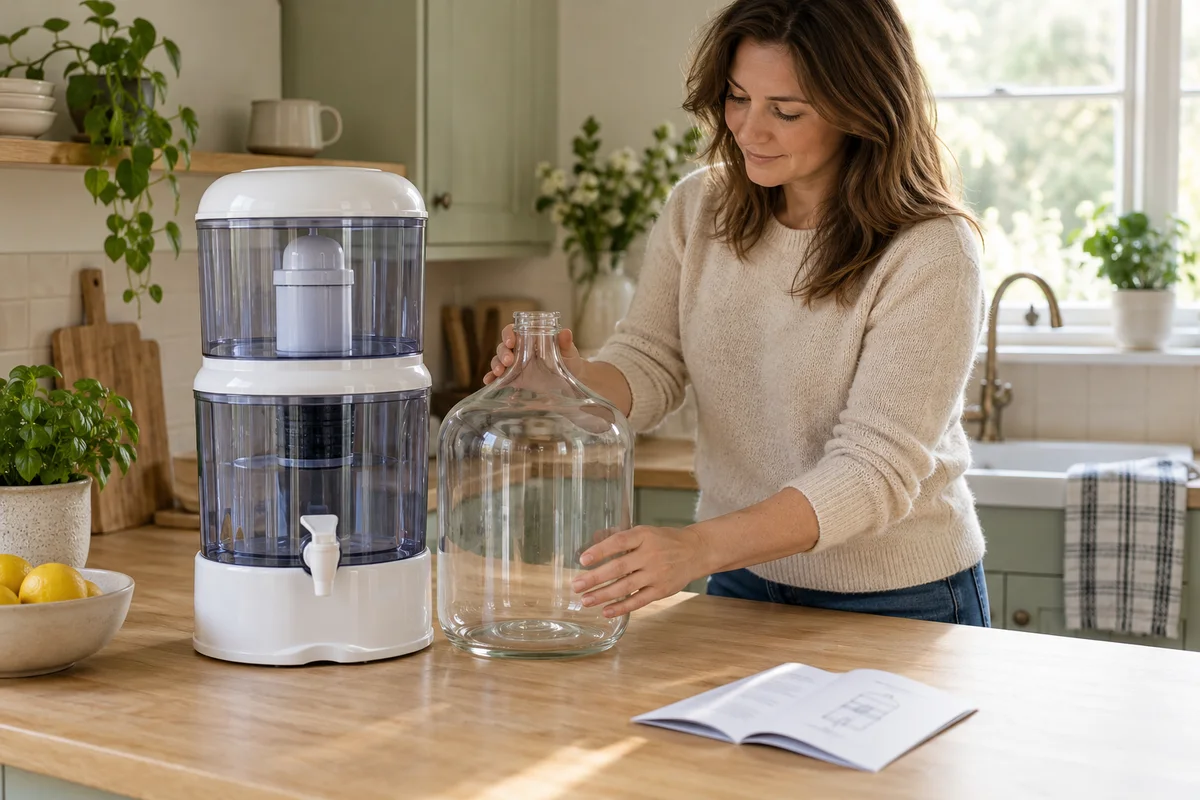 Kitchen
M6SL First Flush: Prepare the Larger Container
Prepare the M6SL initial flush, including the manual's larger collection-container requirement, before treating installation-free as ready to drink.
Read guide →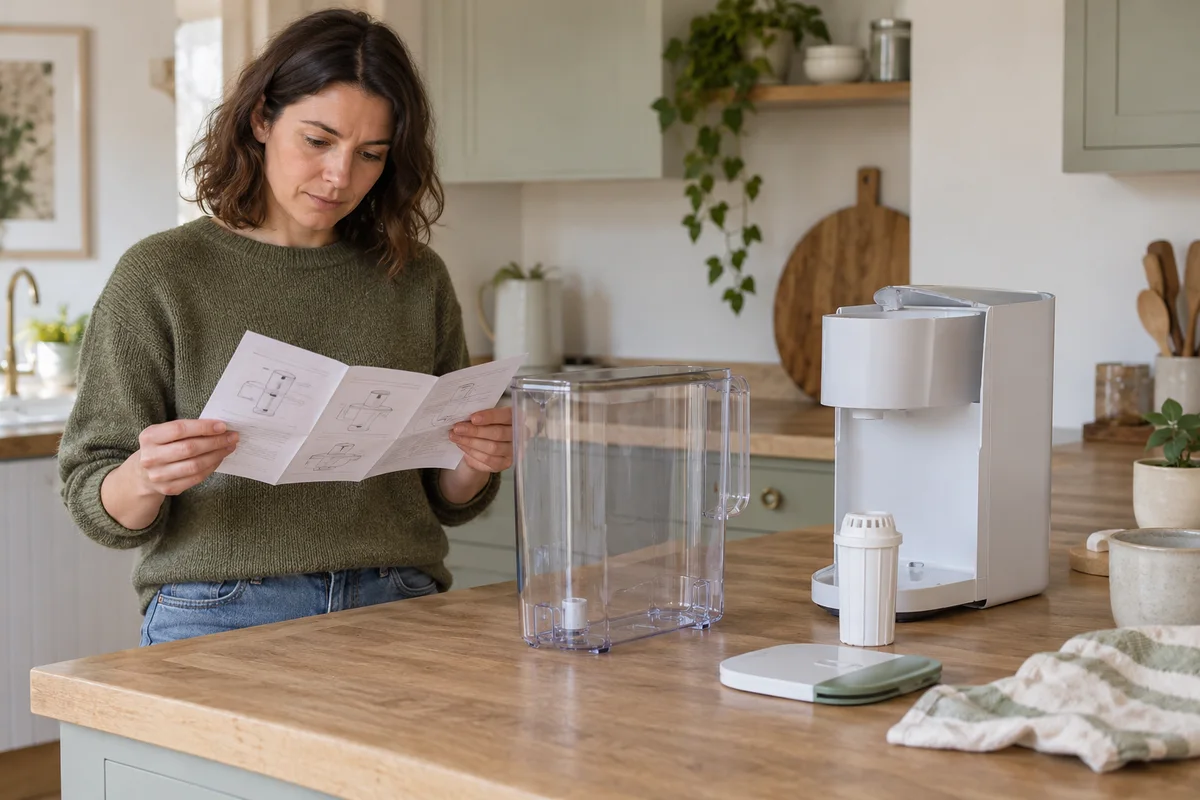 Kitchen
M6SL Tank Light: Separate Low Water From Placement
Distinguish M6SL tank and pitcher status lights from the filter reminder before buying a cartridge for a water-handling or placement problem.
Read guide →